3 Transport
At20%, transport was the second biggest greenhouse gas emitting sector in Ireland in
2023, experiencing the largest increase of all sectors since 1990. In its projections, the
EPA estimates that emissions from transport will reduce by 5 - 26% between 2022 and
2030 depending on the speed and scale of measures implemented (Figure 8).
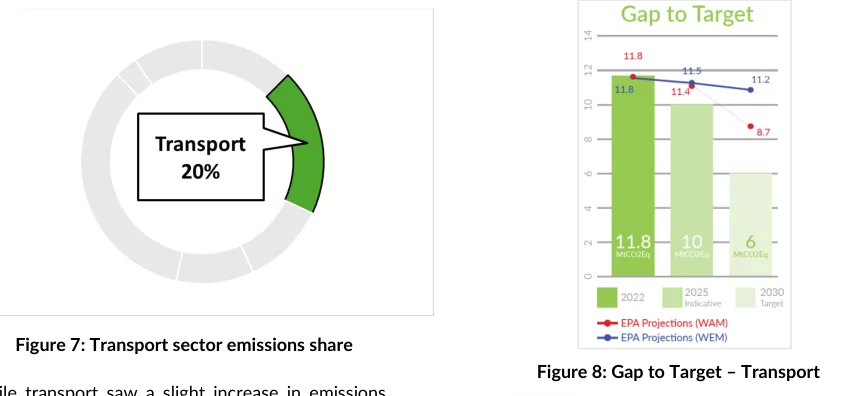
Figure from page 15
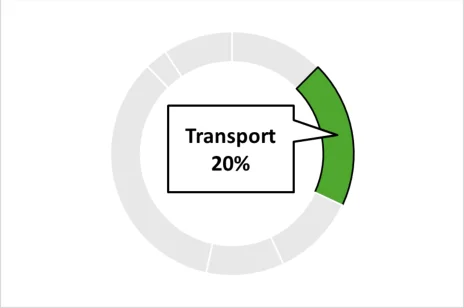
Figure 7: Transport sector emissions share
| Figure 7: Transport sector emissions share | |||
| “avoid” unnecessary emissions by reducing journey | |
|---|---|
| times and travel demand in the first instance. Shifting | |
| journeys to public and active transport also remains | |
| key in CAP24, with an acceleration of infrastructure | |
| pursued. Finally, emissions can be reduced through | |
| the electrification of vehicles, as well as increased | |
| biofuel blends to lessen the fossil fuel content of | |
| petrol and diesel (“improve”). | |
| The CCIM study published in Q1 shows strong | |
| support for Government investment in public | |
| transport instead of motorways: 75% “strongly | |
| su | pport” and 19% “somewhat support” this |
| pri | oritisation. 65% also “strongly support” |
| Go | vernment grants to make EVs more affordable. |
| W | hile higher taxes on cars that use petrol and diesel |
| stil | l retained majority backing (51%), the support for |
| pro | hibitive policies has weakened compared to 2021. |
| Th | is reflects clear links between transport |
| de | carbonisation and the cost-of-living crisis. |
from 2022 to 2023, the dramatic slowing of the rate
of increase is significant. 2023 was the first year that
passenger numbers on PSO Public Transport services
exceeded 300 million, representing a 24% increase in
passenger numbers during 2023. D/Transport is also
finalising its Year 2 Progress Report on actions under
the National Sustainable Mobility Policy. With a
c.70% delivery rate, key actions implemented include
the introduction of the Young Adult Travel Card, the
Transport for Ireland Live App and an enhancement
of public transport services throughout Ireland.
Reducing transport emissions is challenging, with
Figure from page 15
pressures from a growing population and economy as
well as fluctuating fossil fuel prices. The rapid
implementation of high-impact actions to bank
emissions savings is required as early as possible for
cumulative carbon budgets.
CAP24 maintains a focus on the “Avoid Shift
Improve” framework established in CAP23. This
framework emphasises the crucial role of spatial and
land-use planning in designing transport systems to
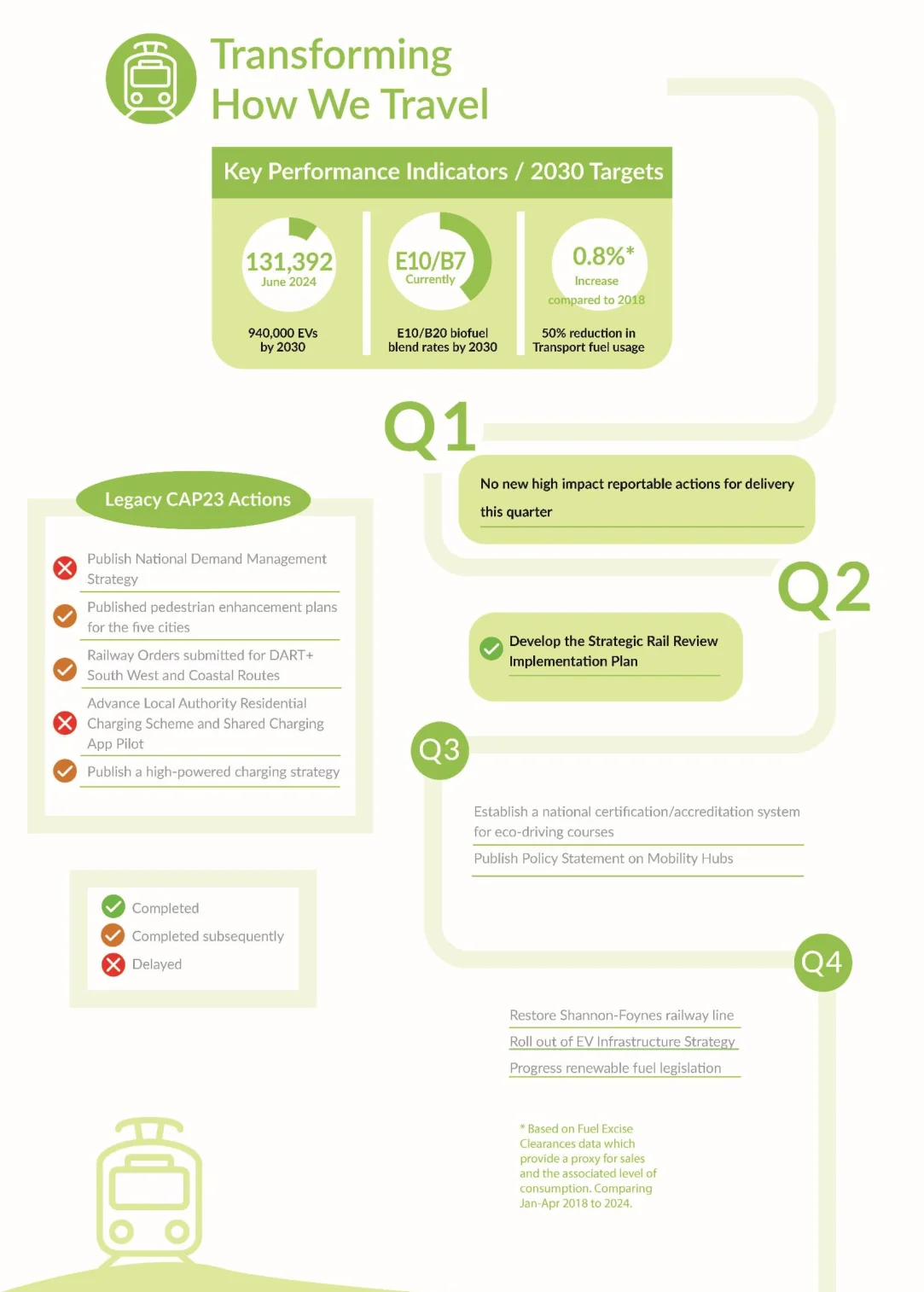
Figure from page 16
Transport - Complete CAP23 Legacy Action
Did You Know? Under Action TR/23/58, the Department of Transport has prepared a high-
powered electric vehicle (EV) charging strategy. The final strategy published in May 2024 as the
‘National Road EV Charging Network Plan’ and with a focus on charging on en-route, motorway,
primary and secondary roads.The Plan outlines a path to achieve cleaner transportation,
alongside proposals for investment, regulation, and policy instruments.
What’s new? Fast, reliable, and widespread EV charging infrastructure will support the move
away from fossil-fuelled cars. Fleet electrification is expected to provide the greatest share of
emissions abatement in the medium term in the transport sector under CAP24. Ireland also has
significant obligations to meet under the EU Alternative Fuels Infrastructure Regulation, with
mandatory targets set for the accessibility, type and location of charging facilities along our road
networks. A comprehensive National EV Charging Network Plan will help to guide and ensure
this investment.
Transport - Delayed CAP23 Legacy Action
Did You Know? Drafting of a National Transport Demand Strategy (TR/23/19) made significant
progress in the first half of 2024, with a Draft Strategy and Implementation Plan launching for
public consultation in April. Public consultation and targeted stakeholder engagement on the
Strategy will continue until August and an SEA/AA screening process will also be undertaken in
this period. It will then be resubmitted to Government for approval and final publication in Q4.
Why is it needed? The new strategy, entitled ‘Moving Together: A Strategic Approach to Improving
the Efficiency of Ireland’s Transport System’, aims to reduce the economic and social costs of
congestion and car-dependency alongside significant investment and scale-up in public transport,
active travel and EV infrastructure. It is crucial for better transport planning, containing options
that can be taken at national, regional and local levels to help avoid and shift Irish transport
emissions. It will make the country’s transport system work better for everyone.

Figure from page 17
Pages 15–17 · View in original PDF