6 Land Use, Land Use Change and Forestry
Using current estimates, land uses had net emissions of c.7.3Mt CO2 eq
Share of GHGs
in 2022, more than the emissions from residential buildings. The Land
in Ireland in
Use, Land Use Change and Forestry (LULUCF) sector has been an
2022
emissions source in Ireland since 1990 and has a challenging profile for
10.7%
future emissions creation. Science continues to evolve to better estimate
emissions from the sector, which may lead to future inventory changes.
The main emissions source in 2021 in LULUCF was from grasslands on
drained organic soil (e.g. used for grazing cattle). Despite currently
representing only c.8% of grasslands, they were responsible for over 80% of
reported emissions from drained peatlands (excluding forested peatlands).
They thus have a disproportionate impact on emissions in the sector.
Forestry on peat soils also creates emissions, as do degraded wetlands
(e.g. bogs drained for peat extraction). These sources are offset somewhat
by removals of CO2 through forests on mineral soils, active (wet) bogs and
Harvested Wood Products which can act as carbon sinks. An urgency
remains to re-balance emissions in the sector in favour of carbon sinks.
The EPA projects that emissions from LULUCF will increase to 2030 as
Figure 6 Projected LULUCF emissions to 2030 (EPA, 2023)
our forestry reaches harvesting age and changes to a carbon source.
Planned policies and measures can reduce the extent of the emissions increase, highlighting
the importance of rapidly increasing tree planting, managing the water table on agricultural
organic soils, and restoring peatland to revert current emissions sources to net sinks.
The draft CAP24 published in December contains detailed discussions on the LULUCF
sector and how best to manage emissions from this source going forward. This includes a
re-commitment to established activity targets in forestry, peatlands and organic and mineral
soils management, and the introduction of some new activity, including in hedgerows. The
approach aims to better align with EU targets for the sector and to account for fluctuating
baselines as scientific understanding evolves.
CAP24 acknowledges that it will be necessary to review and amend LULUCF activity levels
to align with EU LULUCF Regulation targets and the demands on the sector from our
national and international commitments, including to provide for the achievement of climate
neutrality by no later than 2050.
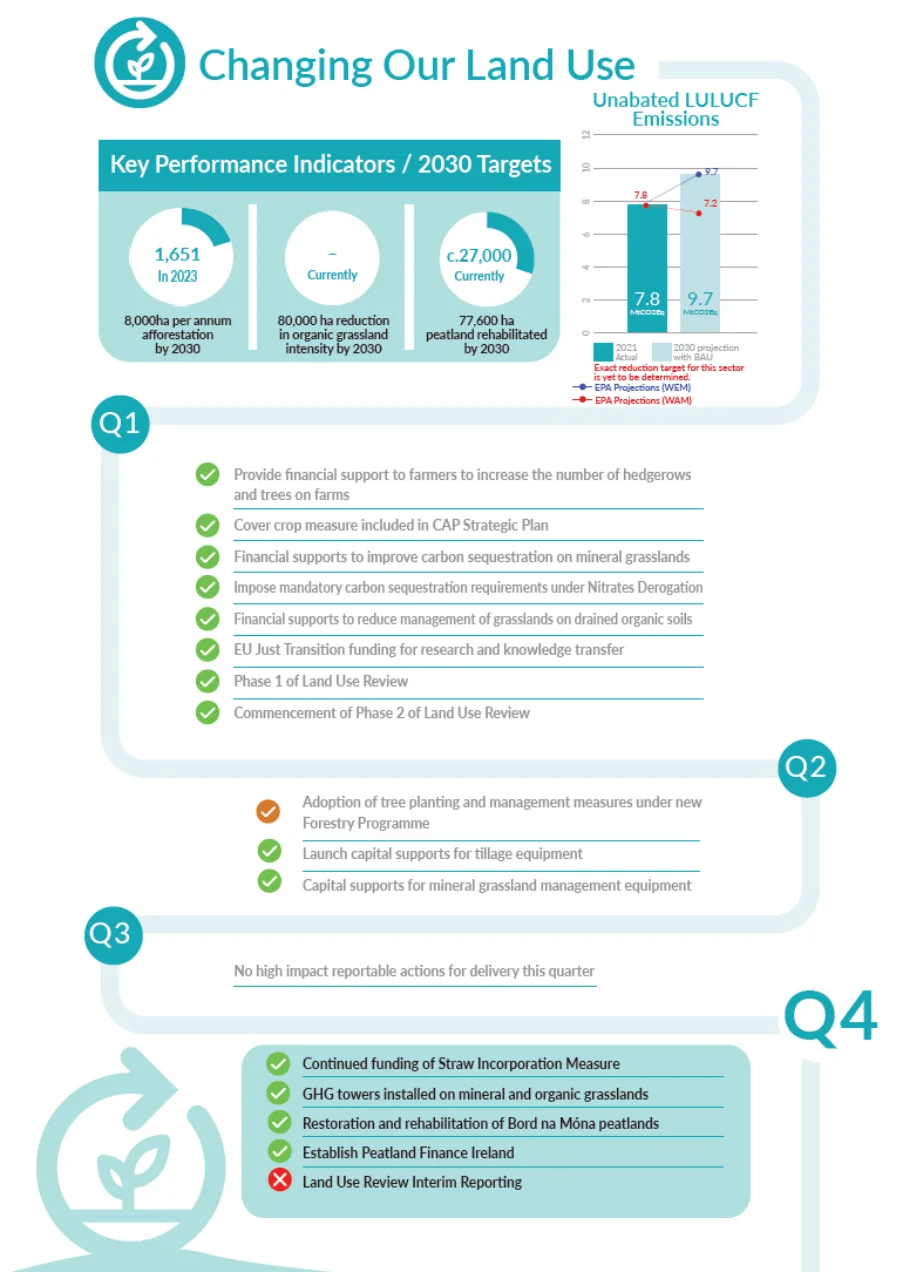
Figure from page 28
| High Impact Action Completed in Q4 2023: LULUCF | ||
| Did You Know? Under Action LU/23/15, CAP23 committed to an on-going programme | ||
| to restore and rehabilitate former Bord na Móna peatlands. 11,000ha had already been | ||
| rehabilitated by the end of December 2022, with a remaining 22,000ha scheduled for | ||
| rehabilitation by end of 2026 in over 80 Bord na Móna bogs. Rehabilitating bogs where | ||
| turf has been extracted for use is essential to reduce emissions from this source and | ||
| begin converting these areas back into carbon sinks. Re-wetting is a common practice to | ||
| achieve this goal. | ||
| What’s new? 16,090 hectares (TBC) of former Bord na Móna lands have been | ||
| rehabilitated by the end of Q4 2023 under their ‘Enhanced Decommissioning, | ||
| Rehabilitation and Restoration Scheme’. Monitoring and data collection for the scheme is | ||
| ongoing and the first Monitoring and Verification Report is now available online. As well | ||
| as helping to reduce and store emissions, this activity will also benefit biodiversity, water | ||
| quality, catchment management and provide space for local communities and people to | ||
| enjoy the outdoors. |
| High Impact Action Delayed in Q4 2023: LULUCF | ||
| Did You Know? Completing a Land Use Review was a key commitment in the | ||
| Programme for Government 2020. Phase 1 of the Review published in Q1 2023 | ||
| (LU/23/19) and provided a scientific assessment of the environmental, ecological and | ||
| economic characteristics of land types across Ireland. Phase 2 thereafter commenced | ||
| with interim reporting due to Government in Q4 2023. This did not complete on time, | ||
| though a status report issued to relevant Ministers on 20 December. | ||
| Why is it needed? Phase 2 of the Land Use Review needs to translate the scientific | ||
| results from Phase 1 into the policies, measures and actions necessary to achieve our | ||
| economic, social and climate objectives from land. The purpose of the initially planned | ||
| Interim Report was superseded by the publication of CAP24 and its new approach to | ||
| LULUCF. A detailed implementation plan will be delivered on this aspect in mid-2024. | ||
| Periodic status reports on the Land Use Review will continue in 2024, with a Final Report | ||
| to Ministers now expected in Spring 2025. |
Pages 27–29 · View in original PDF