5 Buildings
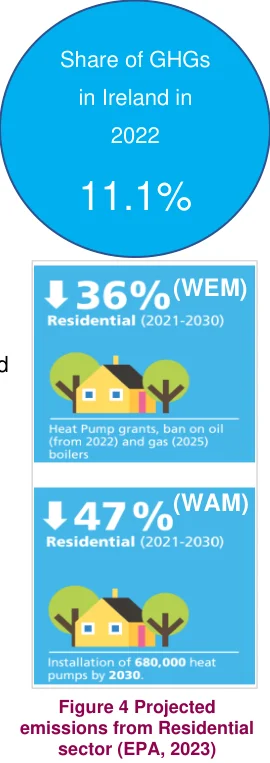
Figure from page 20
Share of GHGs
Emissions from all buildings made up 11.1% of Ireland’s emissions in 2022.
in Ireland in
Most of this (9%) was from residential buildings. Energy prices, average
2022
yearly temperatures, energy efficiency measures, fuel switching, and
11.1%
remote working have all influenced emissions from buildings in recent times.
In the EPA projections published earlier this year, emissions from residential
(WEM)
buildings are set to decrease by 36 - 47% between 2021 and 2030 (Figure 4).
The higher reduction level assumes, among other actions, a ban on oil and
gas boilers in new dwellings, the installation of 680,000 heat pumps, continued
household retrofit activity including 500,000 B2 retrofits/cost optimal
equivalents, and the implementation of full district heating and biomethane
targets to decarbonise heating sources.
(WAM)
With full implementation of ambitious CAP23 measures, residential and
commercial buildings are the only sectors expected to meet emissions
reduction targets for 2030 by the EPA. Cumulative emissions however mean
that the commercial buildings SEC will be breached, with the residential SEC
projected to remain within limits in the second carbon budget period.
Figure 4 Projected emissions from Residential
For Commercial and Public Services, a decrease of 19 - 49% is projected by
sector (EPA, 2023)
the EPA (Figure 5). Accelerated retrofitting of private, public, and
| (WEM) (WAM) | |
|---|---|
| Figure 5 Projected emissions from Commercial and Public Services (EPA, 2023) |
commercial buildings is clearly required for emissions reduction in the built
environment, as committed to under CAP23, along with expansion of
renewable heating options such as district heating and electric heat pumps.
In its Annual Review 2023 released this quarter, the CCAC recommends
more urgency around developing district heating schemes (including
evidence-based zoning at Local Authority level) as well as an obligation on
large energy users to supply their excess heat to surrounding communities.
It further recommends targets to upgrade 100% of social housing stock to
B2 BERs and/or connect to district heating by 2030. Increases in the
number of retrofits carried out each year is also recommended, with prioirty
given to homes that currently use coal or peat for heating. Finally, the CCAC
advocates that mortgage providers be encouraged to provide green
mortgages to align with, and support, necessary retrofit activity.
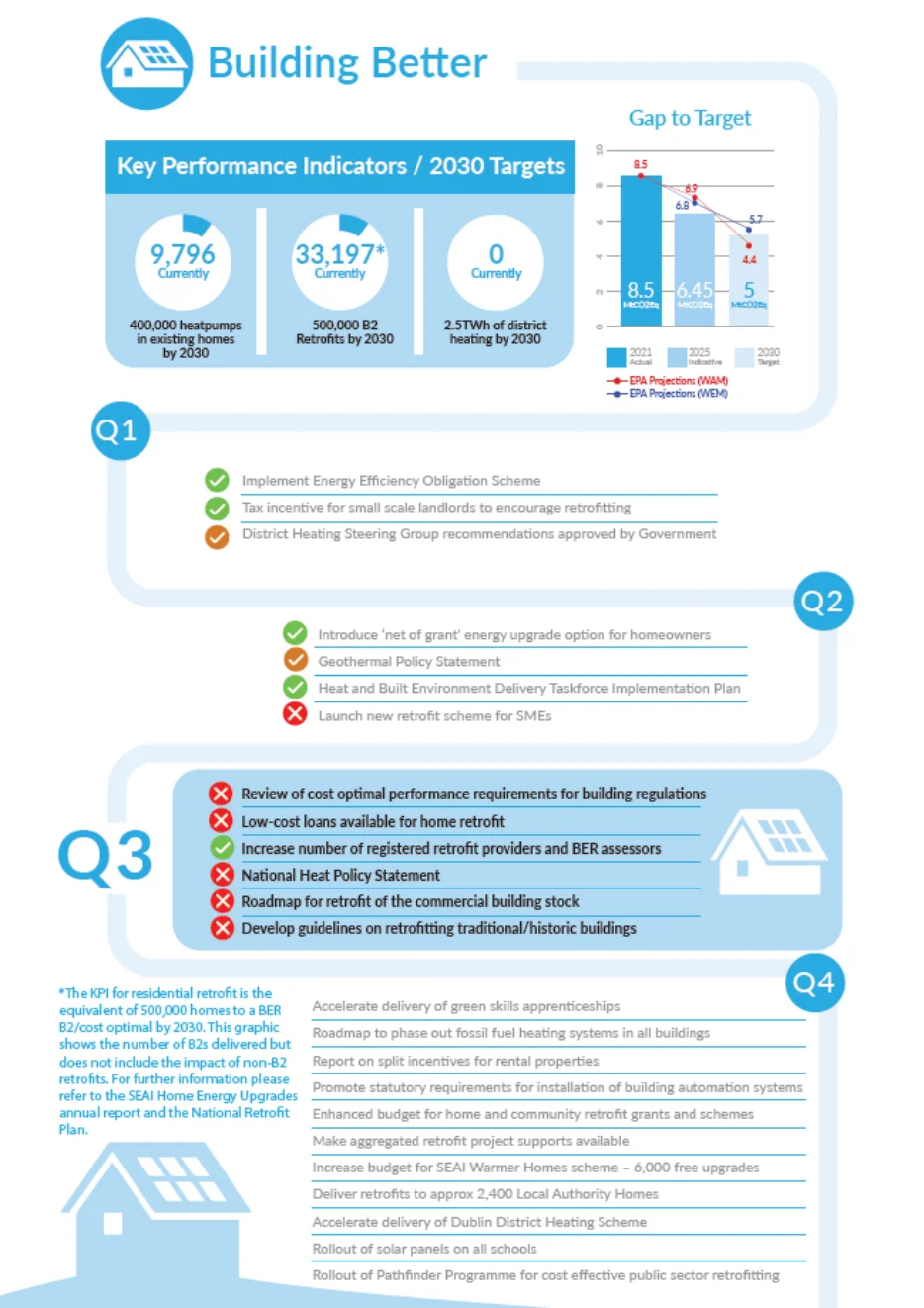
Figure from page 21
| High Impact Action Complete in Q3 2023: Buildings | ||
| Did You Know? While Action BE/23/28 was originally due in Q1, the District Heating | ||
| Steering Group Report required under this action was approved by Government and | ||
| published in July 2023. It outlines key recommendations, including around the need for a | ||
| legislative framework for district heating, a proposed single utility ownership model, the | ||
| potential for a centre of excellence and need for financial supports. Information on the | ||
| steering group and the published report can be found here. | ||
| Why is it needed? Ireland currently has one of the lowest shares of renewable heating | ||
| in Europe, with district heating making up less than 1% of the market. This tried and | ||
| tested heating method is particularly useful for decarbonising older building stock, | ||
| something which other European countries have done successfully. This technology is | ||
| being actively pursued in Ireland, and the District Heating Steering Group was formed | ||
| under CAP21. Under their remit, the group provided a key report to government on the | ||
| steps needed to ensure district heating is developed in a structured way. |
| High Impact Action Delayed in Q3 2023: Buildings | ||
| Did You Know? Retrofitting your home means carrying out multiple energy upgrades | ||
| such as installing insulation and heat pumps. Home retrofits allow consumers to make | ||
| energy, carbon and economic savings, while also enhancing the value of their home. | ||
| However, the upfront costs of retrofitting can be prohibitive, so CAP23 aims to support | ||
| the delivery of low-cost finance for home retrofit to consumers by putting a loan | ||
| guarantee in place for householders to access. | ||
| What’s new? Under Action BE/23/12, the development of an innovative loan guarantee | ||
| scheme has been a complex process involving intensive engagement with multiple | ||
| national and international stakeholders. To date, this has included extensive due | ||
| diligence between the European Investment Bank Group and the Irish banking and credit | ||
| union sector. The action did not complete in Q3 as planned, but subsequently delivered | ||
| early in Q4, with more details available here. |
Pages 20–22 · View in original PDF