4 Electricity
Share of GHGs
Energy industries (primarily power generation) accounted for 14.4% of
in Ireland in
national emissions in 2022. Renewables accounted for 37% of electricity
2022
generated in 2022.
14.4%
In its projections released last quarter, the EPA report that increased
renewable energy generation from wind and solar, if delivered as rapidly
as planned, can reduce energy industry emissions by 50-60% by 2030
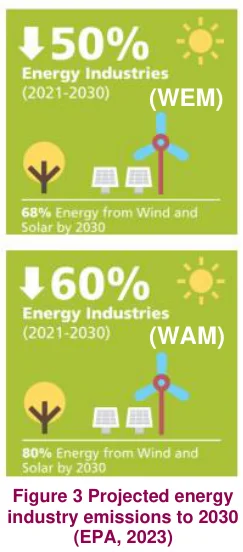
Figure from page 16
and achieve over 80% renewable electricity generation (Figure 3).
Increased interconnection, storage and biomethane are also envisaged to
(WEM)
contribute to reduced emissions, though the sector is still predicted to
breach its sectoral targets and SEC.
Continued dependency on coal use due to the unavailability of sufficient
gas-fired generation creates risks to targets, along with energy security
risks arising from recent geopolitical events and the potential for slow
(WAM)
implementation of required renewable electricity infrastructure.
The EPA was unable to model the full 2GW target for new flexible gas
fired generation targeted in CAP23, though report that the targeted 80%
renewables share could be achieved with lesser GW targets across key
Figure 3 Projected energy industry emissions to 2030
renewables areas. Hydrogen generation post-2030 and demand side
measures to mitigate growth from large energy users were not included in
(EPA, 2023)
the projections due to a lack of clear implementation pathways.
Recommendations from the CCAC Annual Review 2023 this quarter include the need to
accelerate renewable energy generation, including by putting in place the necessary spatial
planning guidance and laying out where and what type of onshore wind should be located
across the country. Sufficient resources, including in Local Authorities, to ensure planning
applications and associated grid infrastructure can be put in place are also considered key.
The Council also looked at accelerating flexibilities, with recommendations to phase out the
use of coal in electricity generation as soon as possible and ensure that 2GW of new flexible
gas-fired generation (which is green hydrogen ready) is delivered on time. The swift
implementation of the Electricity Demand Side Strategy is also recommended.
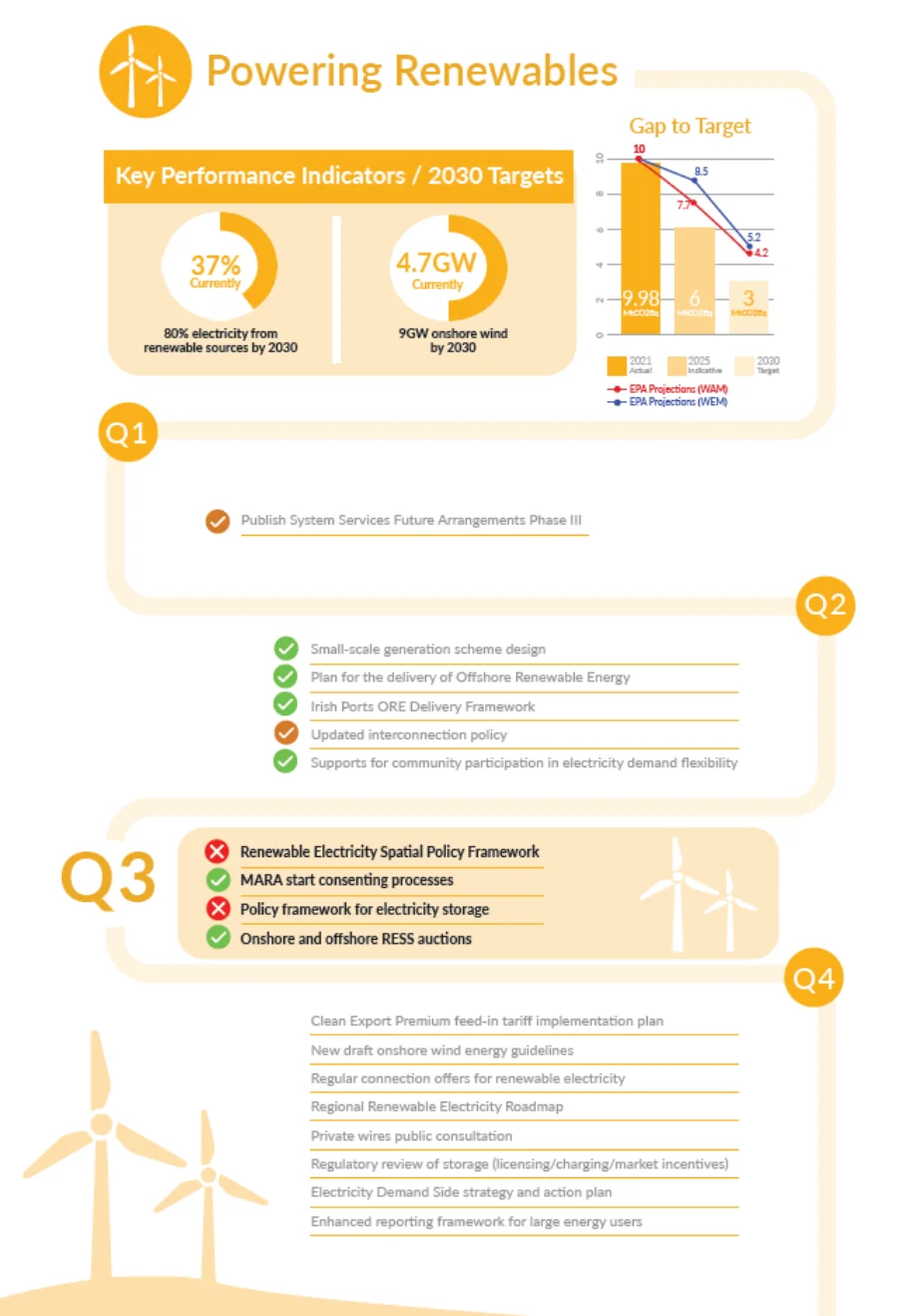
Figure from page 17
| High Impact Action Completed in Q3 2023: Electricity | ||
| Did You Know? CAP23 commits to increasing the share of electricity demand | ||
| generated from renewable sources in Ireland to 80% and reaching 8GW of solar and | ||
| 9GW of onshore wind by 2030. Renewable energy projects will help to protect Irish | ||
| households and businesses from high fossil fuel prices and increase energy security, | ||
| while enabling us to achieve our climate targets. The Renewable Electricity Support | ||
| Scheme (RESS) 3 is the third of a minimum of five envisaged onshore auctions to occur | ||
| between 2020 and 2025 to deliver 2030 targets. These auctions will provide pathways | ||
| for renewable developers, including solar and onshore wind projects. | ||
| What’s new? Provisional results of the recent RESS 3 auction were announced on 26 | ||
| September. The auction design was intended to maximise the volume of renewables | ||
| connecting to the electricity grid, whilst shielding consumers from high prices. RESS 3 | ||
| targeted mature, shovel-ready projects that all have planning permissions and grid | ||
| connection offers and are expected to deliver by early 2027 at the latest. The successful | ||
| projects, most of which are Solar PV, represent a 12% increase in Ireland’s renewable | ||
| energy capacity. Please see here for more information. |
| High Impact Action Completed in Q3 2023: Electricity | ||
| Did You Know? Under CAP23, Ireland has set out to increase the proportion of | ||
| renewable electricity to 80% by 2030, including at least 5 GW of offshore wind energy. A | ||
| new state agency to support this objective was envisioned to implement a new | ||
| streamlined consenting system for the maritime area which is vital to establishing an | ||
| offshore wind energy industry in Ireland. | ||
| What’s new? The Maritime Area Regulatory Authority (MARA) was established on 17 | ||
| July 2023. This significant announcement marks the transition to the new and enabling | ||
| maritime consenting regime. The new agency is responsible for assessing applications | ||
| for Maritime Area Consents (MACs) which will be required before offshore renewable | ||
| developers can make a planning application. Please see | ||
| https://www.maritimeregulator.ie/ for more information. |
| High Impact Action Delayed in Q3 2023: Electricity | ||
| Did You Know? Electricity storage refers to a broad array of technologies that capture | ||
| energy and store it for use when required. It will play an essential role in the | ||
| decarbonisation of the electricity sector. The Programme for Government 2020 included | ||
| a commitment to strengthen the policy framework to incentivise electricity storage. This | ||
| policy framework should explore the deployment of electricity storage technologies and | ||
| examine the role that various forms of storage can play in supporting the transition. | ||
| What’s new? The publication of the policy framework for electricity storage was initially | ||
| scheduled for Q3 2023 but did not complete on time. A consultation paper was published | ||
| in November 2022 and a report summarising the extensive response was published in | ||
| May of this year. Work on the policy framework has been slower than planned due to | ||
| resource constraints in DECC. These are being resolved through recruitment and the | ||
| policy framework is now expected to publish in Q1 2024. |
Pages 16–19 · View in original PDF