3 Transport
Share of GHGs
At 17.1%, transport is the second biggest greenhouse gas emitting sector
in Ireland in
in Ireland in 2022. Transport emissions overall have had the largest
2022
increase of all sectors since 1990.
17.1%
In its emissions projections, the EPA estimates that emissions from
transport will reduce by 1 - 35% between 2021 and 2030 depending on
| the upper level of achievement includes almost 1 million electric vehicles, (WEM) biofuel blends of 10% for petrol and 20% for diesel, as well as a 20% reduction in total kilometres travelled through better land use planning and shift from private fossil-fuelled cars to public transport, walking and cycling. Transport in Ireland will require a multi-facetted approach to reduce emissions sufficiently to 2030 and 2050. This will be challenging, as there (WAM) will be increased pressures from a growing population as well as the potential for fluctuating fossil fuel prices. Transport is also still closely coupled with economic growth, with the EPA foreseeing increased freight emissions in the future without effective action now. The EPA was able to model all proposed decarbonisation measures for Transport, though sectoral targets and the transport SEC are still expected to Figure 2 Projected transport emissions to be breached. The focus remains on the rapid implementation of high-impact 2030 (EPA, 2023) actions to bank emissions savings as early as possible in cumulative carbon budgets. Recommendations from the CCAC Annual Review 2023 this quarter for enhanced climate action in transport echo the “Avoid Shift Improve” framework established in CAP23. This includes recommendations to redesign of motor tax to promote energy efficient vehicles, increase investment in public transport, build more park and ride schemes, increase targets for commercial EVs, support freight decarbonisation and promote public transport services to commuters through updating the Taxsaver commuter ticket and the introduction of workplace parking levies. The CCAC also recommends that the ongoing update of the National Planning Framework better reflects national climate ambitions and the need to avoid future unnecessary emissions in the Transport sector e.g., by locating homes nearer businesses and services to reduce dependency on private cars. | (WEM) (WAM) |
|---|---|
| Transport in Ireland will require a multi-facetted approach to reduce | |
| emissions sufficiently to 2030 and 2050. This will be challenging, as there | |
| will be increased pressures from a growing population as well as the | |
| potential for fluctuating fossil fuel prices. Transport is also still closely | |
| coupled with economic growth, with the EPA foreseeing increased freight | |
| emissions in the future without effective action now. | |
| The EPA was able to model all proposed decarbonisation measures for | |
| Transport, though sectoral targets and the transport SEC are still expected to | Figure 2 Projected transport emissions to 2030 (EPA, 2023) |
| be breached. The focus remains on the rapid implementation of high-impact | |
| actions to bank emissions savings as early as possible in cumulative carbon budgets. | |
| Recommendations from the CCAC Annual Review 2023 this quarter for enhanced climate | |
| action in transport echo the “Avoid Shift Improve” framework established in CAP23. This | |
| includes recommendations to redesign of motor tax to promote energy efficient vehicles, | |
| increase investment in public transport, build more park and ride schemes, increase targets | |
| for commercial EVs, support freight decarbonisation and promote public transport services to | |
| commuters through updating the Taxsaver commuter ticket and the introduction of | |
| workplace parking levies. | |
| The CCAC also recommends that the ongoing update of the National Planning Framework | |
| better reflects national climate ambitions and the need to avoid future unnecessary | |
| emissions in the Transport sector e.g., by locating homes nearer businesses and services to | |
| reduce dependency on private cars. |
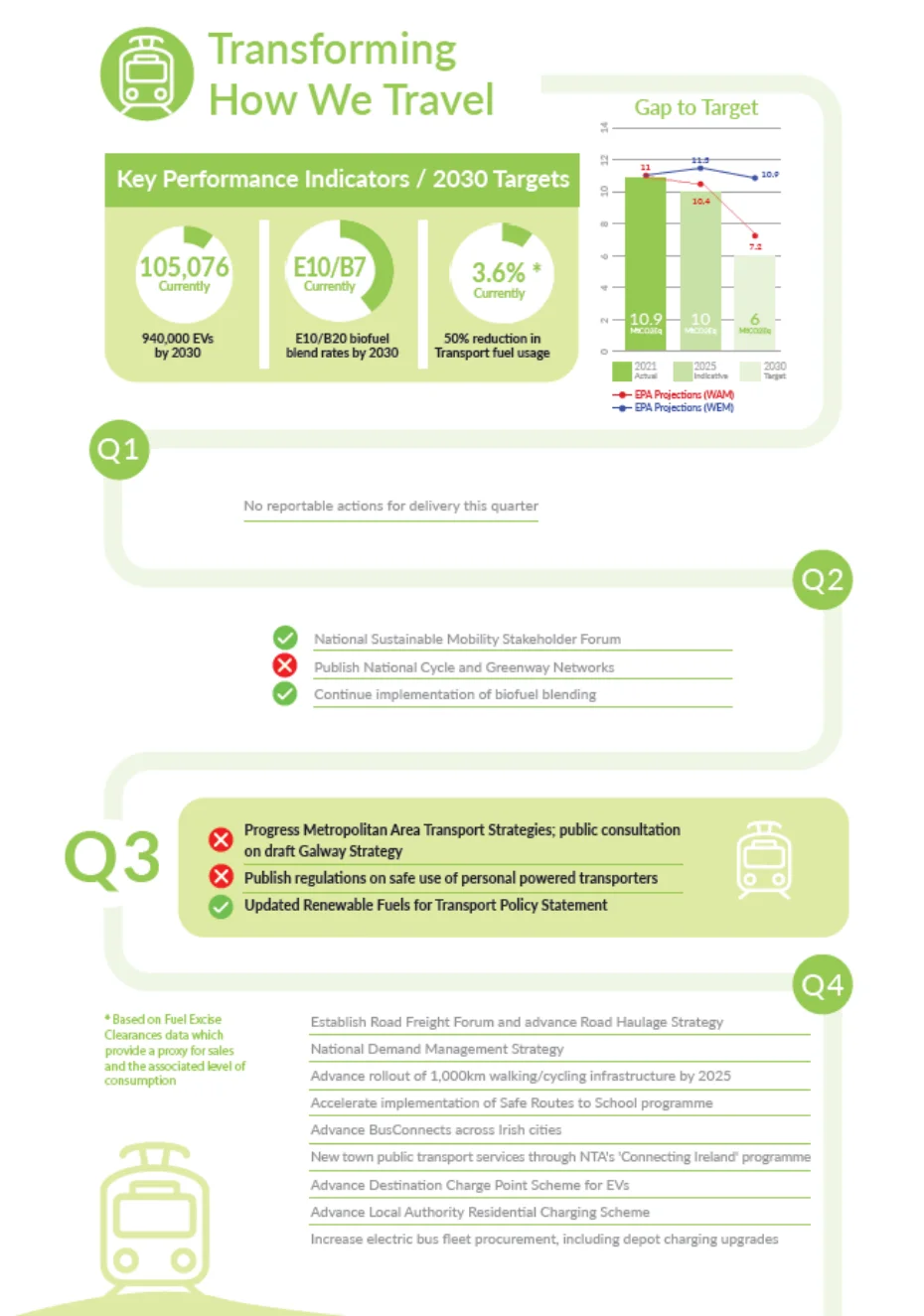
Figure from page 14
| High Impact Action Completed in Q3 2023: Transport | ||
| Did You Know? A variety of measures have been introduced in CAP23 to reduce | ||
| emissions from the transport sector. Among them is the greater use of renewable | ||
| energy, including renewable transport fuels (RTF), across the sector. Examples include | ||
| biofuels, biogas, biomethane and green hydrogen. | ||
| What’s new? Under Action TR/23/63, the Minister for Transport published the | ||
| Renewable Transport Fuel Policy Statement 2023-2025 in June 2023. The policy sets | ||
| out a pathway to incentivise the supply of renewable transport fuel through annual | ||
| increases in the renewable transport fuel obligation rate to 2030. It will also ensure | ||
| European sustainability and greenhouse gas reduction criteria are adhered to and | ||
| provide policy certainty for commercial operators who are responsible for implementing | ||
| the changes. |
| High Impact Action Delayed in Q3 2023: Transport | ||
| Did You Know? Under action TR/23/51 in CAP23, regulations setting down technical | ||
| standards for the use of personal powered transporters on public roads were due to be | ||
| published in Q3. The new Road Traffic and Roads Act 2023 under which these | ||
| regulations will be made was enacted in June 2023. These regulations are required to be | ||
| notified to the European Commission for review under Directive 2015/1535 for at least | ||
| 12 weeks and thus experienced delays in completing in Q3. | ||
| Why is it needed? New and affordable alternatives to fossil-fuelled vehicles will help | ||
| reduce transport emissions and provide modern and safe modes of travel for people | ||
| across Ireland. Such options could include personal powered transporters, such as e- | ||
| scooters and e-bikes. Until now, there has been no updated development of regulations | ||
| for these transport options to make them legal and safer for use on Irish roads. Pending | ||
| approval by the Commission, it is anticipated that the new required regulations will be in | ||
| place before the end of 2023. |
Pages 13–15 · View in original PDF