7 Industry
Share of GHGs
Industrial emissions accounted for 9.7% of Ireland’s total emissions in
in Ireland in
2022, with manufacturing combustion and industrial processes as the
2022
key emissions sources. These emissions are largely affected by cement
9.7%
production in Ireland, with emissions increasing, for example, in times
of economic boom and when Covid-19 restrictions relaxed.
This quarter, the EPA projects that manufacturing combustion emissions will
reduce by 6 - 22% from 2021 to 2030 with the implementation of efficiency
measures and renewable heat generation in industry (Figures 12 and 13). The
full implementation of biomethane targets (with use split across heating in
buildings and industry) is also required to meet the upper end of this range.
Meanwhile, process emissions are projected to increase by 5% in the same
time period under the EPA’s WEM scenario due to anticipated increased
cement production (Figure 13). There is no WAM scenario for process
emissions as no additional measures are yet identified to address them.
The EPA were unable to model the full CAP23 targets for renewable
Figure 13 Projected manufacturing combustion emissions to 2030 (EPA, 2023)
heating in industry nor measures aimed at decreasing embodied carbon
in construction materials due to unclear implementation pathways. The
use of Carbon Capture and Storage in industry post-2030 was also not included for the
same reason. The Industry SEC is thus expected to be breached by quite a significant
margin according to the EPA, without better defined emissions reducing pathways.
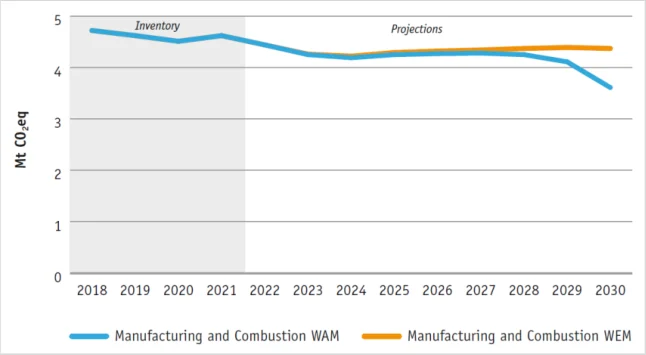
Figure 14 Emissions projections for manufacturing combustion, 2018 - 2030 (EPA, 2023)
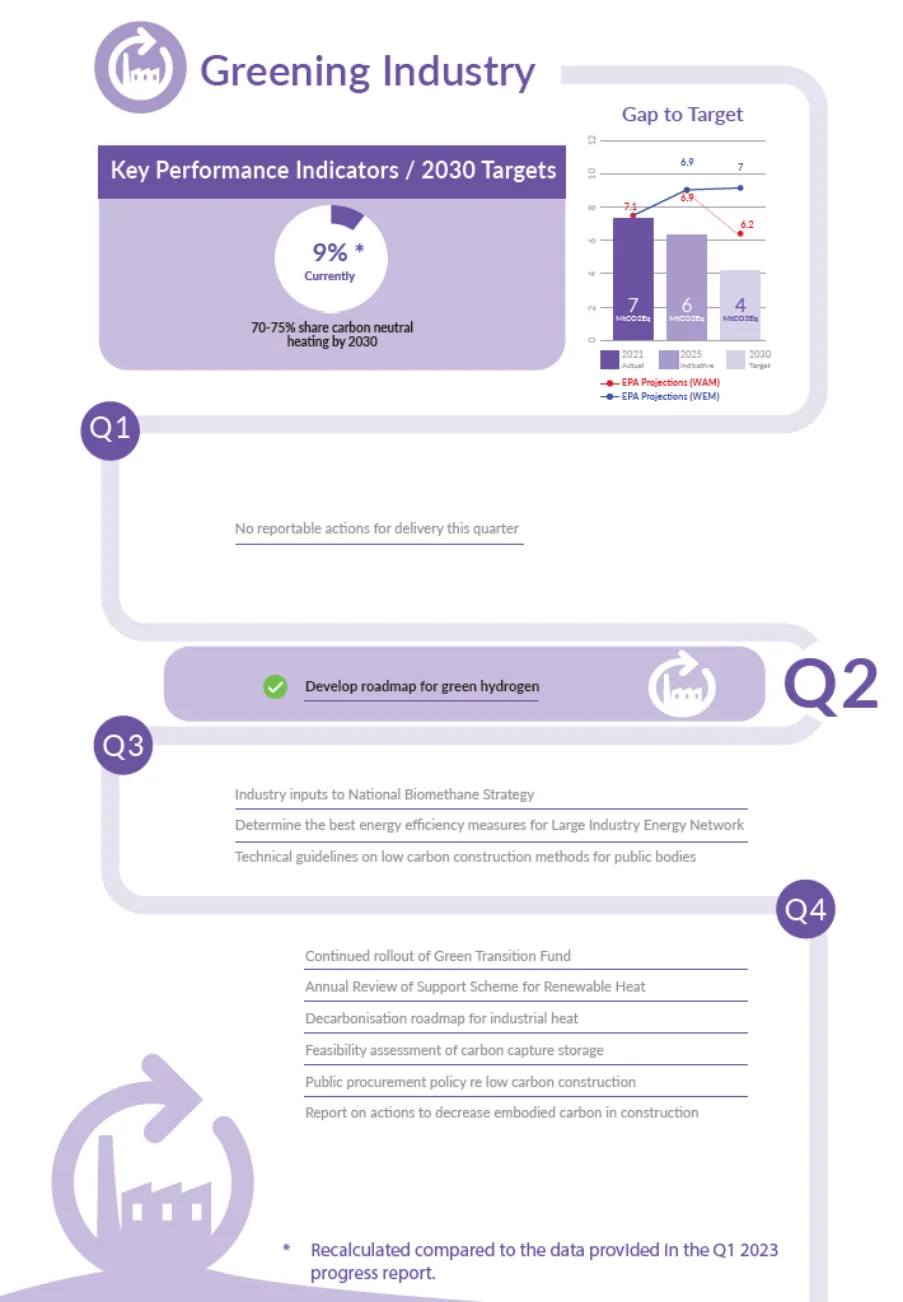
Figure from page 27
| High Impact Action Completed in Q2 2023: Industry | ||
| Did You Know? Decarbonised gases such as green hydrogen are a critical component | ||
| for Ireland’s energy transition. Hydrogen is envisioned to play an important role in | ||
| decarbonising industrial processes, long duration storage of renewable energy, and as a | ||
| transport fuel in hard-to-abate sectors such as heavy goods transport, maritime and | ||
| aviation. CAP23 includes offshore wind targets of at least 5GW to be operational by | ||
| 2030, with green hydrogen in production from surplus renewable electricity. 2GW of | ||
| offshore wind is specifically targeted for green hydrogen production post-2030. | ||
| What’s new? The National Hydrogen Strategy was developed and submitted for | ||
| government approval in Q2 2023. The Strategy covers the whole hydrogen value chain | ||
| including production, transportation, storage, end uses, safety, markets, regulation, | ||
| research, innovation and skills. The Strategy will provide clarity to the public and industry | ||
| in respect of the long-term role that renewable hydrogen can play in our energy system | ||
| out to 2050. It will also establish short-term actions that should be progressed to enable | ||
| the industry to be established over the coming years. |
| High Impact Action Completed in Q2 2023: Industry | ||
| Did You Know? While falling under the Electricity chapter, the support scheme for | ||
| Small-Scale Generation aims to provide an easier route to market for community | ||
| renewable energy projects, including for SMEs, farmers and industrial entities that may | ||
| be seeking to electrify their manufacturing combustion processes. The scheme fills a gap | ||
| in tariff-based supports between the smaller Micro-generation Support Scheme and the | ||
| larger RESS auctions. Small-Scale Generation targets renewable electricity generation | ||
| greater than 50kW, but smaller than typical commercial generators. | ||
| What’s new? The high level design for the Small-Scale Renewable Electricity support | ||
| Scheme published in in Q2 2023 under Action EL/23/13/A. It is crucial to maximise | ||
| commercial and industry participation in the renewable energy transition and can help to | ||
| further decarbonise manufacturing combustion processes while saving businesses’ | ||
| money on energy bills previously reliant on imported fossil fuels. |
Pages 26–28 · View in original PDF