2 Agriculture
Share of GHGs
Agriculture is the largest GHG emitting sector in Ireland. Additional
in Ireland in
agriculture-related emissions also arise in the LULUCF sector from
2022
organic soils drained for farming uses (grasslands). Combined,
34.3%
emissions from agriculture and LULUCF account for c.45% of Irish
emissions. Methane from livestock (enteric fermentation and manure
management) accounts for c.68% of Irish agricultural GHGs.
(WEM)
This quarter, the EPA released its emissions projections for all sectors.
Total emissions from Agriculture are projected to decrease by 4 - 20%
between 2021 and 2030 (Figures 1 and 2). Emissions reductions are
projected from a variety of measures including fertiliser switching, limits on
nitrogen fertiliser use and bovine feed additives, though sectoral targets and
the Agriculture SEC are expected to be breached even with full
implementation of these proposed measures.
(WAM)
Diversification measures proposed in CAP23 with annual savings of 1.5Mt
CO2 eq. by 2030 have not yet been included in the EPA analysis due to a
lack of clarity on implementation pathways.
The significant range presented between “existing” measures (WEM) (4%)
and “additional” measures (WAM) (20%) scenarios signals a need to move
Figure 1 Projected Agriculture emissions to
measures from currently ‘planned’ (WAM) to ‘being implemented’ (WEM) by
2030 (EPA, 2023)
firming up delivery pathways (e.g. timelines, resourcing, incentives/
disincentives etc). Further policy detail on important diversification measures is also crucial
to be able to model their impact.
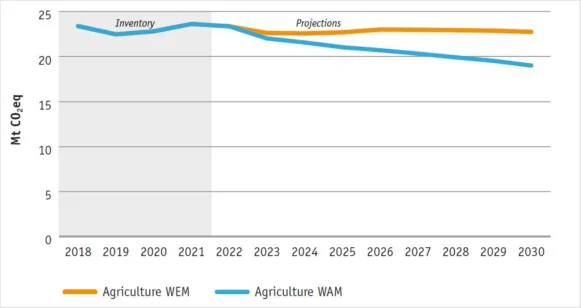
Figure 2 Emissions projections for Agriculture, 2018 - 2030 (EPA, 2023)
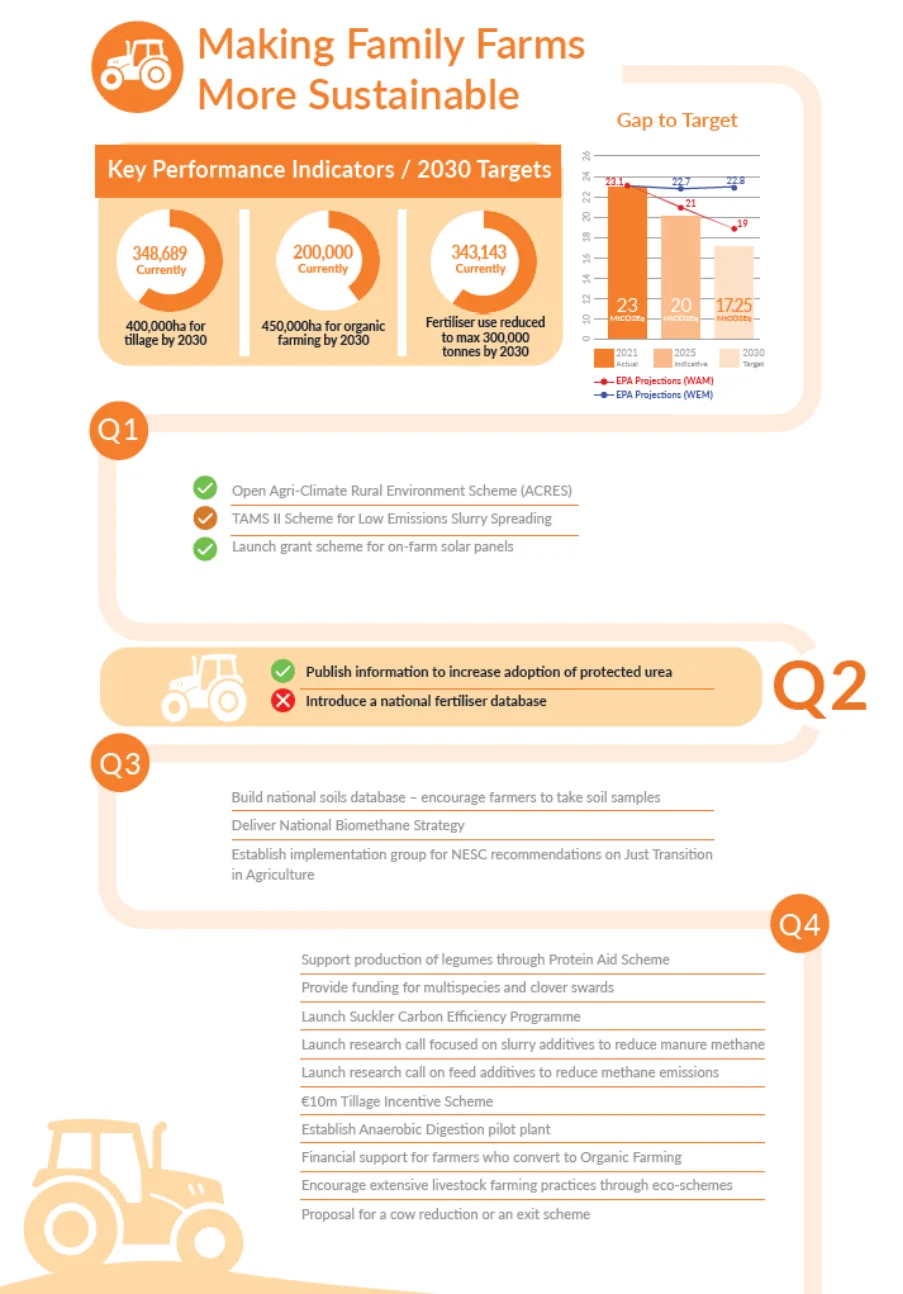
Figure from page 11
| High Impact Action Completed in Q2 2023: Agriculture | ||
| Did You Know? Targeted Agriculture Modernisation Schemes (TAMS) provide grants to | ||
| farmers to build and/or improve a specified range of farm buildings and equipment. This | ||
| includes support for a number of climate action areas identified in CAP23, helping | ||
| farmers to invest in solar power (AG/23/10/A), organic farming (AG/23/9), tillage | ||
| (LU/23/5) and Low Emission Slurry Spreading (LESS) (AG/23/3). LESS helps farmers | ||
| save money and emissions by enhancing nutrient recovery from slurries, improving | ||
| nutrient use efficiency, and reducing dependency on chemical fertilisers. | ||
| What’s new? The TAMS 3 LESS scheme opened to applicants on 8 May, with 45 | ||
| applications received so far. LESS approvals, claims, and payments also remain ongoing | ||
| under TAMS II, the predecessor to TAMS 3. €3.4 million has been spent on LESS under | ||
| TAMS II in the year to date. For more information, and to apply to the scheme, please | ||
| visit: https://www.gov.ie/en/collection/0e509-tams-3/ |
| High Impact Action Delayed in Q2 2023: Agriculture | ||
| Did You Know? Action AG/23/1 under CAP23 aimed to establish a new National | ||
| Fertiliser Database. This action was not completed on time in Q2 due to delays in | ||
| completing the required legislative process through the Dáil. The intention is to launch | ||
| the National Fertiliser Database in Q3. | ||
| Why is it needed? A National Fertiliser Database is a requirement under the 5th | ||
| Nitrates Action Programme and aims to track fertiliser sales more accurately. It will help | ||
| to provide a more realistic picture of where fertiliser is applied to land and minimise | ||
| reporting requirements for farmers. This, in turn, will facilitate timely farmer payments | ||
| under established eco-schemes. Reducing fertiliser nitrogen use is a key action under | ||
| CAP23, proposed to save 0.5 – 0.65 Mt CO eq in annual emissions by 2030. 2 |
Pages 10–12 · View in original PDF