Executive Summary

Figure from page 7
Figure from page 8
Introduction
Opportunities and challenges
This Report presents the final findings and recommendations from the All- Island Strategic Rail Review (“the Review”), which was launched in April 2021 by the Minister of Transport for the Irish Government and the Minister for Infrastructure for the Northern Ireland Executive.
Rail has the potential to deliver on accessibility, climate, connectivity, economic growth, environmental and regional development goals across the whole island – both for passenger and freight flows. It can change the economic landscape of the island by unlocking regeneration and growth opportunities, attracting investment, and supporting sustainable development.
This Report takes account of feedback gathered through two public consultations, including a Draft Strategic Environmental Assessment (SEA), which was published alongside a Draft Final Report from July to September 2023. A summary of the findings and actions arising from the SEA consultation is provided in Appendix A. Final versions of supporting documents, including the SEA and Appropriate Assessment, are published alongside this Report.
As one of the lowest emitters of carbon for passenger and freight trips, rail can help both jurisdictions deliver their commitments to achieving a net carbon zero transport system and economy. As both jurisdictions plan to decarbonise while the island’s population continues to grow, rail can play a role as the stronger ‘backbone’ of the public transport system in facilitating more compact development around transport hubs, enhancing connections between cities, and growing its share of travel.
The Review aims to inform policy and provide a future strategic vision for the railways in both jurisdictions on the island of Ireland. It has examined how the island’s railways are currently used, what role rail could play in future, and how the island’s railway could better serve the people of both jurisdictions.
The Review has focused on how the rail network across the island could contribute to the decarbonisation of the island’s transport systems, promote sustainable connectivity into and between major cities, enhance regional accessibility, and support balanced regional development. It has also considered the interactions between proposed improvements and existing, or planned, commuter rail services. The time horizon for this Review covers the period from today to 2050, to align with both jurisdictions’ stated goals of achieving net zero carbon emissions by this milestone.
To realise this role, rail will need to grow its market (or mode) share of travel. However, there are several challenges preventing rail from realising its full potential on the island of Ireland. These are listed below:
This evidence is supported by the responses received to an initialpublic consultation held between November 2021 and January 2022, which asked the public and wider stakeholders in both jurisdictions about their aspirations for the railway. This exercise showed there is significant interest from stakeholders in both jurisdictions in improving rail services across the whole island, especially in areas that are currently poorly served by the railway.
•There are significant gaps in the rail network’s coverage.
•Service frequencies and speeds are relatively low compared to similar railways (such as those in Scotland and Denmark).
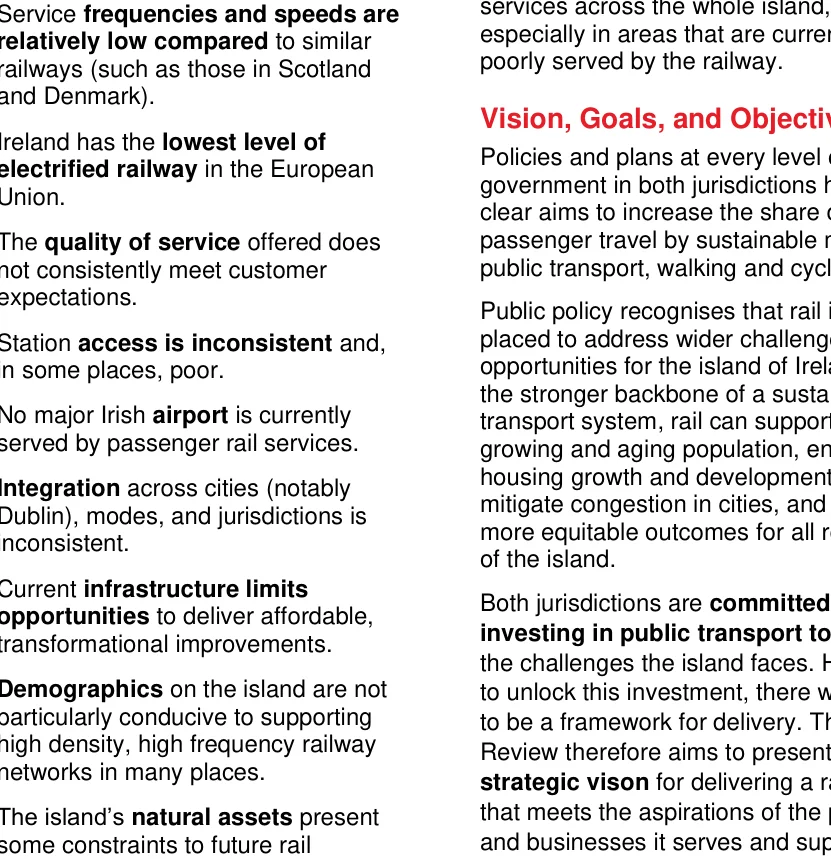
Figure from page 10
Vision, Goals, and Objectives
•Ireland has the lowest level of electrified railway in the European Union.
Policies and plans at every level of government in both jurisdictions have clear aims to increase the share of passenger travel by sustainable modes: public transport, walking and cycling.
•The quality of service offered does not consistently meet customer expectations.
Public policy recognises that rail is well placed to address wider challenges and opportunities for the island of Ireland. As the stronger backbone of a sustainable transport system, rail can support a growing and aging population, enable housing growth and development, mitigate congestion in cities, and deliver more equitable outcomes for all regions of the island.
•Station access is inconsistent and, in some places, poor.
•No major Irish airport is currently served by passenger rail services.
•Integration across cities (notably Dublin), modes, and jurisdictions is inconsistent.
•Current infrastructure limits opportunities to deliver affordable, transformational improvements.
Both jurisdictions are committed to investing in public transport to address the challenges the island faces. However, to unlock this investment, there will need to be a framework for delivery. This Review therefore aims to present a strategic vison for delivering a railway that meets the aspirations of the people and businesses it serves and supports the development of a prosperous, equitable, and sustainable future. To realise the opportunities and address the challenges outlined above, the Review has developed a Vision Statement, six overarching Goals, and 13 Objectives.
•Demographics on the island are not particularly conducive to supporting high density, high frequency railway networks in many places.
•The island’s natural assets present some constraints to future rail development on some corridors.
These challenges mean that the railway is currently unable to achieve high passenger and freight mode share, which is driving undesirable socioeconomic and environmental outcomes.
•Boost reliability and resilience, as there will be more capacity to absorb shocks, and more segregation between different services.
These are presented in Table E.1 along with some key outcomes that the Review’s recommendations could deliver.
Recommendations
•Reduce carbon emissions while doubling demand through decarbonising rail operations and promoting modal shift.
The Review has developed recommendations for policymakers that, together, provide a route to achieving the Review’s Goals and Objectives. These recommendations do not represent official policy for either jurisdiction, but aim to provide a constructive, evidence-based approach for delivering the Goals and Objectives of this Review. The recommendations cover six key themes, which are aligned to the Goals and Objectives of this Review. In total, the Review makes 32 recommendations that range from relatively quick to implement service improvements (e.g., direct Cork – Limerick – Galway services) through to major, long-term infrastructure projects (e.g., a new railway from Belfast to Derry~Londonderry via Portadown).
•Provide much more access to the railway. The number of people living within 5km of a railway station could grow by over 700,000, representing a 25% growth from today’s population catchment.
•Boost patronage and revenue for the railway – the number of passenger journeys and mode share undertaken on the island’s rail network could double from 3% to more than 6% of passenger kms (before additional demand management measures are delivered, which could increase mode share further).
•Support planned improvements to public transport connectivity in the island’s largest cities. Capacity would be unlocked for local services in Dublin, Belfast, Cork, and Limerick, while journeys to, from, and across Dublin City Centre would be significantly enhanced.
An overview of how a future railway might look if all recommendations are implemented in 2050 is listed in Table E.2 and presented in Figure E.1.
Benefits
If the Review’s recommendations were implemented, then this would:
•Deliver direct airport rail links for Dublin, Belfast, and Shannon – over 90% of commercial aviation passengers would be able to access their airports by rail.
•Deliver transformational improvements in the quality, speed, and frequency of rail services across the island. Many journey times would be significantly faster than by car.
Help the rail freight industry rebound by providing better routes between the island’s ports and cities, delivering inland facilities, and lowering the costs of rail freight.
•Enable more direct services between the island’s largest cities, significantly improving connectivity from the North East to the South West of the island, and on some routes potentially quadrupling service frequencies between key cities.
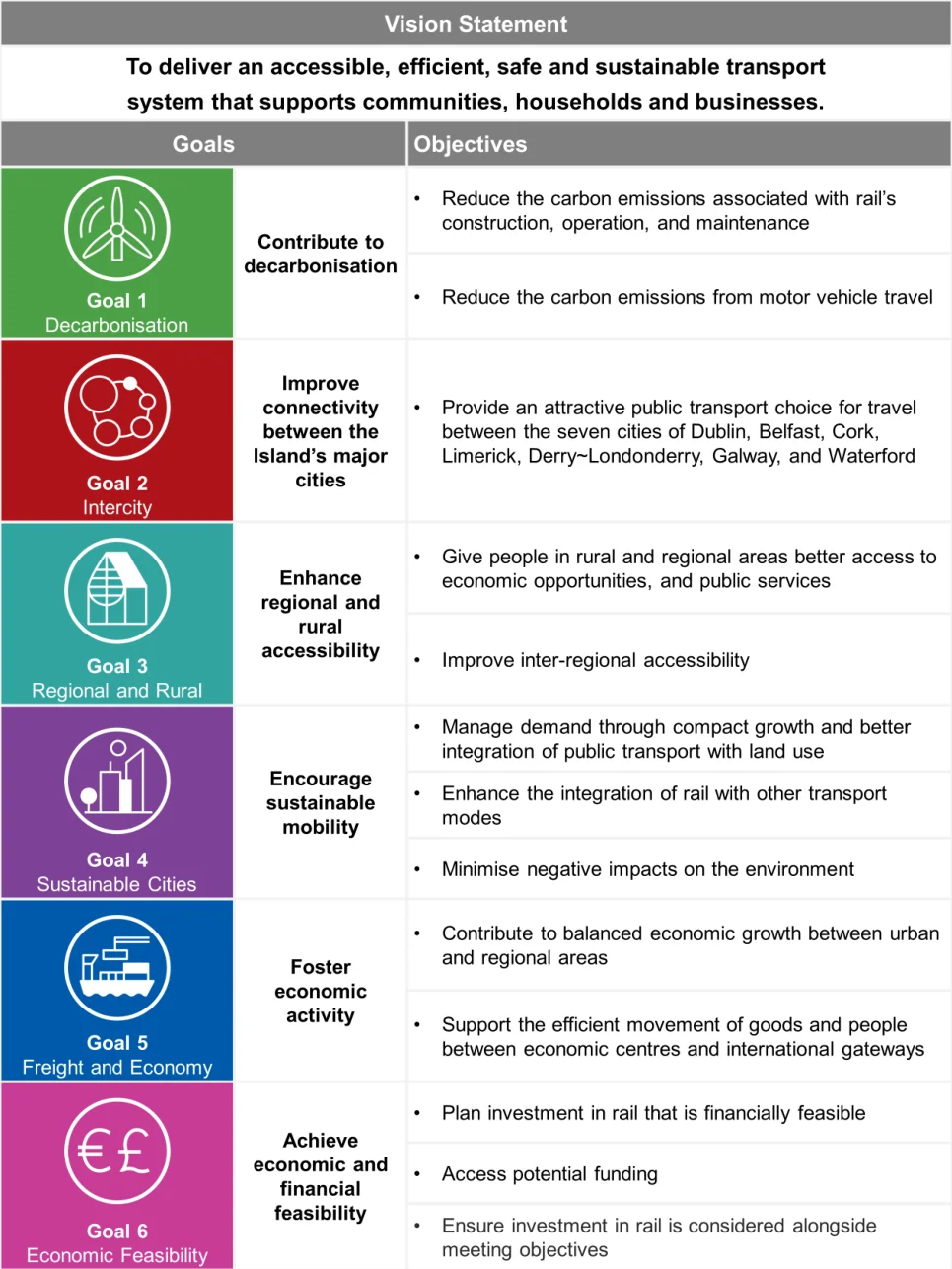
Figure from page 12
Table E.1 | Vision, Goals, Objectives, and potential outcomes of this Review
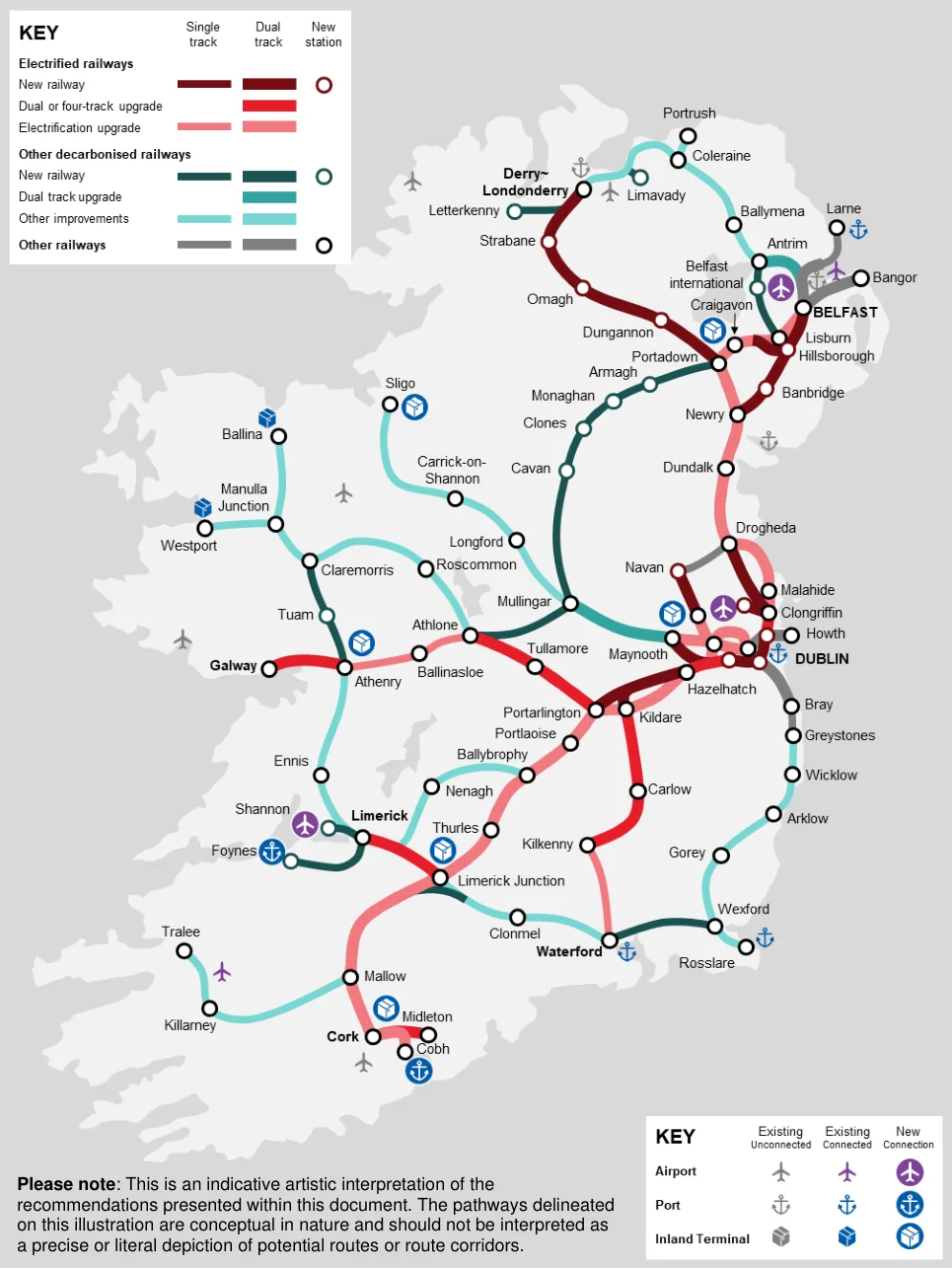
Figure from page 13
Please note: This is an indicative artistic interpretation of the recommendations presented within this document. The pathways delineated on this illustration are conceptual in nature and should not be interpreted as a precise or literal depiction of potential routes or route corridors.
Figure E.1 | A future all-island railway
| Decarbonisation recommendations | ||
|---|---|---|
| 1. Develop and implement an All-Island Rail | ||
| Decarbonisation Strategy that includes an | ||
| electrified intercity network. | ||
| 2. Develop plans to invest in the skills, supply | ||
| chains, and rolling stock to deliver | ||
| decarbonisation. | ||
| 3. Procure hybrid and electric rolling stock in | ||
| the medium term. | ||
| Intercity recommendations | ||
| 4. Upgrade the cross-country rail network to a | ||
| dual-track railway (and four-track in places) | ||
| and increase service frequencies. | ||
| 5. Upgrade the core intercity railway network to | ||
| top speeds of 200km/h (125mph). | ||
| 6. Develop short sections of new railways on | ||
| congested corridors. | ||
| 7. Develop a cross-Dublin solution. | ||
| Regional and rural recommendations | ||
| 8. Provide more direct services between | ||
| Ireland’s West and South Coasts. | ||
| 9. Ensure regional and rural lines have at least | ||
| one train per two hours. | ||
| 10. Increase line speeds to at least 120km/h | ||
| (75mph). | ||
| 11. Upgrade Limerick Junction and the Limerick | ||
| Junction – Waterford line. | ||
| 12. Reinstate the Western Rail Corridor railway | ||
| between Claremorris and Athenry. | ||
| 13. Extend the railway into Tyrone, | ||
| Derry~Londonderry, and Donegal. | ||
| 14. Reinstate the South Wexford Railway. | ||
| 15. Develop the railway to boost connectivity in | ||
| the North Midlands. | ||
| 16. Integrate bus service and rail service | ||
| timetables to connect communities where | ||
| direct rail access proves to be unviable. | ||
| Table E.2 | Review Recommendations | ||
| Sustainable cities recommendations | |||
|---|---|---|---|
| 17. Connect Dublin, Belfast International, and | |||
| Shannon Airport to the railway and improve | |||
| existing rail-airport connections. | |||
| 18. Extend double tracking in the Belfast area. | |||
| 19. Segregate long-distance/fast services from | |||
| stopping services. | |||
| 20. Explore the case for developing new stations | |||
| in the Belfast, Cork, Derry~Londonderry and | |||
| Limerick – Shannon city regions. | |||
| Freight recommendations | |||
| 21. Develop a sustainable solution for first-mile- | |||
| last-mile rail access for Dublin Port. | |||
| 22. Reduce Track Access Charges for freight. | |||
| 23. Strengthen rail connectivity to the island’s | |||
| busiest ports. | |||
| 24. Develop a network of inland terminals close | |||
| to major cities on the rail network. | |||
| Customer experience | |||
| Recommendations | |||
| 25. Continue to invest in initiatives that deliver a | |||
| seamless customer journey. | |||
| 26. Continue to benchmark and monitor service | |||
| quality and deliver continuous improvement. | |||
| 27. Ensure future rolling stock specifications are | |||
| aligned to the infrastructure-led interventions | |||
| outlined in this Review. | |||
| 28. Invest in improving integration within rail and | |||
| between rail and other transport options. | |||
| 29. Deliver ‘clock-face’ timetable calling patterns. | |||
| 30. Develop cross-border structures to improve | |||
| the effectiveness of cross-border | |||
| infrastructure and rail service planning. | |||
| 31. Invest in a rolling programme of accessibility | |||
| improvements, including step-free access. | |||
| 32. Review and update the All-Island Strategic | |||
| Rail Review once a decade, taking account | |||
| of latest policies and developments. |
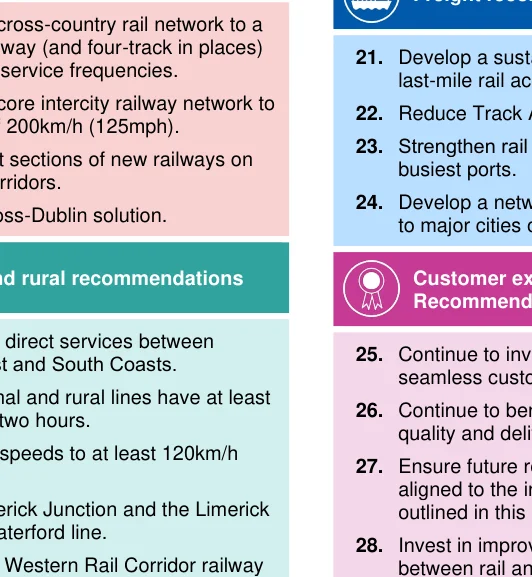
Figure from page 14
More broadly, a transformed railway would help reduce congestion on the island’s road networks, reduce accidents, improve air quality, reduce noise, and reduce the carbon footprint of the transport sector. It would also deliver a significant boost to the productivity of the economy in both jurisdictions through promoting agglomeration (productivity arising from pooling and sharing of resources and knowledge across labour markets) across the island of Ireland.
This includes potential disruption to communities, townscapes, severance, biodiversity, landscapes, noise, and carbon emissions driven by the construction of new railways. These impacts and trade-offs have been carefully considered and have shaped many of the recommendations.
In general, most of this Review’s recommendations focus on existing railways and corridors, which minimises their impact, though some new lines/reopening of old lines is proposed. The Review also recommends tunnelled interventions in urban areas to reduce their impact.
Costs and impacts
In 2021 prices, the total capital cost of the recommendations included in this Review is estimated to be in the order of €32bn/£27bn. Additional annual costs for operating and maintaining a larger rail network on the island are estimated to be circa €600m/£500m, which would be partly offset by increased revenue. This excludes costs associated with existing spending commitments such as the DART+ programme and MetroLink subway in Dublin. A high level of allowance for Optimism Bias has been included to allow for uncertainty. This investment would take the best part of 25 years to deliver, which suggests an annual capital spend of the order of €1.3/£1.1bn would be required in addition to existing commitments (2021 prices, excl. VAT). Updated cost estimates in 2023 prices are provided in Appendix D.
The Review does not recommend constructing new railways through the North West coastal region, partly because of concerns about the impact of this on the environment, as well as value for money considerations. Similarly, the Review has also ruled out developing a large high speed rail system, related to concerns that the carbon generated from its construction would not be offset by downstream carbon emission reductions, and value for money issues.
Going forward, each intervention would be subject to rigorous economic, equality, and environmental impact assessments, which will help strengthen benefits, control costs, and mitigate environmental impacts.
While significant, these costs would represent a similar annual spend as was committed in the middle of the 2000s when Ireland expanded its motorway network, and they would be shared across both jurisdictions.
Some costs would be offset by future revenue, while others could be met by government funding. In addition, there would be other impacts arising from the delivery of some interventions, particularly during their construction.
Appraisal and roadmap
One of the most cited issues in this consultation was concerns about the absence of proposals to extend rail services to Enniskillen in Co. Fermanagh. There were also requests for the Review to reopen more railways and include more new stations in the recommendations, to examine the role of tourism in boosting demand, and to make firmer commitments to delivering a more accessible railway. The feedback from this consultation was carefully analysed and motivated the project team to commission further research – including into the potential role of tourism demand in strengthening the case for investment, as well as sensitivity tests relating to rail to Enniskillen. A summary of the findings and actions arising from this consultation is provided in Appendix A.
The Review undertook a thorough assessment and appraisal exercise of several packages of interventions and used insight drawn from this work to develop the recommendations outlined above. Under the Irish Department of Transport’s Common Appraisal Framework guidance, the economic appraisal of the recommendations included in this report shows that, when taken together, they deliver net economic benefits for the island of Ireland and deliver the Vision, Goals and Objectives outlined above.
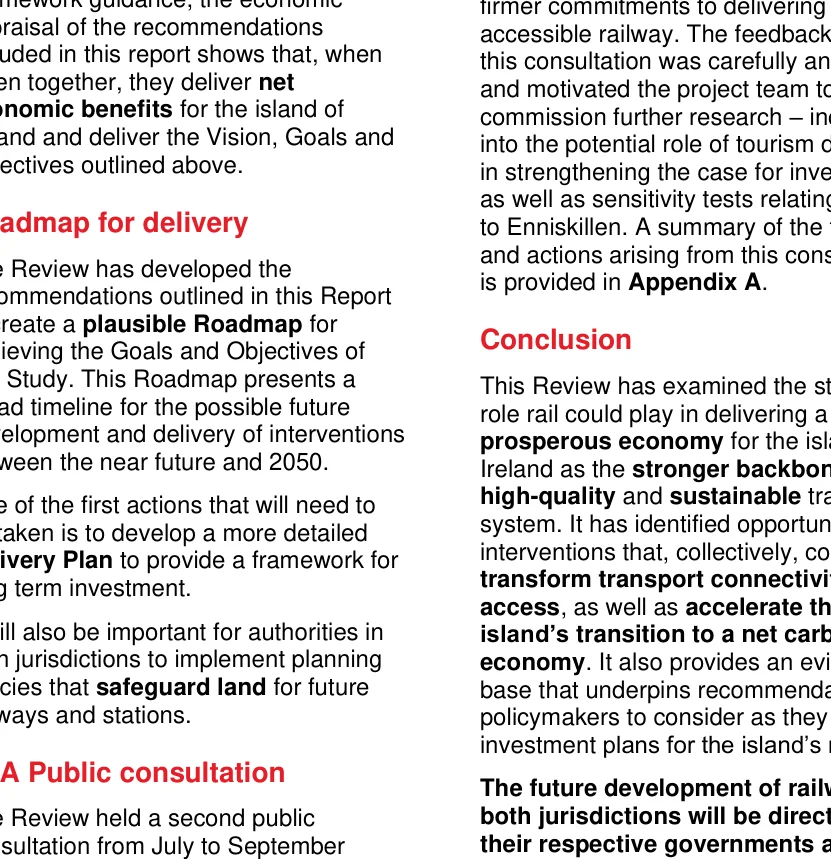
Figure from page 16
Roadmap for delivery
The Review has developed the recommendations outlined in this Report to create a plausible Roadmap for achieving the Goals and Objectives of this Study. This Roadmap presents a broad timeline for the possible future development and delivery of interventions between the near future and 2050.
Conclusion
This Review has examined the strategic role rail could play in delivering a prosperous economy for the island of Ireland as the stronger backbone of a high-quality and sustainable transport system. It has identified opportunities and interventions that, collectively, could transform transport connectivity and access, as well as accelerate the island’s transition to a net carbon zero economy. It also provides an evidence base that underpins recommendations for policymakers to consider as they develop investment plans for the island’s railway.
One of the first actions that will need to be taken is to develop a more detailed Delivery Plan to provide a framework for long term investment.
It will also be important for authorities in both jurisdictions to implement planning policies that safeguard land for future railways and stations.
SEA Public consultation
The future development of railways in both jurisdictions will be directed by their respective governments and legislatures. More work is needed to test the feasibility of many recommendations included in this Report, and each recommendation would be subject to appraisal, environmental assessment, and decision in line with applicable governance processes.
The Review held a second public consultation from July to September 2023. The technical remit of this consultation was to formally consult on a Draft Strategic Environmental Assessment (SEA), which was published alongside the Draft Final Report for the Review. A large majority of responses focused on non-SEA topics.
Pages 7–16 · View in original PDF