Chapter 5 | Benefits and Costs

Figure from page 89

Figure from page 90
Introduction
There would also be more direct services between the island’s largest cities, significantly improved connectivity for journeys across the island that transit through Dublin, and on some routes (such as Dublin – Belfast) potentially a quadrupling in service frequencies between key cities.
This Chapter summarises the benefits, costs, and other impacts that would likely be delivered by the key recommendations outlined in Chapter 4. It also shows how they support the Review’s Goals and Objectives.
The development of the recommendations presented in Chapter 4 was informed by capital cost, operational cost, demand, revenue, and carbon assessment. It was supported by an objective environmental assessment. AppendixB sets out all the interventions that were considered by this Review. It also outlines the process that was followed to determine which interventions should be taken forward for more detailed analysis and, ultimately, be included as recommendations in this Report. Further assessment, analysis, approval, and funding would be required to take any recommendation presented in Chapter 4 forward, and it is for the governments in both jurisdictions to decide which interventions should be pursued.
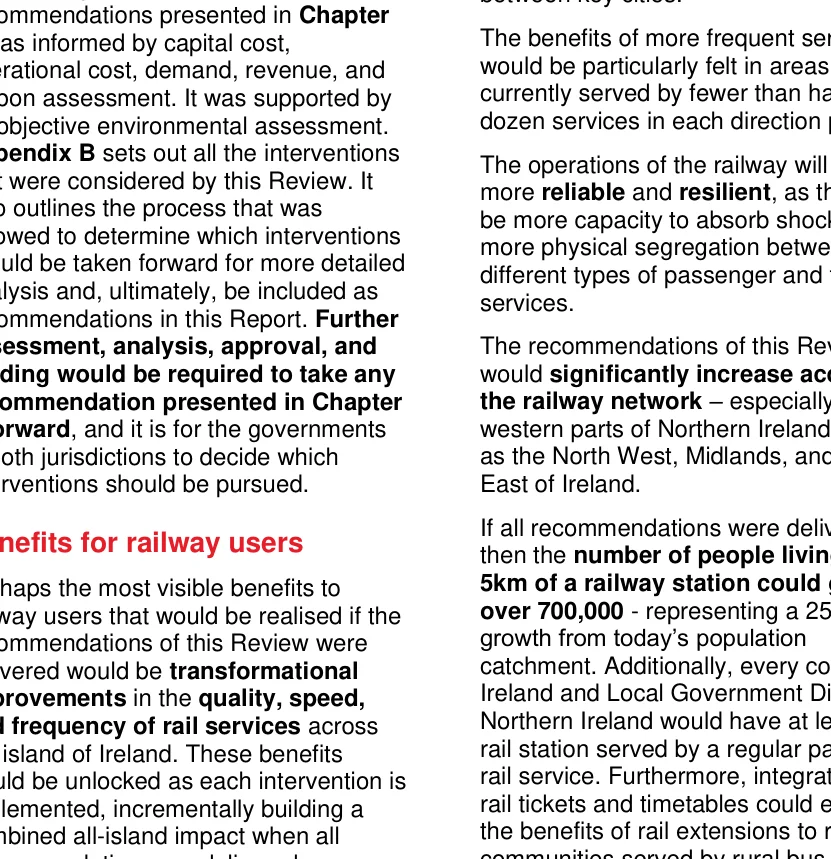
Figure from page 91
The benefits of more frequent services would be particularly felt in areas that are currently served by fewer than half a dozen services in each direction per day.
The operations of the railway will also be more reliable and resilient, as there will be more capacity to absorb shocks and more physical segregation between different types of passenger and freight services.
The recommendations of this Review would significantly increase access to the railway network – especially in western parts of Northern Ireland, as well as the North West, Midlands, and South East of Ireland.
If all recommendations were delivered, then the number of people living within 5km of a railway station could grow by over 700,000 - representing a 25% growth from today’s population catchment. Additionally, every county in Ireland and Local Government District in Northern Ireland would have at least one rail station served by a regular passenger rail service. Furthermore, integrated busrail tickets and timetables could enable the benefits of rail extensions to reach communities served by rural bus routes that interchange with rail hubs.
Benefits for railway users
Perhaps the most visible benefits to railway users that would be realised if the recommendations of this Review were delivered would be transformational improvements in the quality, speed, and frequency of rail services across the island of Ireland. These benefits would be unlocked as each intervention is implemented, incrementally building a combined all-island impact when all recommendations are delivered.
Rail journey times between the largest cities would be significantly reduced – in some cases halved – and would be materially quicker than car. (Figure 17).
Benefits for non-railway users
If all the recommendations were delivered, then passengerjourneys undertaken on the island’s rail network could double. Similarly, the market share of rail would also double from around 3% of passenger kms today to more than 6% (before any demand management measures are considered, which could increase mode share further). It could also increase the revenues of the rail industry, depending on the fares policy adopted.
In addition to the benefits highlighted above, the recommendations of this Review would contribute to several wider socioeconomic and environmental goals.
Analysis for this Review indicates it would: reduce congestion on the island’s road networks, reduce accidents, improve air quality, reduce noise, and reduce the carbon footprint of the transport sector. There would also be reduced carbon emissions from railway operations, and mode shift would add further carbon benefits.
The Review’s recommendations would also enable the island’s largest cities to boost their multi-modal public transport offer. A new east-west railway in Dublin would deliver transformational improvements in cross-city connectivity for the Greater Dublin Area and benefit journeys across the island that transit through Dublin. Additional capacity around Dublin and Belfast would enable Iarnród Éireann and Translink to boost local services. Dublin, Belfast, and Shannon would benefit from airport rail links that would enable 90% of commercial aviation passengers to access their airports by rail.
The recommendations could deliver a significant boost to the productivity of the economy in both jurisdictions through promoting agglomeration – that is, productivity arising from pooling and sharing of resources and knowledge across labour markets and between cities and major economic hubs.
The recommendations would also enable the rail freight industry to rebound by providing better routes between the island’s ports and its major economic centres, delivering inland multi-modal interchange facilities between freight operators, and lowering the costs of rail freight in general terms. Improvements to the Western Corridor and in the South East would ensure there are minimal conflicts between freight and other traffic.
A summary of the key outcomes and benefits that could be delivered is presented later in Table 4.
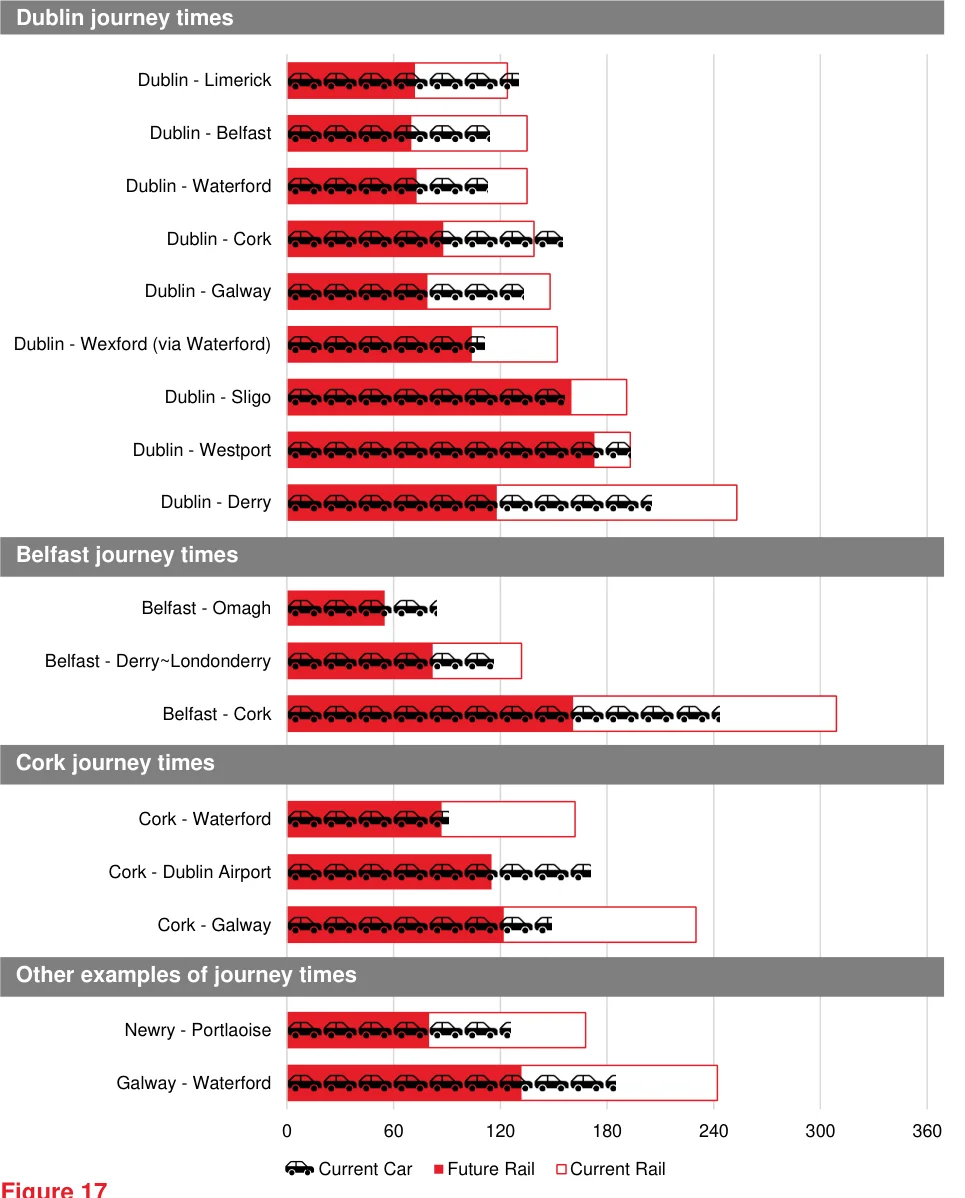
Figure from page 93
Dublin journey times
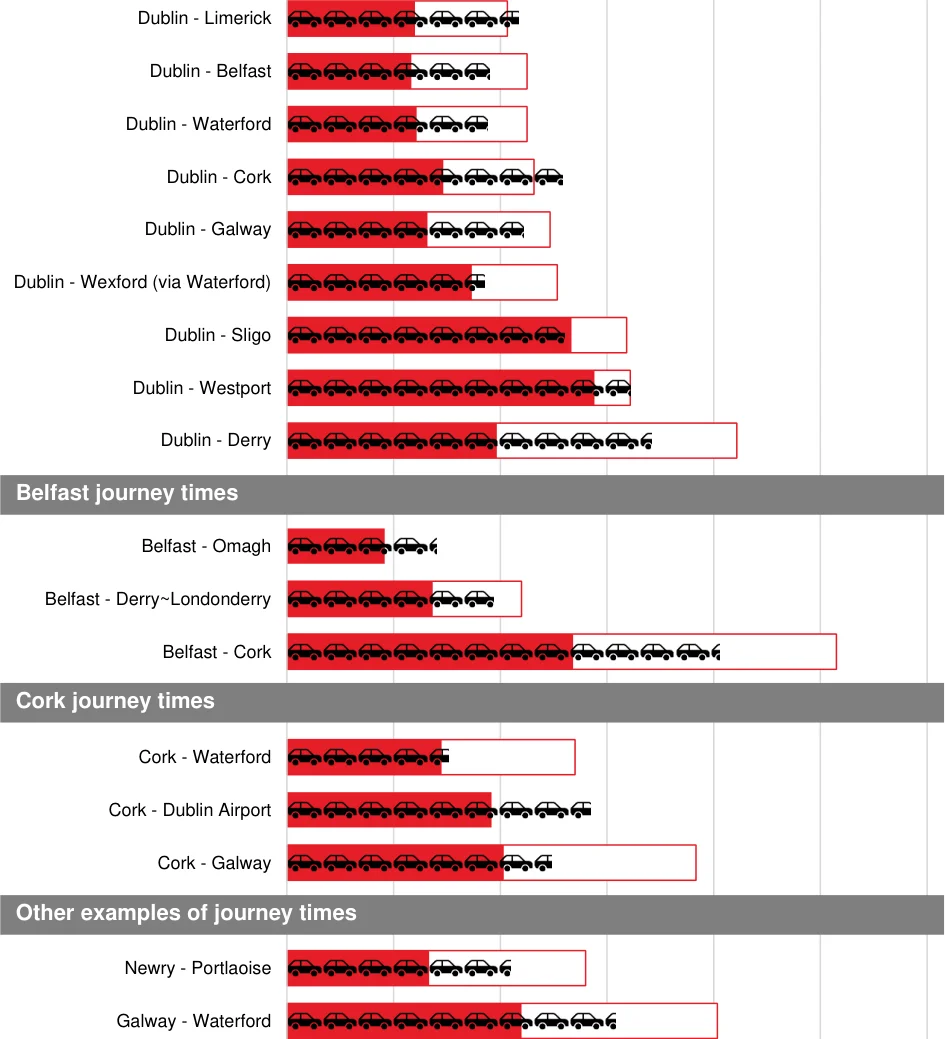
Figure 17
0
Figure 17 Indicative journey times by rail and car This shows indicative in-vehicle passenger journey times between selected stations for the current rail and car journeys and for future rail journeys that would benefit from the recommendations in this Review. This assumes maximum speeds of 200km/h would be achieved on most intercity lines. For the existing journey times, the fastest scheduled services on a weekday are shown. The modelling used to generate these estimates assumes the interventions would take effect in 2040 and would therefore reflect the projected population and economy of the island in this year. The comparison car journey times shown in the same chart present the average in vehicle journey car journey times between the same stations in 2021.
Costs
Other trade-offs considered
The Review has undertaken a high-level, top-down assessment of the capital, maintenance, and operating costs of delivering the recommendations of this Review. These costs were informed by benchmarking exercises of Ireland and other European railways and benefitted from insights from Iarnród Éireann and Translink.
In addition to the monetised costs outlined above, there would be other trade-offs and impacts arising from the delivery of the interventions described in Chapter 4, particularly during their construction. This includes potential disruption to communities, townscapes, severance, biodiversity, landscapes, noise, and carbon emissions driven by the construction of new railways. These impacts and tradeoffs have been carefully considered by this Review and have shaped many of the recommendations.
In 2021 prices, the capital cost of the Review’s recommendations is estimated to be in the order of €32bn/£27bn. This excludes VAT and costs of existing proposals such as the DART+ programme and Dublin MetroLink. A high level of allowance for Optimism Bias has been included in this estimate. Updated cost estimates in 2023 prices are provided in Appendix D.
In general, most of this Review’s recommendations focus on existing railways and corridors, which minimises their impact, though some new lines/reopening of old lines is proposed. The Review also recommends tunnelled interventions in urban areas to reduce their impact.
The additional operating and maintenance costs for maintaining a larger rail network on the island are estimated to be circa €600m/£500m in 2021 prices, which could be met by additional revenue and/or government support (depending on fare levels).
The Review does not recommend constructing new railways through the North West coastal region, partly because of concerns about the impact of this on the environment, as well as value for money considerations. Similarly, the Review has also ruled out developing a large high speed rail system, related to concerns that the carbon generated from its construction would not be offset by downstream carbon emission reductions, and value for money issues.
This investment would take around 25 years to deliver, which suggests an annual capital spend of the order of €1.3/£1.1bn would be required above existing commitments. A breakdown of these costs is provided in Table 3 and more details about on how they were derived is set out in Appendix B.
Going forward, each major intervention described in this report would be subject to rigorous economic, equality, and environmental impact assessments, which will help to further strengthen benefits, control costs, and mitigate potential environmental impacts.
While these additional costs are significant, and will increase with inflation, they are similar in scale to the funding Ireland invested in the 2000s to expand its motorway network and would be shared across both jurisdictions.
Assessment and appraisal
Personas and stories
The Review assessed and appraised several interventions in different combinations (referred to as “Packages” and “Scenarios” in Appendix B). A qualitative Multi Criteria Assessment of these Packages and Scenarios is presented in Table A.5 in Appendix B. Some interventions (largely freight and customer service interventions) were not quantitatively assessed but were qualitatively assessed. An economic appraisal of the recommendations of this Review suggests that – altogether – they have the potential to generate a Benefit to Cost Ratio broadly equal to one under the Department of Transport’s Common Appraisal Framework (the approach used for Northern Ireland generated lower BCRs). A breakdown of the monetised benefits and costs generated by this appraisal is shown in Figure 18.
Customer personas are fictional profiles which represent characteristics of both existing and potential customers of the rail network. The purpose of developing personas is to help understand and empathise with a diverse range of customer needs and help to embed a customer mindset in the decision-making process. Understanding the customer and their end-to-end journey helps ensure that services can stay resilient to changing needs and trends.
Several personas were created during the first stages of the Review to enable the project team to form an understanding of the challenges people face today. The personas were informed by a desktop study of current literature, news articles, and data analysis as well as feedback from the public consultation. Table 5 below presents some of the tangible benefits a future transformed railway could deliver for these customer personas.
Figure 18 Breakdown of monetised costs and benefits of the recommendations of this Review (approximately €20bn/£16.7bn in 2011 discounted prices).
| Intervention | Capital Cost Estimates Range, 2021 prices | |||||
|---|---|---|---|---|---|---|
| In Euros (€), millions | In Sterling (£), millions |
Electrification and/or dual tracking
Belfast – Drogheda electrification
Dublin – Portarlington electrification
Kildare – Waterford electrification/dual-tracking
Portarlington – Galway electrification/dual-tracking
Portarlington - Limerick Junction electrification
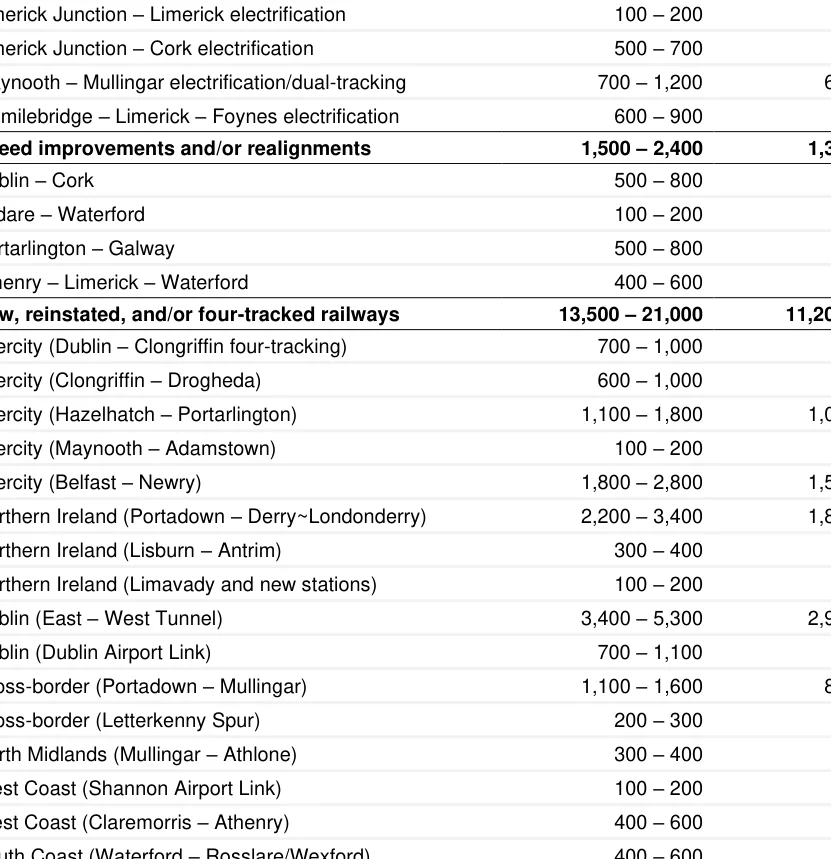
Table 3
Limerick Junction – Limerick electrification
Limerick Junction – Cork electrification
Maynooth – Mullingar electrification/dual-tracking
Sixmilebridge – Limerick – Foynes electrification
Speed improvements and/or realignments
Dublin – Cork
Kildare – Waterford
Portarlington – Galway
Athenry – Limerick – Waterford
New, reinstated, and/or four-tracked railways
Intercity (Dublin – Clongriffin four-tracking)
Intercity (Clongriffin – Drogheda)
Intercity (Hazelhatch – Portarlington)
Intercity (Maynooth – Adamstown)
Intercity (Belfast – Newry)
Northern Ireland (Portadown – Derry~Londonderry)
Northern Ireland (Lisburn – Antrim)
Northern Ireland (Limavady and new stations)
Dublin (East – West Tunnel)
Dublin (Dublin Airport Link)
Cross-border (Portadown – Mullingar)
Cross-border (Letterkenny Spur)
North Midlands (Mullingar – Athlone)
West Coast (Shannon Airport Link)
West Coast (Claremorris – Athenry)
South Coast (Waterford – Rosslare/Wexford)
Rolling stock
Total (capital and rolling stock)
Additional annual operating and maintenance costs
Table 3 Capital cost estimates of recommended interventions

Table 3
Based on broad assumptions on route and service specifications and includes 56% optimism bias. Some estimates in this table may differ to other estimates prepared by other parties for some interventions. This is because a ‘top-down’ approach to cost estimating (based on unit costs applied to items such as 1km of new track and/or stations) was necessary to provide estimates for a large number of interventions, which is by its nature likely to yield different results.
In summary, the qualitative and quantitative assessments and appraisals undertaken for this review suggest that, as a whole, the recommendations of this Review could deliver net economic benefits for the island of Ireland while meeting all the Review’s Goals and Objectives (see Table 4).
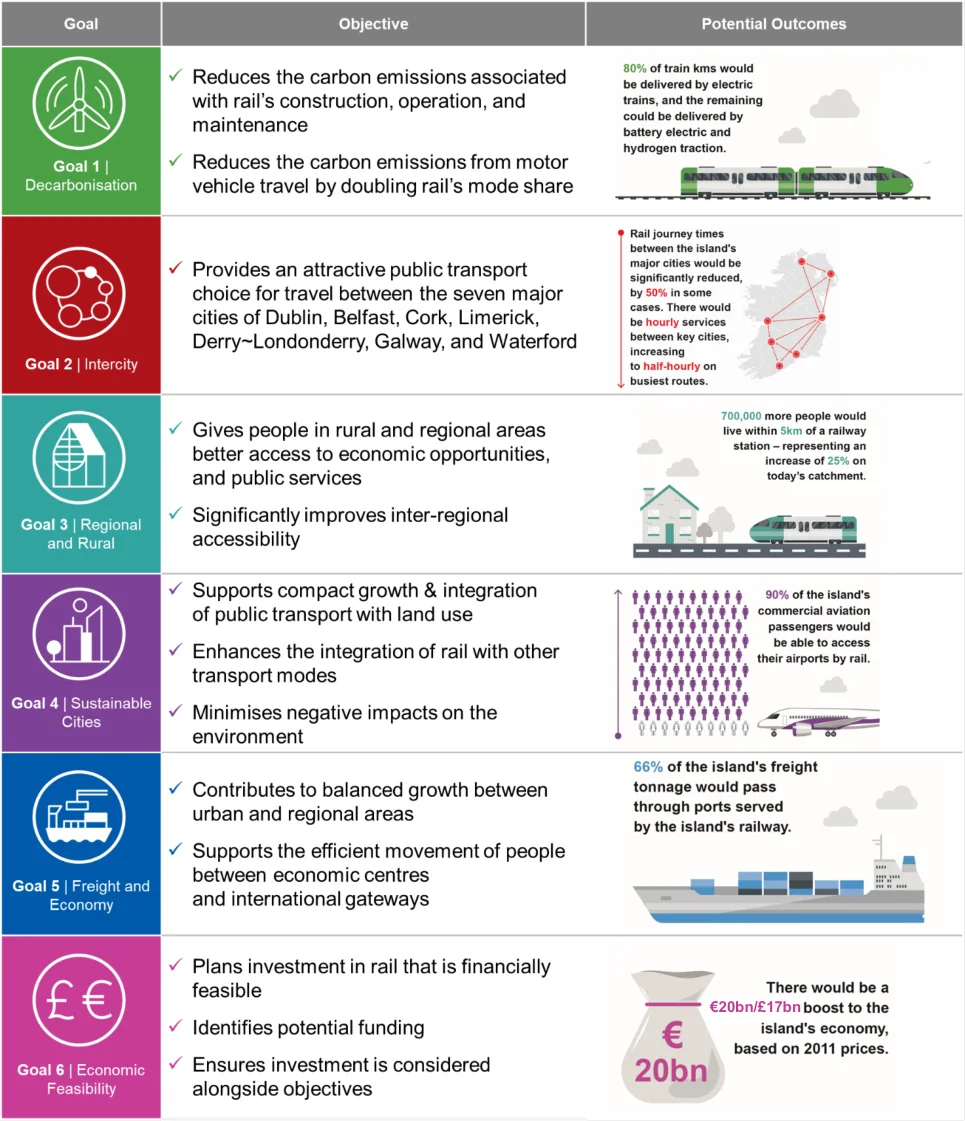
Table 4
€20bn/£17bn
Table 4 How the recommendations of this Review deliver its Goals and Objectives
| Lauren | ||
|---|---|---|
| The student | ||
| Lauren is a 19-year-old student who commutes from Strathfoyle in | ||
| Derry~Londonderry to the University of Ulster campus in Coleraine. | ||
| Today’s railway | A potential future railway | |
| • Lauren lives far from | • A new station at Strathfoyle would provide | |
| Derry~Londonderry station and often | much more convenient access to the | |
| needs a lift from her parents. | network. | |
| • A lack of secure cycle parking at the | • Improved cycle parking facilities at | |
| station and on board the train for bikes | stations and new carriages with more | |
| dissuades Lauren from cycling to and | space for bikes will make it much more | |
| from the station. | convenient to combine rail and cycling for | |
| end-to-end journeys. | ||
| • With just one train service per hour, | ||
| long waits to interchange at Coleraine | • Increases in frequency to two trains per | |
| station, and the last service departing | hour, extended schedules, and more | |
| shortly after 22:00, Lauren has to plan | coordinated timetabling for the | |
| her schedule around the timetable. | interchange at Coleraine will give more | |
| freedom to rail passengers. | ||
| Marta | ||
| The commuter | ||
| Marta is a 35-year-old who travels from her home in Newry to | ||
| work in Dublin two days per week. | ||
| Today’s railway | A potential future railway | |
| • Marta now works on a hybrid schedule, | • More flexible ticketing options will make | |
| so season tickets no longer represent | rail more accessible to more people. | |
| good value for money and day return | ||
| • Integrated ticketing across travel modes, | ||
| tickets are expensive. | ||
| including rail, bus, and cycling, together | ||
| • Neither her home nor her workplace | with coordination of rail and bus | |
| are immediately adjacent to stations so | timetables will greatly expand the | |
| her first and last mile connections can | effective catchment of rail services. | |
| be inconvenient. | ||
| • Separation of DART and intercity rail with | ||
| • The rail journey to Dublin is relatively | a new line from Drogheda to Clongriffin | |
| slow due to old alignments and conflict | and four tracking onwards to Dublin City | |
| with DART services. It is often delayed | Centre will greatly speed up rail travel | |
| between Drogheda and Connolly. | times. |
Pages 89–98 · View in original PDF