Sustainable Cities
Sustainable Cities
This section describes the key considerations and recommendations that have been developed to ensure this Review supports the ambitions of cities in both jurisdictions. In particular, it highlights how interventions developed in support of this Review’s wider all-island Goals and Objectives can help the island’s cities improve their urban and wider commuter rail networks.
Several cities across the island of Ireland are developing significant improvements to public transport services. These improvements cut across multiple modes of transport and are underpinned by city and regional strategies that take a holistic approach to journeys in their areas.
Figure from page 71
Additionally, this section considers opportunities to better connect the island’s railway to three of its busiest international airports (Dublin, Belfast International, and Shannon).
Plans for multi-billion Euro improvements to public transport services in the island’s largest cities are taken as committed and are fully supported by the Review. While the scope of the Review does not include detailed proposals for commuter and urban rail services on the island, the Review indicates how the all-island interventions recommended by this Review can support plans to improve these services.
Dublin
As noted in the introduction to this Chapter, the Greater Dublin Area (GDA) Transport Strategy sets out a statutory framework for the development of transport across the Dublin region up to 2042. The recommendations set out below represent potential additional complementary provision which could be considered for inclusion in future updates to the GDA Transport Strategy.
There is significant alignment between the Goals and Objectives of this Review and the ambitions of the island’s largest cities – as set out in the National Transport Authority’s Metropolitan Transport Strategies for the Greater Dublin Area, Cork, and Limerick-Shannon Area, as well as the Department for Infrastructure’s Eastern Area Transport Plan. For example, the DART+ Programme in Dublin and planned new stations in the Belfast area should help grow the attractiveness of rail, which, in turn, should boost demand for intercity services. That said, there may be competition for capacity between intercity, freight, urban, and commuter rail services. This Review has therefore considered where conflicts might arise between different services and proposes plausible solutions to address these potential conflicts.
In line with this Transport Strategy, the National Transport Authority and Iarnród Éireann are currently delivering an ambitious DART+ Programme, which will expand DART beyond its current coastal corridor to the North, West, and South West of the GDA. This will include increasing service frequencies on several lines, including Dublin Connolly – Maynooth, Connolly – Drogheda, and Heuston – Hazelhatch. To support the development of higher frequency DART services, there will likely be a need to segregate DART services from others – particularly intercity and freight. This is especially the case if the future heavy rail network of Ireland is driven by different OHLE traction than the 1.5kV DC DART system.
Belfast
The Greater Belfast Area has benefitted from significant investment in public transport in recent years. A new major transport hub is being delivered at Belfast Grand Central, and there are plans to expand the city’s successful Glider mass transit system.
In the relatively near future, Translink and the Department for Infrastructure are planning to deliver a new station to the west of Lisburn. Other potential interventions – some of which have been described above – that would boost the attractiveness of rail in Belfast include:
•Developing a new railway between Adelaide and the Lisburn area to deconflict intercity and local services.
•Reinstating the railway between Lisburn – Antrim with a station at Belfast International Airport.
The recommendations included in this Review that would support this objective include:
•Developing new stations at Templepatrick/ Ballymartin, Lisburn West, Craigavon, and potentially elsewhere on the network.
•Developing a long-term solution to the bottleneck between Connolly – Drogheda.
•Improving connectivity between Sydenham station and George Best Belfast City Airport.
•Providing a new link between Adamstown – Maynooth to enable Sligo services to be diverted away from the DART West route and to enable DART to eventually extend commuter services to Navan.
Derry~Londonderry
The development of a new railway between Portadown and Derry~Londonderry could free up additional capacity on the existing Coleraine route and enable separate suburban and inter-city services on these two corridors.
•Routing longer-distance services to the South East via an improved railway between Kildare and Waterford and a reinstated rail link between Waterford and Wexford.
Improvements to suburban services could include building a spur to and station at Limavady and building new stations at places such as Ballykelly.
•Delivering a transformational, eastwest, cross-Dublin rail link between Heuston and the Northern Line.
Cork
Airports
Cork is currently served by a commuter service that provides a two-train per hour service between Cork Kent, Midleton, and Cobh. There are proposals to electrify and expand the Cork suburban network to serve several new stations and improve frequencies on all branches. Phase 1 of Cork’s commuter rail programme, which is ongoing, will deliver capacity improvements in the area. The Cork Metropolitan Area Transport Strategy includes proposals for a tram route between Mahon and Ballincollig, which in the longer term could extend south to Cork Airport and Carrigaline.
Four of the five busiest airports on the island of Ireland (based on 2019, prepandemic patronage data) are not connected to the rail network. This includes the busiest airport in Ireland – Dublin – which is the busiest airport in Europe to lack a rail or metro/light rail connection. Several committed schemes and intervention options outlined in this Chapter identify opportunities to improve airport connectivity. Committed and proposed interventions include:
Figure from page 73
•Plans to connect Dublin Airport to Dublin via a new MetroLink line.
•As discussed above, proposals to connect Belfast International Airport through reinstating the Lisburn – Antrim railway.
Limerick
Currently, there are limited local rail services in the Limerick area. However, the configuration of the railway here, as well as committed plans to reinstate the railway to Foynes, could open-up opportunities to develop a suburban rail service to serve local journeys. Options for developing local rail services in this area are set out in the Limerick Shannon Metropolitan Area Transport Strategy and include developing stations between Foynes – Limerick – Sixmilebridge and extending the railway to Mungret and Shannon Airport.
Additionally, this Review has considered options to improve airport connectivity by:
•Directly connecting Dublin Airport to the inter-urban rail network. Several options have been considered for connecting the island’s busiest airport to the inter-urban railway, including building a direct link from the Northern Line.
A direct link could be combined with the proposed cross-Dublin tunnel to enable direct journeys between the Airport and places beyond Dublin, including Cork, Limerick, Galway (and potentially Northern Ireland with a change at Clongriffin). This aims to complement the MetroLink project, which will connect the Dublin Airport to Dublin City Centre.
Galway and Waterford
While Galway and Waterford do not have specific urban rail services, many of the recommendations in this Review will support sustainable mobility in these cities and enable them to deliver their respective Metropolitan Area Transport Strategies.
•Building a spur from Limerick to Shannon Airport.
•Improving connectivity between Sydenham and George Best Belfast City Airport.
Recommendations
−Building a spur from
In support of wider policies and strategies for urban railways in the island’s largest cities, both jurisdictions should develop plans shown in Figure 14 and described below to:
Sixmilebridge or Cratloe to Shannon Airport. This intervention could include developing new stations between the airport and Limerick to be served by a new urban rail service centred on Limerick.
•Connect Dublin, Belfast, and Shannon airports to the railway by.
−Building a spur from Clongriffin
•Extend double tracking in the Belfast area. The section of railway between Antrim and Monkstown would need to be dualled to enable more frequent local services to the North and East of Belfast.
18
to Dublin Airport. This intervention, which aims to complement the planned MetroLink project in Dublin, would enable intercity and other longer-distance services to directly access Ireland’s busiest airport. With the proposed cross-Dublin tunnel outlined in the intercity section above, this intervention could connect places like Cork and Galway to Dublin Airport.
•Segregate long-distance/fast services from stopping services. This can be achieved by delivering a four-track railway on the approaches to Dublin Heuston and Connolly, and potentially by diverting Sligo and Longford trains away from the Maynooth – Connolly corridor using a new link between Adamstown and Maynooth.
19
−Reinstating the railway between
Lisburn and Antrim. This would enable Belfast International Airport to be connected to the railway network.
•Explore the case for developing new stations in the Belfast, Cork, Derry~Londonderry (e.g., Limavady), and Limerick – Shannon city regions.
20
− Improving existing rail-airport
connections at George Best Belfast City Airport.
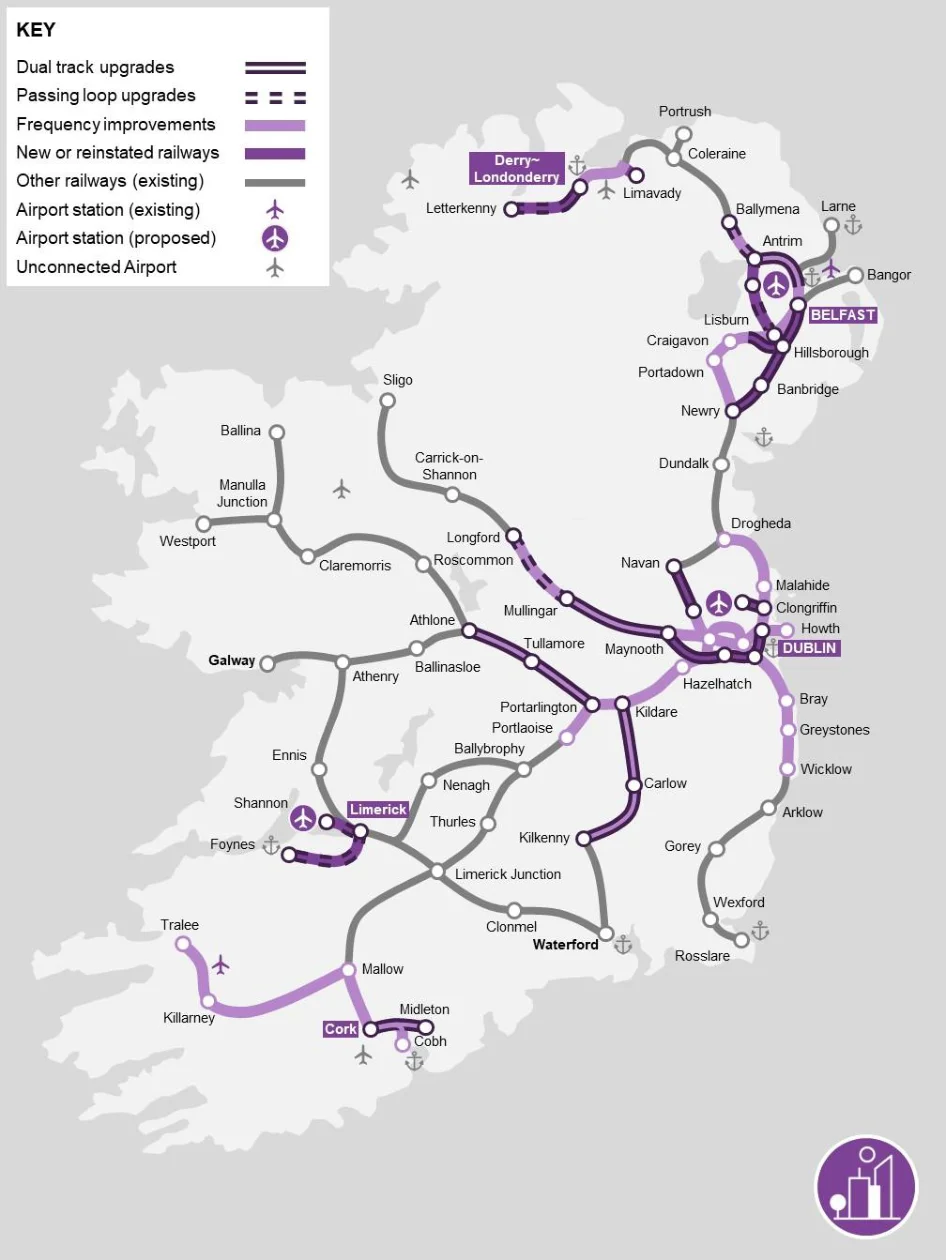
Figure 14
Figure 14 Sustainable cities heavy railway interventions
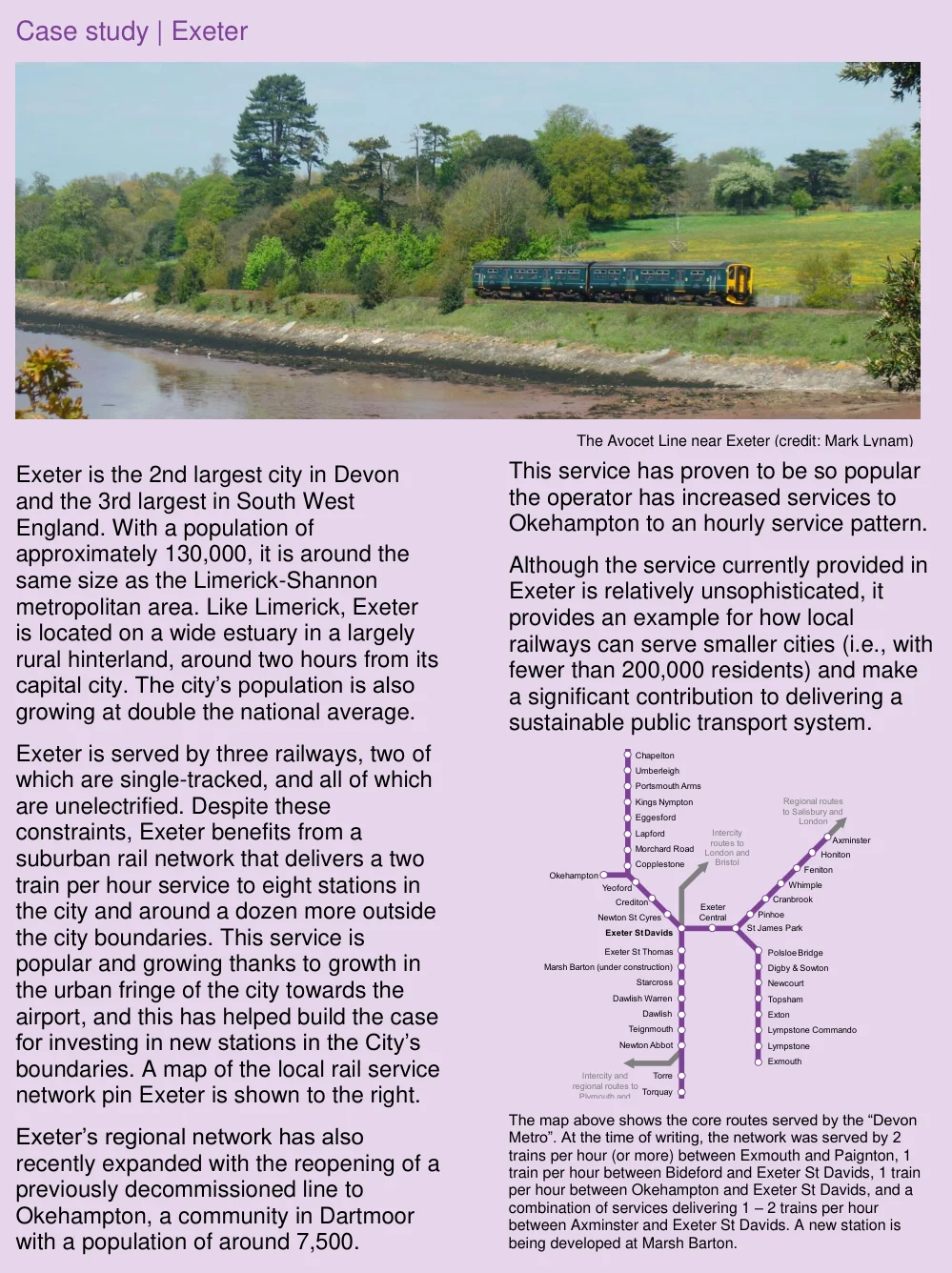
Figure from page 76
Case study | Exeter
The Avocet Line near Exeter (credit: Mark Lynam)
This service has proven to be so popular the operator has increased services to Okehampton to an hourly service pattern.
Exeter is the 2nd largest city in Devon and the 3rd largest in South West England. With a population of approximately 130,000, it is around the same size as the Limerick-Shannon metropolitan area. Like Limerick, Exeter is located on a wide estuary in a largely rural hinterland, around two hours from its capital city. The city’s population is also growing at double the national average.
Although the service currently provided in Exeter is relatively unsophisticated, it provides an example for how local railways can serve smaller cities (i.e., with fewer than 200,000 residents) and make a significant contribution to delivering a sustainable public transport system.
Exeter is served by three railways, two of which are single-tracked, and all of which are unelectrified. Despite these constraints, Exeter benefits from a suburban rail network that delivers a two train per hour service to eight stations in the city and around a dozen more outside the city boundaries. This service is popular and growing thanks to growth in the urban fringe of the city towards the airport, and this has helped build the case for investing in new stations in the City’s boundaries. A map of the local rail service network pin Exeter is shown to the right.
Chapelton
mberleigh
Portsmouth Arms
Regional routes to Salisbury and
Kings Nympton
Eggesford
London
Intercity routes to London and
Lapford
Axminster
Morchard Road
Honiton
Bristol
Copplestone
Feniton
Okehampton
Whimple
eoford
Cranbrook
Crediton
Exeter Central
Pinhoe
Newton St Cyres
St ames Park
xeter St avids
Exeter St Thomas
Polsloe Bridge
Marsh Barton (under construction)
Digby Sowton
Starcross
Newcourt
Dawlish Warren
Topsham
Dawlish
Exton
Teignmouth
Lympstone Commando
Newton Abbot
Lympstone
Exmouth
Intercity and regional routes to
Torre
Tor uay
Plymouth and
The map above shows the core routes served by the “Devon Metro”. At the time of writing, the network was served by 2 trains per hour (or more) between Exmouth and Paignton, 1 train per hour between Bideford and Exeter St Davids, 1 train per hour between Okehampton and Exeter St Davids, and a combination of services delivering 1 – 2 trains per hour between Axminster and Exeter St Davids. A new station is being developed at Marsh Barton.
Exeter’s regional network has also recently expanded with the reopening of a previously decommissioned line to Okehampton, a community in Dartmoor with a population of around 7,500.
Pages 71–76 · View in original PDF