Regional and Rural
Regional and Rural
Approach
The island of Ireland’s railway network today is approximately half of its size at its peak. The decommissioning of railways around the mid part of the 20th century cut some rural communities off from the rail network. Additionally, interregional connectivity is poor in many places, especially in border areas.
The Review has considered options to:
•Connect as many towns with populations of 10,000 or more to the rail network as possible. These towns (including some in city regions that are out of the scope of this Review) are shown in Figure 11. A threshold of towns with a population of 10,000 was chosen as this is the threshold used by Ireland’s National Planning Framework as a definition of a “large town” and is the threshold used by Northern Ireland’s Statistics and Research Agency as the definition of a “medium town”.
It is clear from responses to the initial public consultation that there is significant stakeholder interest in restoring abandoned railways and improving connectivity in poorly served areas of the island, particularly in the North West and South East. Public policy in both jurisdictions is increasingly recognising the need to rebalance the economy away from Dublin and Belfast to enable all parts of the island to prosper.
•Directly connect each of the regions of the island of Ireland. These were defined in the “Work Package 1: Context and Policy” Report and are shown in Figure 11.
•Improve intraregional connectivity. There are several “missing links” within the regions that could support important inter and intra-regional journeys (also shown in Figure 11).
•Linked to the cost, they would have a significant adverse impact on the natural environment. As an example, the Review considered multiple opportunities for boosting connectivity in the North West of the island but ruled out options that would cut through the Sperrins Area of Outstanding Natural Beauty.
To achieve the aims outlined above, the Review examined options for reinstating former railways and building new railways across the whole island of Ireland. The Review sifted these options and grouped them into four geographical regions:
•Northern Ireland;
•West Coast;
•The Review’s assessment of the carbon impact of some packages of interventions found that some options might generate more carbon emissions through their construction than would be offset through attracting more people to the railway from less sustainable travel options.
•South Coast; and
•North Midlands.
Short listed options were then assessed (as “packages”), costed, and appraised against the Review’s Goals and Objectives. Some options were found to be unviable because:
•They do not align with local planning policy. The Review has not taken forward options to develop new railways that contradict the National Transport Authority’s metropolitan strategies, Northern Ireland Executive policies, or on alignments that local authorities consider to be better suited to alternative modes.
•They would not attract enough demand (within the Review’s horizon up to 2050) to justify having a regular passenger rail service. In many cases, lower cost public transport options such as buses and coaches may provide a better service than a highly infrequent rail service.
•They would be highly costly to deliver. This is especially the case for potential rail routes that cut through challenging terrain (which is common in coastal areas around the island).
A full list of the options that were considered, along with rationale for why some were taken forward and why others were not, is provided in Appendix B. The options recommended for further study are discussed in more detail below.
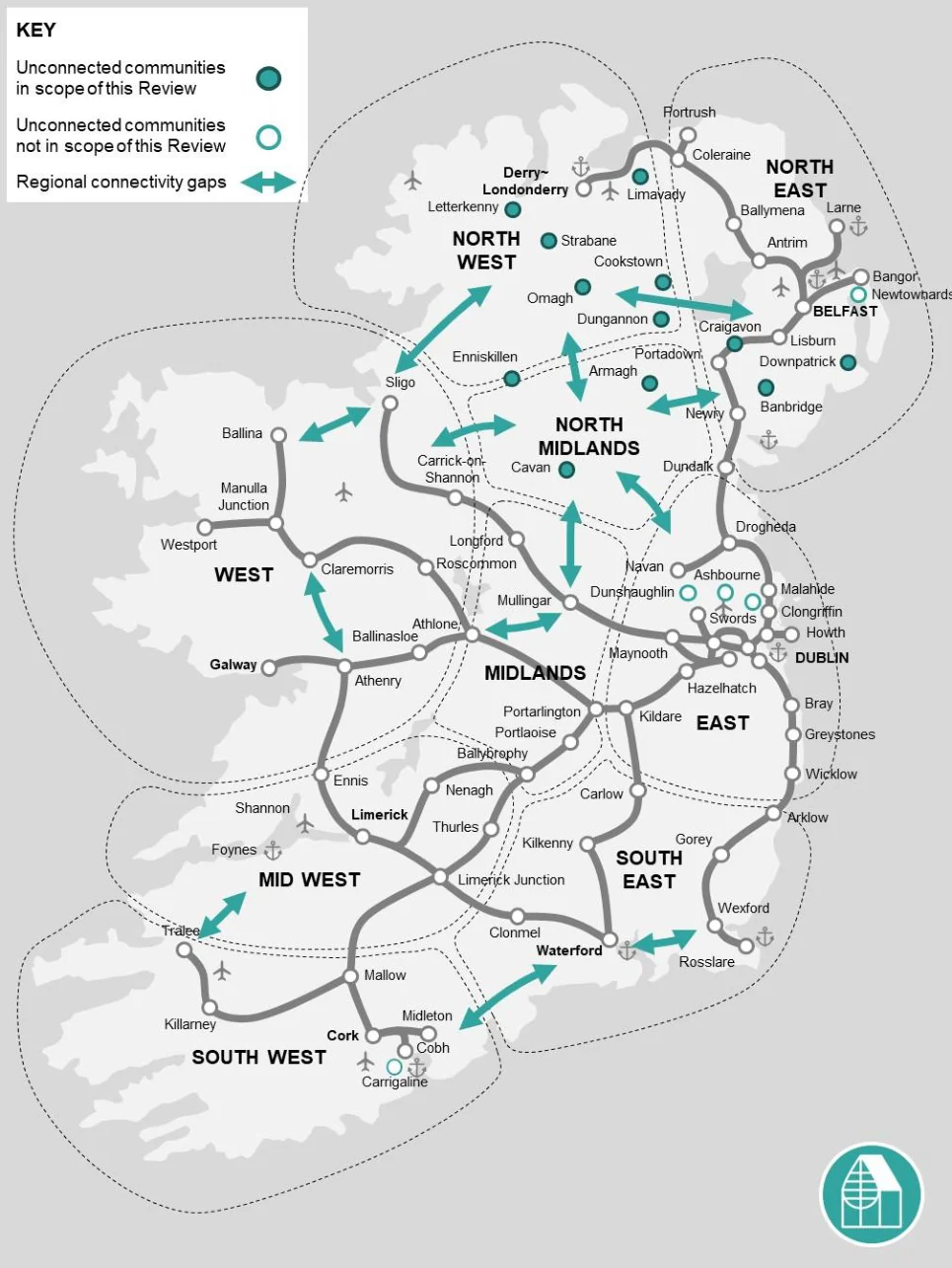
Figure 11
Figure 11 Regional and rural connectivity challenges
Northern Ireland
The railway network in Northern Ireland is centred on Belfast and is mostly confined to the area east of the River Bann. Service patterns are reasonably frequent in the core of the network, with half hourly services all day on lines connecting Belfast with Portadown, Bangor, and Whitehead and hourly services to Derry~Londonderry, Portrush, and Larne. Enterprise services between Belfast and Dublin run around once per two hours.
Given the large gaps in the existing network, and the number of large settlements currently unserved, there are many opportunities to enhance and grow the rail network in Northern Ireland. The Review has considered improved intercity connections for Belfast and Derry~Londonderry, both between the two cities themselves and onwards to Dublin and Galway. Many regional and rural lines have also been considered that reconnect larger settlements and restore regional links to the Midlands and the West of Ireland.
The existing network has several constraints, which reduce the quality of service. None of the network is electrified and large portions are single track, particularly the lines from Whiteabbey to DerryLondonderry and Downshire to Larne along with the Dargan Bridge in Belfast. Level crossings in places such as Lurgan and poor alignments such as the line between Portadown and Newry limit speeds and capacity. Online upgrades are very challenging on some existing alignments, such as the coastal route between DerryLondonderry and Coleraine. Congestion on routes into Belfast and Dublin also limits the speed and frequency of the Enterprise service between the island’s two largest cities.
Some of the options considered were found to have limited viability for rail services within the horizon of the review. Physical constraints ruled out some options, such as the Sperrin Mountains ruling out Cookstown as a stop on a service from Derry~Londonderry to either Belfast or Dublin. In other cases, remoteness from population centres was the major factor, particularly for routes serving Enniskillen where anticipated travel demand is unlikely to justify the cost of delivering rail services at this time.
Rail services to locations such as Newtownards would function as commuter links to Belfast and thus fell outside the scope of the Review. Future Local and Regional Transport Plans could consider how Belfast’s public transport network can better serve these places.
In addition to constraints on the existing network, its sparseness leaves many large settlements entirely unserved by rail. The west of Northern Ireland was one of the areas worst affected by rail closures in the mid-twentieth century, and large settlements such as Armagh, Cookstown, Dungannon, Enniskillen, Omagh, and Strabane have had no rail services for decades. There are also large towns further east with no rail access despite their proximity to Belfast, mostly in County Down including Banbridge, Downpatrick, and Newtownards.
The Review has identified several opportunities in Northern Ireland where rail is well-placed to improve connectivity.
West Coast
While many of the larger settlements along the west coast of Ireland are served by the railway network, these are along three distinct lines linking Galway, Westport/Ballina, and Sligo to Dublin without direct services between the main settlements in the region. Links to other regions are also limited, with the line linking Athenry to Limerick the only one that does not run to Dublin. Service frequencies are fairly low, with only between five and nine services per weekday in each direction. The region is the source of much of the island’s existing freight on the routes from Ballina and Westport to Waterford and Dublin.
These opportunities include:
•Restoring the rail line between Derry ~ Londonderry and Portadown. This would link the large towns of Strabane, Omagh, and Dungannon to the rail network and greatly improve intercity connectivity between Derry~Londonderry and both Dublin and Belfast.
Figure from page 63
•Reinstating the railway from Portadown to Armagh, Cavan, and Mullingar. This would reconnect many towns to the network and boost connectivity between Northern Ireland, the Midlands, and the West.
Further to the north there have been no rail services in County Donegal since the mid-twentieth century, although the county once had an extensive network – albeit narrow gauge rather than Irish gauge. The Western Rail Corridor connecting Limerick to Sligo, which was closed to scheduled passenger services in the 1960s and 1970s, had been expected to reopen as far north as Claremorris in the 2007-2013 National Development Plan. However, with the onset of the 2008 financial crisis, only the section between Ennis and Athenry was completed.
•Building a new direct linebetween Lisburn and Newry, together with a tunnel from Adelaide to the Lisburn area. This would improve journey times and deliver much needed capacity on the Belfast-Dublin route, while also providing rail services to Banbridge and Dromore.
•Electrifyingmuch of the network, which would contribute to decarbonisation and improve journey times on existing lines.
•Integrating bus and rail ticketing and timetabling. This would enable people in areas without direct rail services, such as Enniskillen, to seamlessly connect with the rail network for longer journeys.
The Review has considered several options to improve connectivity both within the region and to and from adjacent regions. These have included increasing frequencies to a minimum of once per two hours on all routes, and hourly or better on many lines. Targeted speed improvements and double tracking between Athenry and Galway have also been evaluated.
Many new lines have been assessed, including routes linking Derry~Londonderry to Sligo via Letterkenny, Sligo to Galway via Claremorris, and Sligo to Enniskillen and onwards to Portadown and Belfast via either Clones or Omagh.
These interventions include:
•Improving services between Galway and Dublin, Limerick, Cork and Waterford – together with double tracking between Athenry and Galway.
•Improving service frequencies between key Mayo towns and Athlone by building more passing loops on this corridor.
Given the relatively low population density and lack of larger towns across the region, the Review has found that expansion of rail is difficult to justify in much of the region within the horizon of the Review. Furthermore, there is challenging terrain in many parts of the region – for instance, a line between Sligo and Derry-Londonderry would require complex crossings of the River Garavogue and River Erne and then a route through the Barnesmore Gap. The relatively low level of anticipated demand suggests that rail is not the appropriate solution to improve connectivity along many of the routes assessed.
•Restoring the rail line between Athenry and Claremorris. This would be particularly beneficial for freight, allowing a direct route for freight from Ballina and Westport to ports on the South Coast that avoid the most congested part of the rail network around Dublin. This would also reconnect Tuam to the railway and enable direct services between Galway and Mayo.
•Developing a new rail link from Letterkenny to Derry~Londonderry. This would connect the major urban centres of the North West to each other and greatly improve access to Belfast and Dublin.
While many options for developing new railways in the region are unlikely to be viable within the horizon of this Review, the Review has identified several interventions that could have potential.
South Coast
There are several constraints that make it challenging to improve passenger and freight access to the South East. Much of the railway is single track, limiting opportunities to increase service frequencies. Rail alignments are poor, limiting opportunities to increase speeds.
While the South West of Ireland has relatively good connectivity to Dublin, the South East is more isolated, and connectivity between the South Coast cities of Cork and Waterford is poor.
The South East of Ireland is connected to the railway by a largely single-track railway that runs south of Dublin to Rosslare Europort via Wexford. The railway is intensely used by the DART service between Dublin and Greystones. Between Greystones and Rosslare Europort, however, the railway is lightly used by passenger services (around 4 – 5 trains per day each direction). The towns of Wicklow, Arklow, Gorey, Enniscorthy, and Wexford, as well as Rosslare Harbour, are therefore poorly served by rail. Journey times from Rosslare Europort to Dublin are currently around 3 hours.
There are also significant conflicts with DART services, particularly between Dublin and Greystones, and there are significant geographical constraints limiting potential diversions (e.g., Bray Head).
Despite these challenges, there are opportunities for growing the role of rail in this region. Over 300,000 people live in County Wexford and County Wicklow, and Rosslare Europort is growing following changes to trading arrangements between Ireland, the UK, and the European Union.
Rail connectivity in the South East has declined in recent years with the closure of the South Wexford Railway in 2010. Furthermore, the line from Waterford to Limerick Junction has only two services per day per direction and has many speed restrictions, hampering connections to Limerick and Cork.
The Review has considered interventions to enable faster and more frequent journeys between Rosslare Europort and Dublin, including adding passing loops, tunnelling through Bray Head, developing a new railway along the M11 corridor, and building a new line for DART services along the N11 corridor. A more direct route between Cork and Waterford was also considered but found to be impractical due to the geography of this corridor.
A map of these proposals is shown in Figure 12.
Many of these solutions would be very costly and are unlikely to be justifiable as most railways in this region would not be expected to support more than one or two trains per hour in each direction.
It appears that the best way forward for boosting connectivity in the South East of Ireland in the shorter term is to introduce an hourly shuttle service between Wexford and Greystones, with DART services to be extended to Wicklow.
Figure 12 South East Ireland
Connectivity could be further improved by reinstating the railway between Waterford and Rosslare (including a chord/curve to the south of Wexford) and extending some Dublin – Waterford intercity services to a new station to the south of Wexford O’Hanrahan once the line between Heuston and Waterford has been upgraded. With improvements to the intercity corridors described above, this would reduce journey times between Dublin and Wexford by around an hour. This intervention would also support further development of freight services to and from Rosslare Europort.
Improving the Waterford to Limerick Junction line would also improve connectivity between the South East and cities to the South and West. This railway could deliver significant benefits for freight services, which could access the North West without needing to pass through Dublin or turn back at Kildare.
Furthermore, installing a curve at Limerick Junction would enable trains to leave the Cork – Dublin line and join the Limerick – Waterford line, which would boost passenger rail connectivity between Cork and Waterford.
North Midlands
Given its central location, restored rail links through the region would also help integrate other regions across the island. The Review considered direct services from Belfast to Galway that would link the West and North East to each other in addition to connecting the communities along the way. Lines through the region would also deliver alternative freight paths to Northern Ireland that avoid the most congested parts of the network around Dublin, improving the reliability of both passenger and freight services across the network.
Bisected by the border, the North Midlands region is centred on parts of counties Armagh, Cavan, Fermanagh, and Monaghan. It saw large scale closures to its rail network in the midtwentieth century and today is entirely unserved by rail. This is despite the region containing several large towns that are relatively close to the two largest cities on the island – Dublin and Belfast.
The Review considered the potential of rail to serve several functions within the region. One of these would be to connect communities within the region to each other and to their nearest major cities of Belfast, Dublin, and Galway. Public transport and road connections within the region are often poor compared to other parts of the island which impacts on its economic competitiveness. Large settlements such as Armagh and Cavan are within the commuting catchment of Belfast and Dublin and restored rail links would have a beneficial impact on access to employment, third level education, healthcare, and international gateways.
The Review has found that while anticipated demand (within the Review’s horizon) fell below the threshold for rail on some routes, such as from Clones to Sligo via Enniskillen, there is potential for rail in certain parts of the region. While through services from Belfast to Galway were not found to generate high demand, demand towards Dublin and between Armagh and Belfast was sufficient to support rail services. Combined with the restoration of rail services on the line between Mullingar and Athlone this line would greatly increase inter-regional accessibility across the northern half of the island.
Recommendations
To deliver the regional and rural Goals and Objectives of this Review, both governments should develop plans to develop the interventions shown in Figure 13 and listed below:
•Extend the railway into Tyrone, DerryLondonderry, and Donegal. Reinstating the railway between Portadown, Dungannon, Omagh, Strabane, DerryLondonderry, and Letterkenny would connect the railway to many communities and support direct services between Dublin, Belfast, Derry~Londonderry, and Letterkenny.
13
•Provide more direct services between Ireland’s West and South Coasts – e.g., between Galway, Limerick, and Cork.
8
•Ensure regional and rural lines have at least one train per two hours (at regular times) – and hourly services between Galway, Limerick, Cork, and Waterford.
9
•Reinstate the South Wexford Railway to boost connectivity in the South East.
14
•Develop the railway to boost connectivity in the North Midlands. Reinstating the railway between Portadown, Cavan, Mullingar, and Athlone would address several regional connectivity gaps. Building a new link between Maynooth and Adamstown and dualling the railway to Mullingar would also add capacity to support services to this region.
•Increase line speeds to at least 120km/h (75mph) – this would deliver significant benefits for communities across the island.
15
10
•Upgrade Limerick Junction and the Limerick Junction – Waterford line. This will support freight services between the South Coast ports, Foynes, and the North West. With a chord at Limerick Junction, it will support direct Cork – Waterford services.
11
•Integrate bus service and rail service timetables to connect communities where direct rail access is unviable – bus services can help new railways boost public transport connectivity to places like Donegal, Enniskillen, Cookstown, and Downpatrick.
16
•Reinstate the Western Rail Corridor railway between Claremorris and Athenry. This will support freight and regional connectivity objectives in the West of Ireland.
12
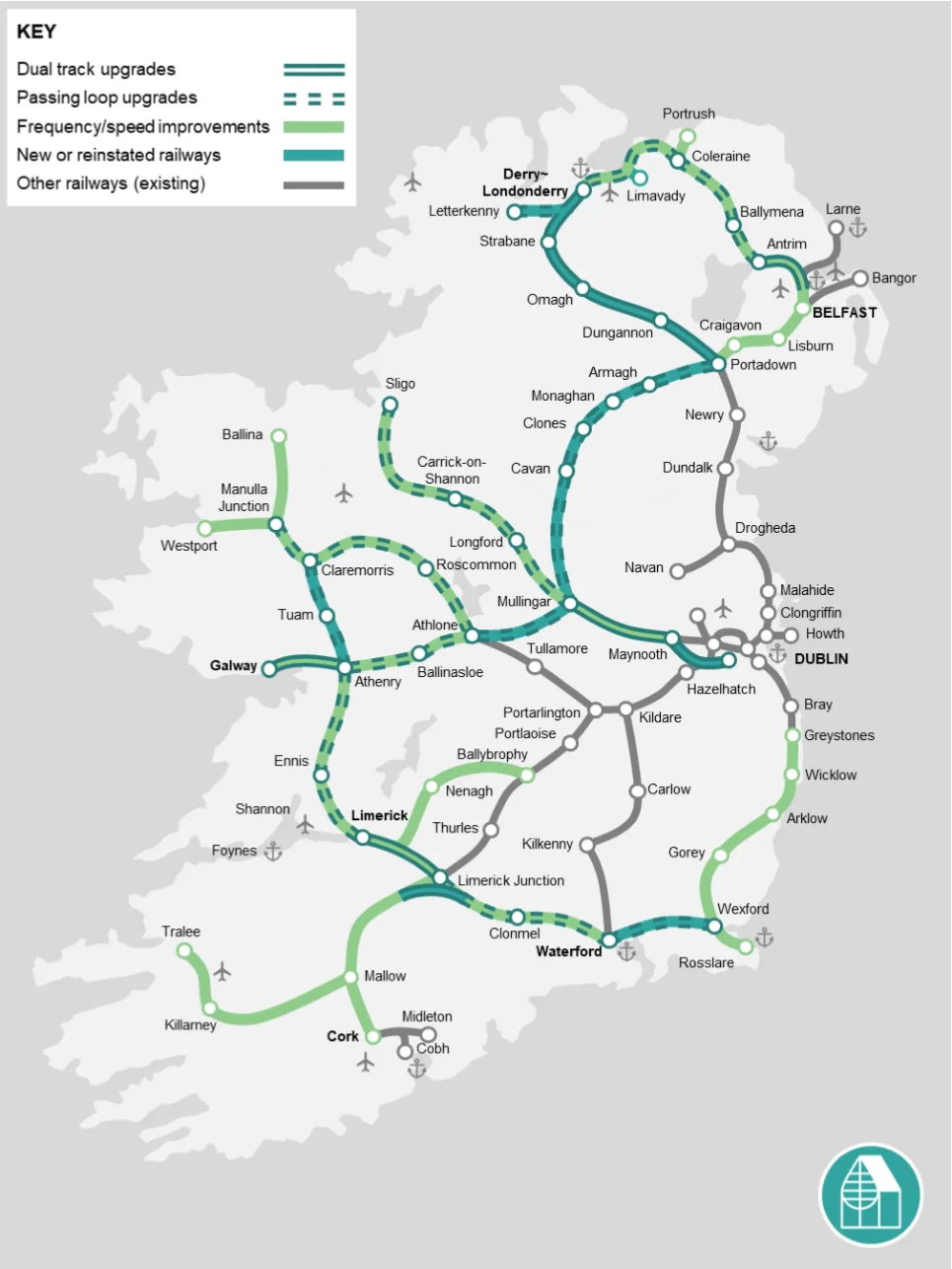
Figure 13
Figure 13 Regional and rural interventions
Case study | Scottish Borders Railway
The Borders Railway at Galashiels (Photo: Walter Baxter, Creative Commons)
The Borders Railway serves a northsouth corridor in the South East of Scotland connecting the city centre of Edinburgh with settlements to the South East of the city, Midlothian, and the Borders. The corridor runs c. 50km from Edinburgh City Centre to the village of Tweedbank in the Borders. This railway was closed in 1969 and partially reopened in September 2015.
This demand has exposed the ‘basic’ infrastructure and caused overcrowding which would not have been an issue had actual demand mirrored the forecasted demand. While high demand should be seen as a success, the failure to anticipate this demand has meant that the Borders Railway has effectively capped its capacity. Some of the constraints built into the infrastructure also presents longterm challenges in decarbonising the railway.
The Business Case for reinstating this railway was borderline (at best), and the Final Business Case reported a Benefit to Cost Ratio of 0.5 – 0.7 in 2012. The railway specification was limited to an unelectrified, single-track railway, reflecting relatively cautious demand forecasts.
The good news is that, despite some of the challenges presented by infrastructure capacity constraints, it has been possible to increase service frequencies to two trains per hour during peak hours. There are also long-standing plans to extend the railway across the border to Carlisle, which would enable the railway to take on a greater role as an inter-regional railway.
In reality, demand for the Borders Railway far exceeded expectations. It became so popular that the annual return journey demand in the first year alone was 75% greater than estimated in the Business Case, which assumed just under 650,000 passengers would use the railway in its first year of operation. This grew to 1.7 million journeys in 2018/19.
It is a difficult balance to strike between future proofing infrastructure and minimising exposure to perceived goldplating. In this sense, the borders railway offers a cautionary tale for pessimists.
Pages 59–70 · View in original PDF