Decarbonisation
Decarbonisation
now. The proposed approach to decarbonising the island’s railway is therefore based on proven, available solutions. At the time of writing, the strategic options available for decarbonising the island’s railways that appear to be most viable are:
Both jurisdictions on the island of Ireland are committed to achieving net-zero carbon emissions by 2050. Rail has the potential to play a major role in decarbonising the island’s transport networks in two ways – by encouraging people to switch from carbon emitting modes to rail, and by reducing the emissions from the wider rail system. However, in contrast to many EU countries, the island’s rail network is currently highly reliant on diesel traction. This is a challenge for both passenger and freight transport.
•Electrified railways: Electric traction is proven, widely used, and supported by relatively strong supply chains. It can support passenger trains and freight trains over long distances, at high speed, and without refuelling. However, this option requires significant investment in infrastructure such as Over Head Line Equipment (OHLE). Ireland is currently investing heavily in expanding OHLE for the DART service in the Dublin area, which will increase the length of electrified railway from circa 50km to 150km (around 5% of the island’s railway route length).
Figure from page 49
Decarbonising the railways will require action on construction, operations, maintenance, and renewals. The construction industry is leading on decarbonising construction, maintenance, and renewals. This Review has generally focused on decarbonising operations, although it has also considered and estimated the impact of embodied carbon arising from developing new railways.
•Battery electric trains: Battery electric trains have been proven at a relatively small scale. These are suited to operating short distances but cannot currently support higher speed (i.e., 200km/h) passenger trains or freight trains over long distances.
The scope of this Review does not include developing a detailed decarbonisation strategy for the island’s railways. That said, the Review has developed a plausible approach for decarbonising the island’s railways by drawing on insights from Great Britain’s Traction Decarbonisation Network Strategy and Denmark’s Togfunden programme.
•Hydrogen powered trains: This technology is earlier in its development cycle, but the signs are promising. Hydrogen trains have been shown to work in a live operating environment, although the economics of adopting this technology at scale are less clear. This technology could support passenger services over relatively long distances in areas with relatively easy access to hydrogen production and storage.
Strategic options
There is a wide range of emerging technologies under development that could, in the long term, play a significant role in delivering carbon neutral rail transport. However, if both jurisdictions are to achieve their commitments to fully decarbonise their economies by 2050, then it is imperative that action is taken
•Hybrid trains are likely to be needed while the network electrifies. Hybrid trains can operate on electric and nonelectric railways, whereas electric only vehicles can only operate when endto-end routes are electrified. Most hybrid trains produced today run under diesel and electric traction, but future trains may include hydrogen traction. Ultimately, the goal should be to eliminate diesel altogether. Hybrid trains are in high demand globally, so the market should be able to provide these for the island.
Based on the opportunities and limitations presented by the technological options outlined above, the Review has attempted to define which sections of the railway network are best suited to electrification, battery electric, hydrogen, and multiple options.
In general, it appears that OHLE is needed to deliver long-distance, highspeed passenger services, whereas alternative traction options may be more viable for slower and/or shorter journeys. This suggests OHLE should be considered the leading option for decarbonising corridors used by intercity services, while alternatives could be considered elsewhere. Figure 9 shows how this approach might look if it were rolled out across the whole island.
•OHLE Alternating Current (AC) voltage is desirable for high-speed operations. The expanding DART network is powered by 1500V Direct Current (DC) OHLE and, while there are advantages in rolling out DART traction beyond Dublin, there are drawbacks to this approach. It is likely to cost more and may not deliver enough power to support 200km/h services, so it is likely that DART will operate to a different traction system to electric intercity services.
Further considerations
There are further issues to consider, which will ultimately shape the island’s approach to decarbonising the railway:
•The island will need a green electricity grid to deliver a truly netzero carbon railway. The rail industry could support this process by investing in renewable power sources on their estates, switching to “green” energy providers, investing in low carbon vehicles (road, plant, and rail), and reducing the consumption of resources through moving to a circular economy.
•Delivering electrification will take time and investment. A rolling programme of electrification will require skills, capacity, robust supply chains, and certainty of long-term investment. Experience from overseas suggests a “stop-start” approach to electrification yields significantly higher unit costs than a steady, rolling programme.
Recommendations In summary, to achieve the decarbonisation Goals and Objectives of this Review, governments in both jurisdictions should:
•Develop plans to invest in the skills, supply chains, and rolling stock to deliver decarbonisation. This will help control the costs of what is likely to be a significant long-term investment in the island’s railways.
2
•Develop and implement an All- Island Rail Decarbonisation Strategy that, as a minimum, includes an electrified intercity network. This should determine which decarbonisation solutions should be adopted for each part of the railway, recommend a common set of standards to be applied across the whole island, and provide a roadmap for decarbonising the railway by 2050.
1
•Procure hybrid and electric rolling stock in the medium term. Given the long lead in times for the procurement and delivery of rolling stock, and its relatively long operational life, it is recommended that planning for electric and hybrid traction across the island should start soon.
3
The map provided in Figure 9 provides a plausible outcome that might be delivered by this Strategy, which assumes core intercity routes would be electrified with OHLE, while regional lines could be served by hybrid solutions, such a battery and/or hydrogen operated trains.
Case Study | Hydrogen Trains
While electric and battery operated trains could play a major role in decarbonising the island of Ireland’s railways, there also may be a role for hydrogen in some parts of the island, particularly on longer distance routes that serve rural areas, where the business case for investing in OHLE may be weak. There are examples of hydrogen trains in passenger use across Europe, including in Germany and Italy. An example of a hydrogen train in commercial operation – in this case Alstom’s Concordia Stream Hydrogen model – is shown to the right.
A hydrogen powered passenger train (Credit: Alstom)
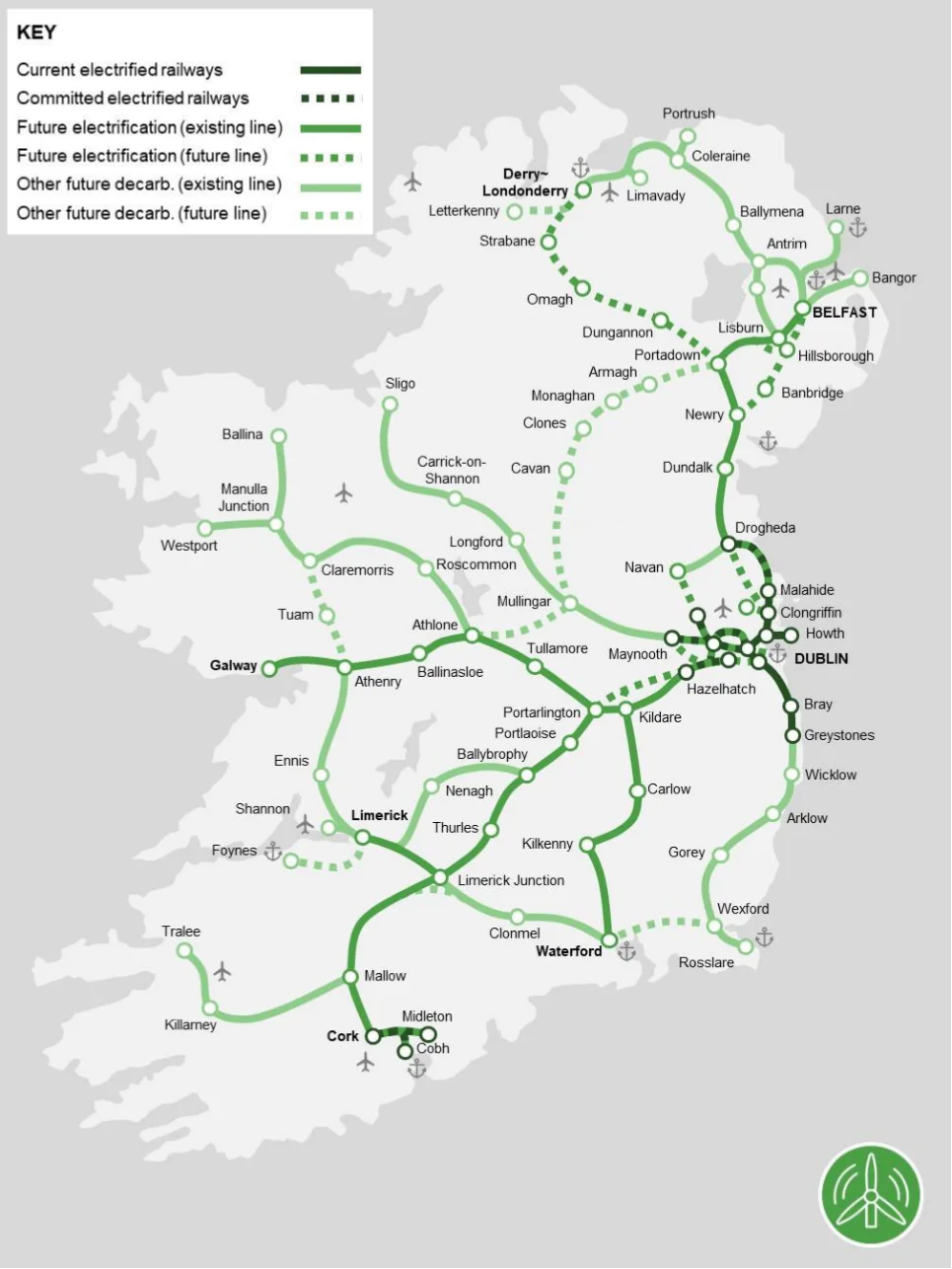
Figure 9
Figure 9 Decarbonisation interventions
Pages 49–52 · View in original PDF