Chapter 4 | Recommendations

Figure from page 43
Figure from page 44
Introduction
Recommendations
This Chapter presents plausible choices for policymakers that, together, provide a route to achieving the Review’s Goals and Objectives. In doing so, this Chapter presents a set of recommendations and summarises the case for taking them forward to the next stage of development.
In this Chapter recommendations are presented by themes, which broadly align to the Review’s Goals and Objectives. Table 2 list the 32 recommendations that are presented in this Chapter and Figure 8 shows how a potential future railway would look in 2050 if all these recommendations were delivered.
Consistent with the introduction to this Report, the recommendations provided below do not represent official policy for either jurisdiction, but aim to provide a constructive, evidence-based approach for delivering the Goals and Objectives of this Review. Furthermore, this Report does not make firm recommendations about the timing for delivering options, although a plausible Roadmap is presented in Chapter 6. Ultimately, it will be for policymakers in both jurisdictions to decide which of the plausible options presented in this Chapter should be taken forward at any time.
The estimated capital, operating, and maintenance costs of the infrastructure interventions presented in this chapter are summarised in Chapter 5. These costs exclude recommendations relating to freight access charges and customer experience. Any option referenced in this chapter but not listed as a recommendation is not included in these cost estimates.
In total, the Review examined over 70 geographically specific options and assessed their feasibility, economic viability, and contribution to the Review’s Goals and Objectives. Around half of these options were progressed and are presented in this Chapter.
Appendix B provides details about the process the Review followed to develop its recommendations and explains why some options were not progressed. Further details about the options that were considered but ruled out are also provided in this Appendix.
As required under Annex I of the SEA Directive (2001/42/EC), mitigation measures and monitoring measures are proposed to address potential negative effects arising from the implementation of the Review. The Directive has been transposed into Irish law under Statutory Instrument No. 436 of 2004 (the Planning and Development (Strategic Environmental Assessment) Regulations 2004), as amended; and Northern Irish law under the Environmental Assessment of Plans and Programmes Regulations (Northern Ireland) 2004.
Statutory strategy alignment
The Review notes that the Greater Dublin Area (GDA) Transport Strategy has recently been adopted in accordance with Section 11 of the Dublin Transport Authority Act 2008. The Strategy sets out a statutory framework for the development of transport across the Dublin region up to 2042. The recommendations set out in this Chapter are intended, within the GDA, to represent potential additional complementary provision which could be considered for inclusion in future updates to the GDA Transport Strategy. It is acknowledged that this Strategy is the statutory plan for the development of transport within the GDA. It is intended that this Report will be an input for the next review of the GDA Transport Strategy within the next six years.
Mitigation and monitoring measures are proposed by the SEA Environmental Report under the following environmental topics:
•Population and Human Health;
•Biodiversity;
Strategic Environmental Assessment and Appropriate Assessment
•Land and Soils;
•Water;
•Air and Climate;
A Strategic Environmental Assessment (SEA) and Appropriate Assessment (AA) of the All-Island Strategic Rail Review have been carried out to ensure environmental considerations have been incorporated into the Review. Any new projects or plans arising from the implementation of this Review shall be subject to appropriate feasibility, options and environmental assessments where required.
•Archaeological, Architectural and Cultural Heritage;
•Landscape and Visual;
•Material Assets; and
•Noise. Mitigation and monitoring measures are also proposed by the Appropriate Assessment completed of the Review. All sets of measures shall be adhered to in full during the implementation of this Review.
All mitigation and monitoring measures are outlined in Appendix C of this Review, and in the SEA documents and Appropriate Assessment Report (Natura Impact Statement) which are published alongside this Review.
| Decarbonisation recommendations | ||
|---|---|---|
| 1. Develop and implement an All-Island Rail | ||
| Decarbonisation Strategy that includes an | ||
| electrified intercity network. | ||
| 2. Develop plans to invest in the skills, supply | ||
| chains, and rolling stock to deliver | ||
| decarbonisation. | ||
| 3. Procure hybrid and electric rolling stock in | ||
| the medium term. | ||
| Intercity recommendations | ||
| 4. Upgrade the cross-country rail network to a | ||
| dual-track railway (and four-track in places) | ||
| and increase service frequencies. | ||
| 5. Upgrade the core intercity railway network to | ||
| top speeds of 200km/h (125mph). | ||
| 6. Develop short sections of new railways on | ||
| congested corridors. | ||
| 7. Develop a cross-Dublin solution. | ||
| Regional and rural recommendations | ||
| 8. Provide more direct services between | ||
| Ireland’s West and South Coasts. | ||
| 9. Ensure regional and rural lines have at least | ||
| one train per two hours. | ||
| 10. Increase line speeds to at least 120km/h | ||
| (75mph). | ||
| 11. Upgrade Limerick Junction and the Limerick | ||
| Junction – Waterford line. | ||
| 12. Reinstate the Western Rail Corridor railway | ||
| between Claremorris and Athenry. | ||
| 13. Extend the railway into Tyrone, | ||
| Derry~Londonderry, and Donegal. | ||
| 14. Reinstate the South Wexford Railway. | ||
| 15. Develop the railway to boost connectivity in | ||
| the North Midlands. | ||
| 16. Integrate bus service and rail service | ||
| timetables to connect communities where | ||
| direct rail access proves to be unviable. |
| Sustainable cities recommendations | |||
|---|---|---|---|
| 17. Connect Dublin, Belfast International, and | |||
| Shannon Airport to the railway and improve | |||
| existing rail-airport connections. | |||
| 18. Extend double tracking in the Belfast area. | |||
| 19. Segregate long-distance/fast services from | |||
| stopping services. | |||
| 20. Explore the case for developing new stations | |||
| in the Belfast, Cork, Derry~Londonderry and | |||
| Limerick – Shannon city regions. | |||
| Freight recommendations | |||
| 21. Develop a sustainable solution for first-mile- | |||
| last-mile rail access for Dublin Port. | |||
| 22. Reduce Track Access Charges for freight. | |||
| 23. Strengthen rail connectivity to the island’s | |||
| busiest ports. | |||
| 24. Develop a network of inland terminals close | |||
| to major cities on the rail network. | |||
| Customer experience | |||
| recommendations | |||
| 25. Continue to invest in initiatives that deliver a | |||
| seamless customer journey. | |||
| 26. Continue to benchmark and monitor service | |||
| quality and deliver continuous improvement. | |||
| 27. Ensure future rolling stock specifications are | |||
| aligned to the infrastructure-led interventions | |||
| outlined in this Review. | |||
| 28. Invest in improving integration within rail and | |||
| between rail and other transport options. | |||
| 29. Deliver ‘clock-face’ timetable calling patterns. | |||
| 30. Develop cross-border structures to improve | |||
| the effectiveness of cross-border | |||
| infrastructure and rail service planning. | |||
| 31. Invest in a rolling programme of accessibility | |||
| improvements, including step-free access. | |||
| 32. Review and update the All-Island Strategic | |||
| Rail Review once a decade, taking account | |||
| of latest policies and developments. |
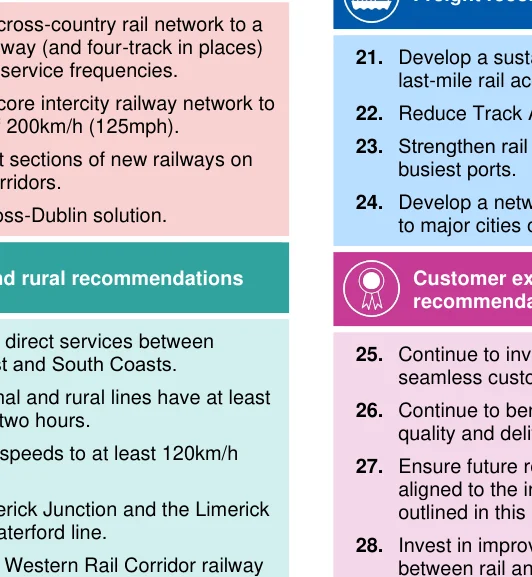
Figure from page 47
Table 2 List of the Review’s recommendations
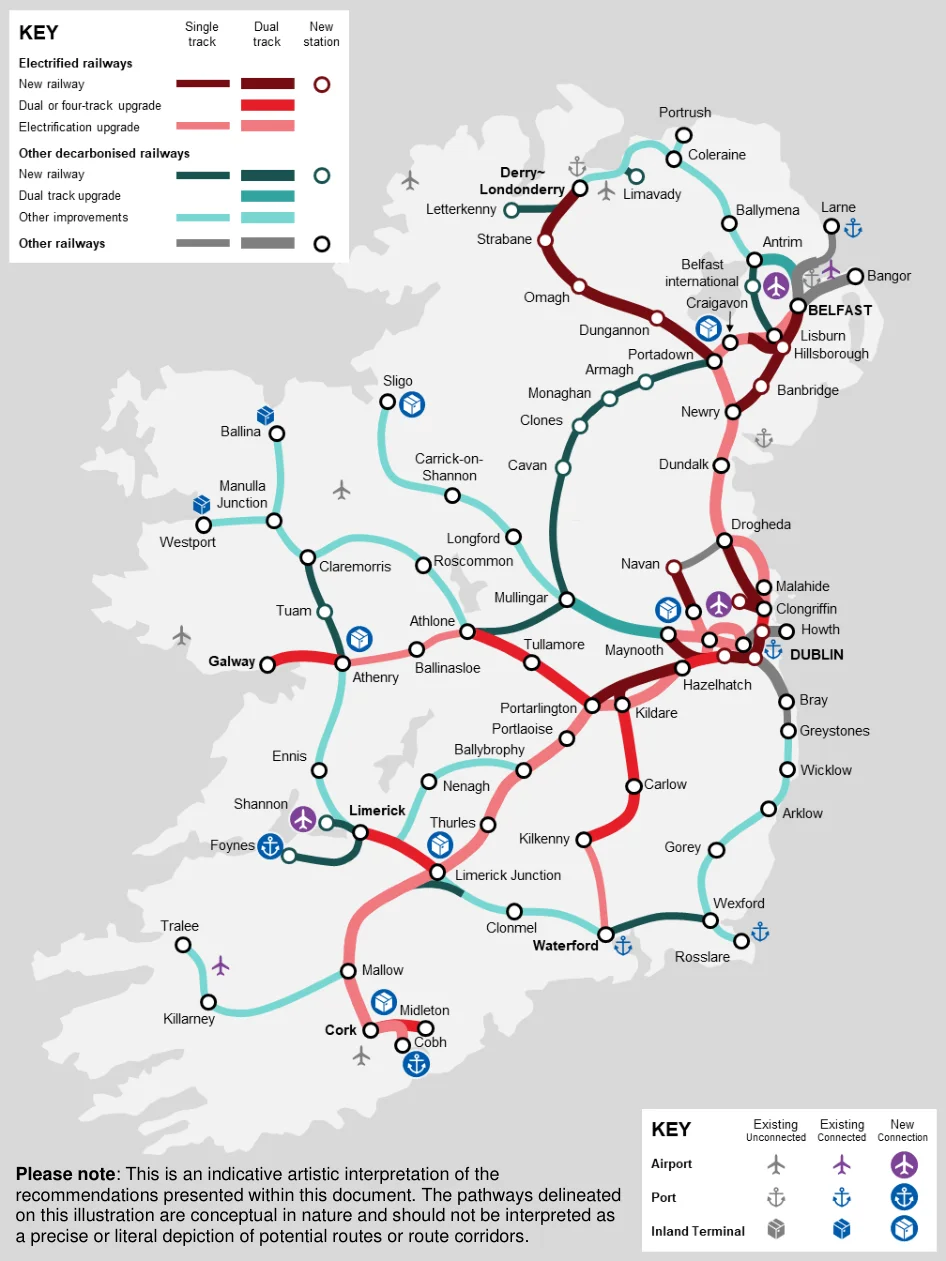
Figure 8
Please note: This is an indicative artistic interpretation of the recommendations presented within this document. The pathways delineated on this illustration are conceptual in nature and should not be interpreted as a precise or literal depiction of potential routes or route corridors.
Figure 8 A potential future railway on the island of Ireland
Decarbonisation
now. The proposed approach to decarbonising the island’s railway is therefore based on proven, available solutions. At the time of writing, the strategic options available for decarbonising the island’s railways that appear to be most viable are:
Both jurisdictions on the island of Ireland are committed to achieving net-zero carbon emissions by 2050. Rail has the potential to play a major role in decarbonising the island’s transport networks in two ways – by encouraging people to switch from carbon emitting modes to rail, and by reducing the emissions from the wider rail system. However, in contrast to many EU countries, the island’s rail network is currently highly reliant on diesel traction. This is a challenge for both passenger and freight transport.
•Electrified railways: Electric traction is proven, widely used, and supported by relatively strong supply chains. It can support passenger trains and freight trains over long distances, at high speed, and without refuelling. However, this option requires significant investment in infrastructure such as Over Head Line Equipment (OHLE). Ireland is currently investing heavily in expanding OHLE for the DART service in the Dublin area, which will increase the length of electrified railway from circa 50km to 150km (around 5% of the island’s railway route length).
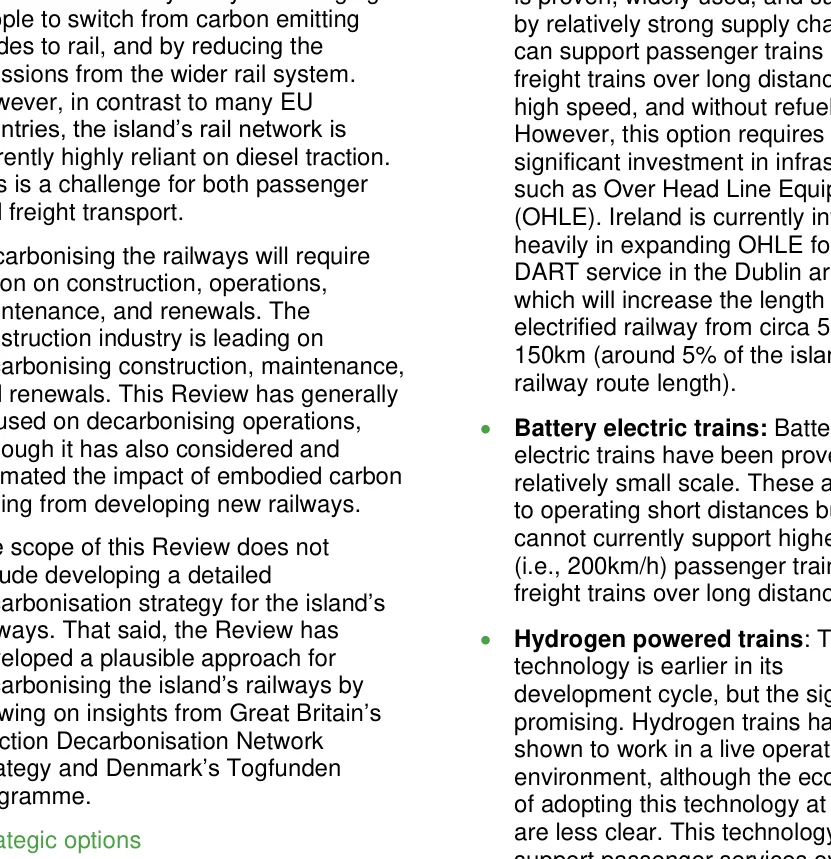
Figure from page 49
Decarbonising the railways will require action on construction, operations, maintenance, and renewals. The construction industry is leading on decarbonising construction, maintenance, and renewals. This Review has generally focused on decarbonising operations, although it has also considered and estimated the impact of embodied carbon arising from developing new railways.
•Battery electric trains: Battery electric trains have been proven at a relatively small scale. These are suited to operating short distances but cannot currently support higher speed (i.e., 200km/h) passenger trains or freight trains over long distances.
The scope of this Review does not include developing a detailed decarbonisation strategy for the island’s railways. That said, the Review has developed a plausible approach for decarbonising the island’s railways by drawing on insights from Great Britain’s Traction Decarbonisation Network Strategy and Denmark’s Togfunden programme.
•Hydrogen powered trains: This technology is earlier in its development cycle, but the signs are promising. Hydrogen trains have been shown to work in a live operating environment, although the economics of adopting this technology at scale are less clear. This technology could support passenger services over relatively long distances in areas with relatively easy access to hydrogen production and storage.
Strategic options
There is a wide range of emerging technologies under development that could, in the long term, play a significant role in delivering carbon neutral rail transport. However, if both jurisdictions are to achieve their commitments to fully decarbonise their economies by 2050, then it is imperative that action is taken
•Hybrid trains are likely to be needed while the network electrifies. Hybrid trains can operate on electric and nonelectric railways, whereas electric only vehicles can only operate when endto-end routes are electrified. Most hybrid trains produced today run under diesel and electric traction, but future trains may include hydrogen traction. Ultimately, the goal should be to eliminate diesel altogether. Hybrid trains are in high demand globally, so the market should be able to provide these for the island.
Based on the opportunities and limitations presented by the technological options outlined above, the Review has attempted to define which sections of the railway network are best suited to electrification, battery electric, hydrogen, and multiple options.
In general, it appears that OHLE is needed to deliver long-distance, highspeed passenger services, whereas alternative traction options may be more viable for slower and/or shorter journeys. This suggests OHLE should be considered the leading option for decarbonising corridors used by intercity services, while alternatives could be considered elsewhere. Figure 9 shows how this approach might look if it were rolled out across the whole island.
•OHLE Alternating Current (AC) voltage is desirable for high-speed operations. The expanding DART network is powered by 1500V Direct Current (DC) OHLE and, while there are advantages in rolling out DART traction beyond Dublin, there are drawbacks to this approach. It is likely to cost more and may not deliver enough power to support 200km/h services, so it is likely that DART will operate to a different traction system to electric intercity services.
Further considerations
There are further issues to consider, which will ultimately shape the island’s approach to decarbonising the railway:
•The island will need a green electricity grid to deliver a truly netzero carbon railway. The rail industry could support this process by investing in renewable power sources on their estates, switching to “green” energy providers, investing in low carbon vehicles (road, plant, and rail), and reducing the consumption of resources through moving to a circular economy.
•Delivering electrification will take time and investment. A rolling programme of electrification will require skills, capacity, robust supply chains, and certainty of long-term investment. Experience from overseas suggests a “stop-start” approach to electrification yields significantly higher unit costs than a steady, rolling programme.
Recommendations In summary, to achieve the decarbonisation Goals and Objectives of this Review, governments in both jurisdictions should:
•Develop plans to invest in the skills, supply chains, and rolling stock to deliver decarbonisation. This will help control the costs of what is likely to be a significant long-term investment in the island’s railways.
2
•Develop and implement an All- Island Rail Decarbonisation Strategy that, as a minimum, includes an electrified intercity network. This should determine which decarbonisation solutions should be adopted for each part of the railway, recommend a common set of standards to be applied across the whole island, and provide a roadmap for decarbonising the railway by 2050.
1
•Procure hybrid and electric rolling stock in the medium term. Given the long lead in times for the procurement and delivery of rolling stock, and its relatively long operational life, it is recommended that planning for electric and hybrid traction across the island should start soon.
3
The map provided in Figure 9 provides a plausible outcome that might be delivered by this Strategy, which assumes core intercity routes would be electrified with OHLE, while regional lines could be served by hybrid solutions, such a battery and/or hydrogen operated trains.
Case Study | Hydrogen Trains
While electric and battery operated trains could play a major role in decarbonising the island of Ireland’s railways, there also may be a role for hydrogen in some parts of the island, particularly on longer distance routes that serve rural areas, where the business case for investing in OHLE may be weak. There are examples of hydrogen trains in passenger use across Europe, including in Germany and Italy. An example of a hydrogen train in commercial operation – in this case Alstom’s Concordia Stream Hydrogen model – is shown to the right.
A hydrogen powered passenger train (Credit: Alstom)
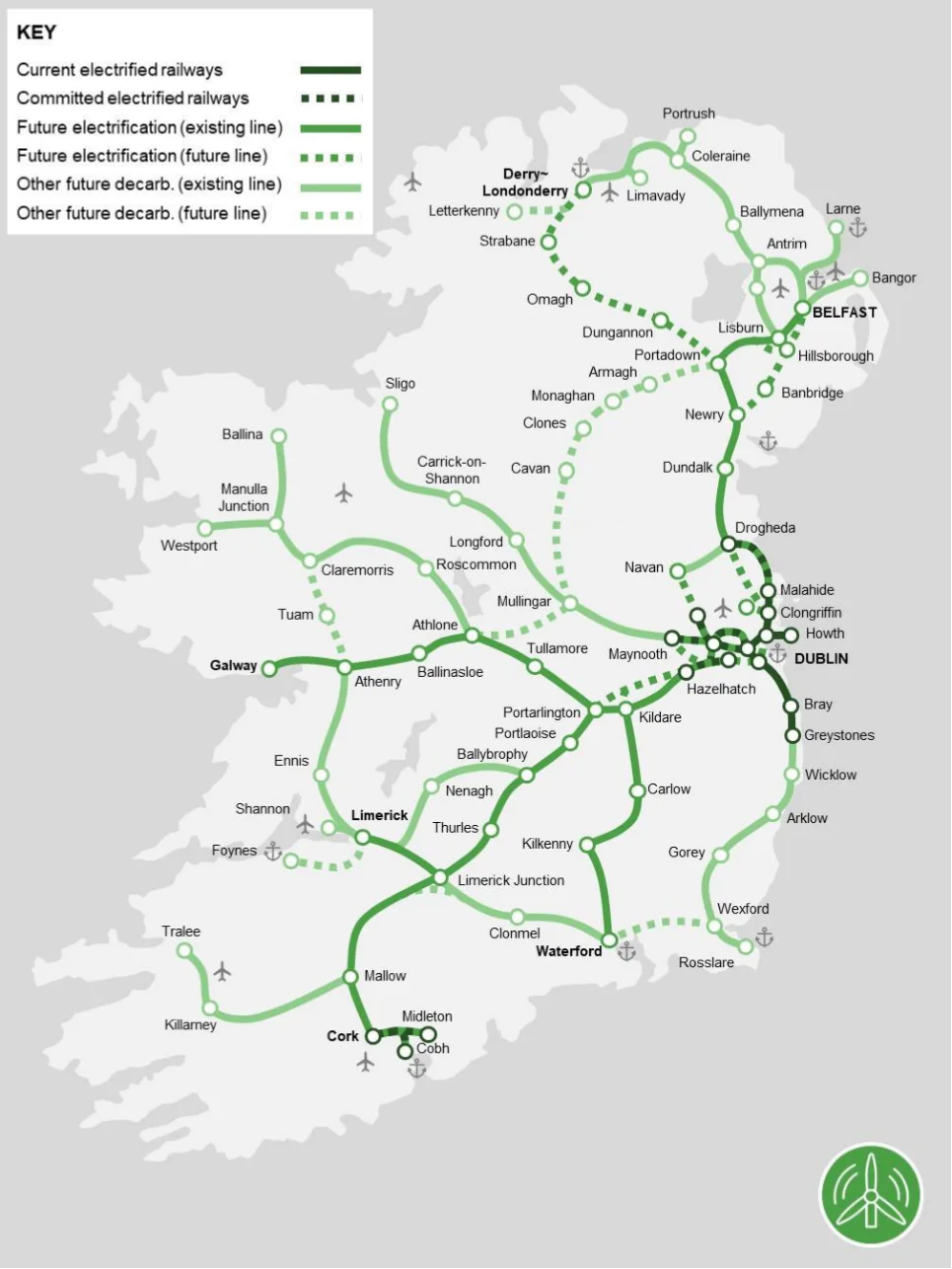
Figure 9
Figure 9 Decarbonisation interventions
Intercity Spine
Journey times
The island of Ireland’s current intercity passenger rail service falls significantly short of the level of service widely available in Western Europe.
An attractive all-island intercity passenger rail service should deliver journey times between the island’s major cities that are materially faster than car journeys. This suggests passenger rail intercity journeys should aim to achieve an average speed higher than average speeds achieved on the island’s motorways, which have maximum speed limits between 100 – 120 km/h (62 – 75mph).
•Journey times are often uncompetitive with car journey times on most intercity routes.
•Service frequencies are less than one train per hour between all seven key cities, except for Dublin – Cork.
Evidence from Great Britain and Europe suggests that to achieve an average speed of 120 km/h, intercity rail services need to operate at speeds of up to 200km/h (125mph). This ensures that, even when allowing for stops, waiting times, and interchange times, the railway delivers a faster journey than the car.
•Connectivity limitations between the South/West and North/East sections of the rail network (focused on Heuston and Connolly stations) means it can be difficult to travel directly between Belfast and Derry ~ Londonderry on one side and Cork, Galway, Waterford, and Limerick on the other by rail.
Significant upgrades to signalling, track condition, level crossings, and rolling stock will be needed across the island’s rail network to achieve a 200km/h railway. It may be possible to deliver some of these enhancements through Iarnród Éireann and Translink’s existing asset renewals programmes.
•Feedback from the initial public consultation that there is an aspiration from the public to improve the quality of service provided by current intercity services. Some aspects of the railway that drive service quality are addressed in this section (e.g., speed and service frequency), while others are considered in the “Customer Experience” section below (e.g., on board experience).
High Speed Rail
The Review has considered whether developing a new, fully segregated, 300 km/h (186mph) high speed rail network could be a viable proposition for the island of Ireland.
Both Iarnród Éireann and Translink are investing in improving line speeds and increasing service frequencies. For example, in the relatively near future, it is envisaged that the Dublin – Belfast Enterprise service will operate hourly. However, if both jurisdictions wish to deliver a world-class passenger rail service between the largest cities on the island of Ireland, then significant interventions will be needed to improve journey times, service frequencies, and cross island connectivity.
While this scenario could deliver transformational improvements in journey times between the island’s largest population centres, analysis undertaken for this Review suggests the benefits of delivering this network would be significantly outweighed by the costs. Given the distance between key population centres, there are diminishing economic returns in targeting speeds above 200km/h.
Furthermore, developing a large new rail network would likely have a significant adverse impact on the natural environment and would risk generating more carbon through construction than would be offset through attracting more demand to the railways.
To better connect northern and eastern parts of the island to the South and West, the Review recommends a long-term intervention that transforms east–west connectivity between Heuston and the Dublin – Belfast corridor, with interchange stations in Dublin City Centre, should also be considered. The concept for an eastwest tunnel in Dublin has been studied extensively in the past, largely in the context of an expanding DART or Dublin mass transit system. It has been cited in several strategic documents in the past by both the National Transport Authority and Iarnród Éireann.
This is not to say new intercity railways should be ruled out – indeed, the evidence suggests a mix of online and offline improvements will be needed to deliver the Goals and Objectives of this Review.
Figure from page 54
Service frequencies
In the short term, some frequency enhancements can be delivered with existing infrastructure thanks to the planned procurement of additional rolling stock. However, to achieve a step change in frequencies and operating performance, it will be necessary to add capacity on sections of the rail network where there is a high level of conflict between intercity, freight and local commuter rail services. This is particularly relevant on busy sections of the railway on the approaches to Dublin and Belfast, and on singletracked sections of the railway such as Portarlington – Athlone.
The development of such a solution will obviously need to be aligned with the development of the rail network within the Greater Dublin Area generally. The Transport Strategy for the Greater Dublin Area 2022 to 2042 proposes to protect and preserve an alignment for a cross- Dublin tunnel for delivery post 2042, and it is recommended that any such proposal considers fully the implications of this Review for the tunnel’s alignment, functionality, and delivery.
Considering this context, this Review encourages policymakers to consider whether this intervention could support longer distance services such as direct services between the island’s largest cities (e.g., Belfast – Cork) and Dublin Airport (e.g., Cork – Dublin Airport), as well as medium distance commuter services (serving stations as far out as Athlone, Portlaoise, Kilkenny and Drogheda). A future east-west tunnel would almost certainly include interchange stations with the planned MetroLink underground line and DART network. In addition to boosting connectivity across Dublin, this intervention would help relieve pressure at terminus stations at Connolly and Heuston and stimulate development and regeneration in the areas served by new underground stations.
Most capacity can be delivered by building additional track, upgrading junctions, and adding platform capacity in some places. These improvements could be delivered in parallel with line speed improvements. In some cases, it may be easier to develop new lines rather than deliver dual or four-tracking upgrades on existing corridors, such as between Drogheda and Clongriffin.
Cross-island connectivity
In the longer term, and in line with the Review’s goals of improving all-island connectivity between the major cities, consideration will be required as to the optimal solution for cross-Dublin services.
Recommendations
•Upgrade the core intercity railway network to line speeds of up to 200km/h (125mph) by:
The Review has considered the costs and benefits of potential solutions to the alignment and capacity constraints outlined above, as well as their impact on the environment. This work has informed the recommendations set out below.
oUpgrading the condition and
strength of straight sections of track.
In summary, to deliver a world-class allisland intercity railway that meets the Goals and Objectives of this Review, governments in both jurisdictions should develop plans to:
oRealigning some sections of the
railway where steep curves and level crossings currently force trains to reduce speeds.
oProviding capacity to segregate
•Upgrade the cross-country rail network to a dual-track railway (and four-tracks in places) and increase intercity service frequencies.
4
intercity and regional services from other services on busier sections of the railway, which could include loops on busy sections to accommodate growth while longer term solutions are developed.
●This would involve dual-tracking the railway between Portarlington – Athlone, Kildare – Kilkenny, and Maynooth – Mullingar and four-tracking Connolly/Spencer Dock – Clongriffin.
oUpgrading signalling and rolling
stock – which could be delivered incrementally as part of a wider renewals programme.
●In addition to enabling higher frequency intercity services on these corridors, these improvements would allow more commuter services to serve intermediate stations and thus enable intercity services to deliver faster cityto-city journey times.
Recommendations (Continued)
•Develop short sections of new railways on congested corridors. There are three sections of the network that are likely to require a four-tracking or new rail alignment solution to accommodate conflicting demands for capacity and deliver a 200 km/h railway. These three sections are:
This railway would be shorter than a four-tracked solution, deliver faster journey times, require fewer significant crossings, require less land and property acquisition, generate less disruption to existing services during construction, and would have a more limited impact on the environment.
oBelfast – Lisburn – Newry: The
existing railway between Newry and Belfast has significant constraints due to its alignment, level crossings, and limited space to add capacity between Lisburn and Belfast. A new railway could deliver significant journey time and capacity benefits for this corridor.
oPortarlington/Kildare –
Hazelhatch: This railway is also expected to become busy as the commuter market to the South West of Dublin grows. It should be feasible to four-track the corridor as far as Portarlington but doing so would have some impact on towns on the route and would involve building tracks through the Curragh. An alternative option could be to build a new alignment from Hazelhatch to Portarlington (with a spur to the Waterford line) that avoids the Curragh. This route would be shorter and could deliver faster journeys.
oDublin – Drogheda: This railway
is expected to become busier when the DART network is extended to Drogheda MacBride. While it is probably technically feasible to four-track this railway – notably between Connolly and Malahide – four-tracking some sections may result in a significant adverse effect on the integrity of several Special Protection Areas and potentially the waterfronts of Malahide and Balbriggan. An alternative approach could be to build a new railway from Drogheda to Clongriffin following the M1 corridor.
•Develop a cross-Dublin solution. An east-west railway from Heuston to Spencer Dock could deliver transformational improvements in cross-island connectivity if combined with improvements north of Connolly.
A map illustrating the interventions that are likely needed to deliver a fast, frequent, and high-quality intercity railway service is shown in Figure 10.
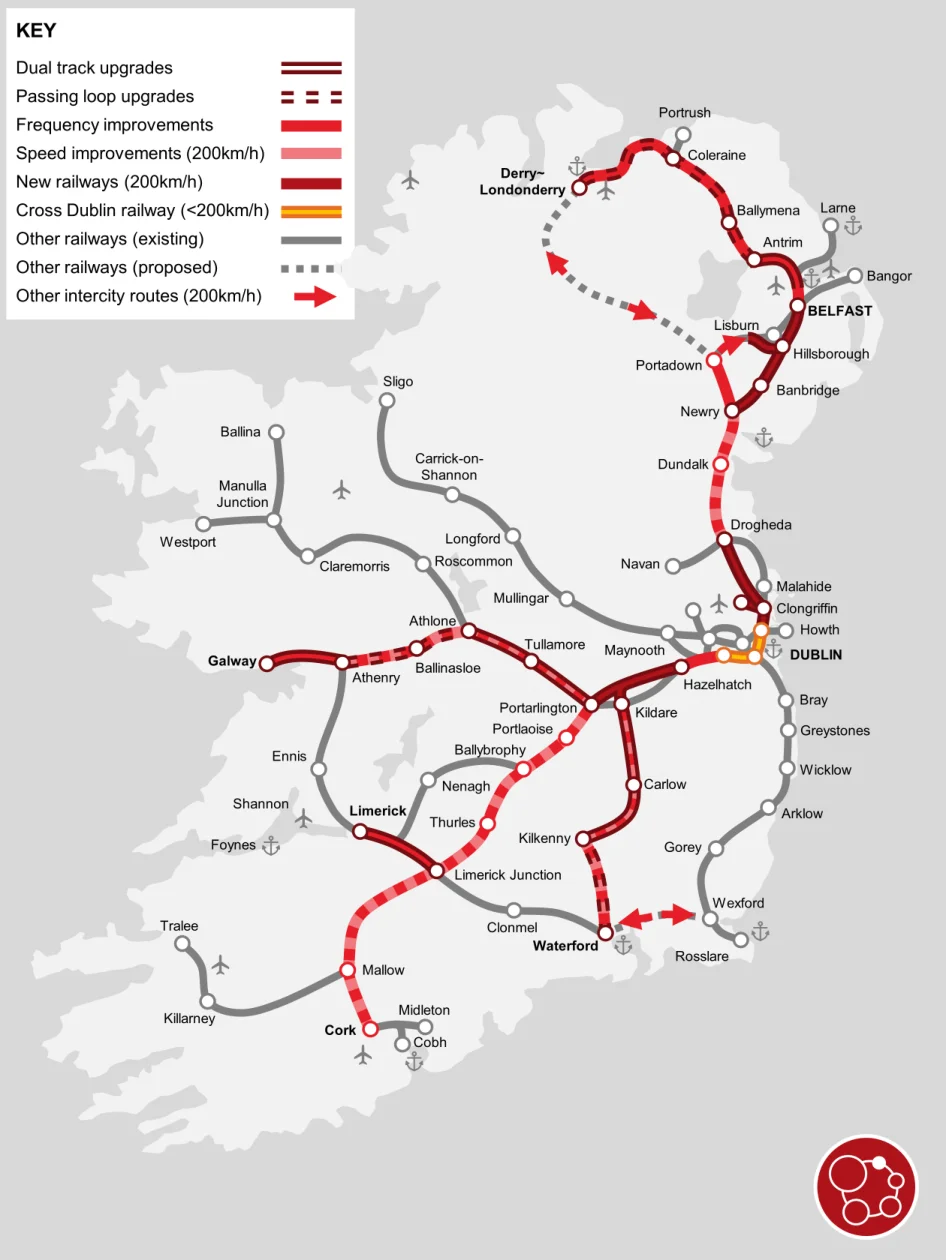
Figure 10
Figure 10 Intercity network interventions
| Case Study | Denmark | This aims to reduce travel time to under one hour between each major city pair, increase the accessibility of regional cities, and enable them to play a stronger role in the economy. This programme of investment has included delivering Denmark’s first high- speed railway line, which runs between Copenhagen and Ringsted on the route to Odense and was completed in 2018. This line relieves congestion on busy commuter routes on the key corridor from the west of the country to Copenhagen. Further investments in high speed railways from Odense to Aarhus to Aalborg are planned. Today, Denmark’s railway delivers average speeds between its major cities that, in some cases, are twice as fast as current speeds between major cities on the island of Ireland. Denmark has achieved these improvements largely through investing in the existing network, with one short section of new railway on a congested corridor. Economic assessment indicates that – based on future projections – the “Hour Model” will be a profitable project. The investment in rail infrastructure improvements have been forecast to have a Net Present Value of between DKK 11bn and DKK 7.6bn (€1.5bn/£1.3bn - €1bn/£0.8bn) for New Construction Budgeting surcharges of 10% and 50% respectively. This project will also help improve agglomeration between Denmark’s key cities, and boost productivity nationwide. This case study illustrates the benefits that a faster, higher capacity intercity rail provides for a country with similar socioeconomic and geographical characteristics to the island of Ireland. | ||
| Denmark shares many similarities with | |||
| Ireland. It has a similar population size, | |||
| and its economic geography is highly | |||
| centred on a large metropolitan area on | |||
| the eastern side of a large island. Denmark | |||
| held a strategic review of its railway in | |||
| 2006 and identified similar challenges that | |||
| the island’s railways face today, including: | |||
| • Low levels of electrification; | |||
| • Capacity constraints, especially on | |||
| main lines into the capital city; | |||
| • Conflicts between intercity, regional, | |||
| suburban, and freight services; and | |||
| • Speed restrictions and poor alignments, | |||
| resulting in relatively slow journeys. | |||
| To achieve a modern railway, Denmark | |||
| developed, and has started to implement, | |||
| a new plan, Togfonden DK (Train Fund | |||
| Denmark) since 2014. | |||
| Most of the funds in Togfonden DK are | |||
| used for large investments in new and | |||
| faster rail connections, including faster | |||
| travel times on most regional lines, an | |||
| upgrade to support transport of rail freight, | |||
| and extensive electrification of the network. | |||
| Several upgrades to the railway network | |||
| have since been planned and completed to | |||
| reduce journey times between major cities | |||
| in the country and the achievement of a | |||
| concept called the Hour Model. |
Regional and Rural
Approach
The island of Ireland’s railway network today is approximately half of its size at its peak. The decommissioning of railways around the mid part of the 20th century cut some rural communities off from the rail network. Additionally, interregional connectivity is poor in many places, especially in border areas.
The Review has considered options to:
•Connect as many towns with populations of 10,000 or more to the rail network as possible. These towns (including some in city regions that are out of the scope of this Review) are shown in Figure 11. A threshold of towns with a population of 10,000 was chosen as this is the threshold used by Ireland’s National Planning Framework as a definition of a “large town” and is the threshold used by Northern Ireland’s Statistics and Research Agency as the definition of a “medium town”.
It is clear from responses to the initial public consultation that there is significant stakeholder interest in restoring abandoned railways and improving connectivity in poorly served areas of the island, particularly in the North West and South East. Public policy in both jurisdictions is increasingly recognising the need to rebalance the economy away from Dublin and Belfast to enable all parts of the island to prosper.
•Directly connect each of the regions of the island of Ireland. These were defined in the “Work Package 1: Context and Policy” Report and are shown in Figure 11.
•Improve intraregional connectivity. There are several “missing links” within the regions that could support important inter and intra-regional journeys (also shown in Figure 11).
•Linked to the cost, they would have a significant adverse impact on the natural environment. As an example, the Review considered multiple opportunities for boosting connectivity in the North West of the island but ruled out options that would cut through the Sperrins Area of Outstanding Natural Beauty.
To achieve the aims outlined above, the Review examined options for reinstating former railways and building new railways across the whole island of Ireland. The Review sifted these options and grouped them into four geographical regions:
•Northern Ireland;
•West Coast;
•The Review’s assessment of the carbon impact of some packages of interventions found that some options might generate more carbon emissions through their construction than would be offset through attracting more people to the railway from less sustainable travel options.
•South Coast; and
•North Midlands.
Short listed options were then assessed (as “packages”), costed, and appraised against the Review’s Goals and Objectives. Some options were found to be unviable because:
•They do not align with local planning policy. The Review has not taken forward options to develop new railways that contradict the National Transport Authority’s metropolitan strategies, Northern Ireland Executive policies, or on alignments that local authorities consider to be better suited to alternative modes.
•They would not attract enough demand (within the Review’s horizon up to 2050) to justify having a regular passenger rail service. In many cases, lower cost public transport options such as buses and coaches may provide a better service than a highly infrequent rail service.
•They would be highly costly to deliver. This is especially the case for potential rail routes that cut through challenging terrain (which is common in coastal areas around the island).
A full list of the options that were considered, along with rationale for why some were taken forward and why others were not, is provided in Appendix B. The options recommended for further study are discussed in more detail below.
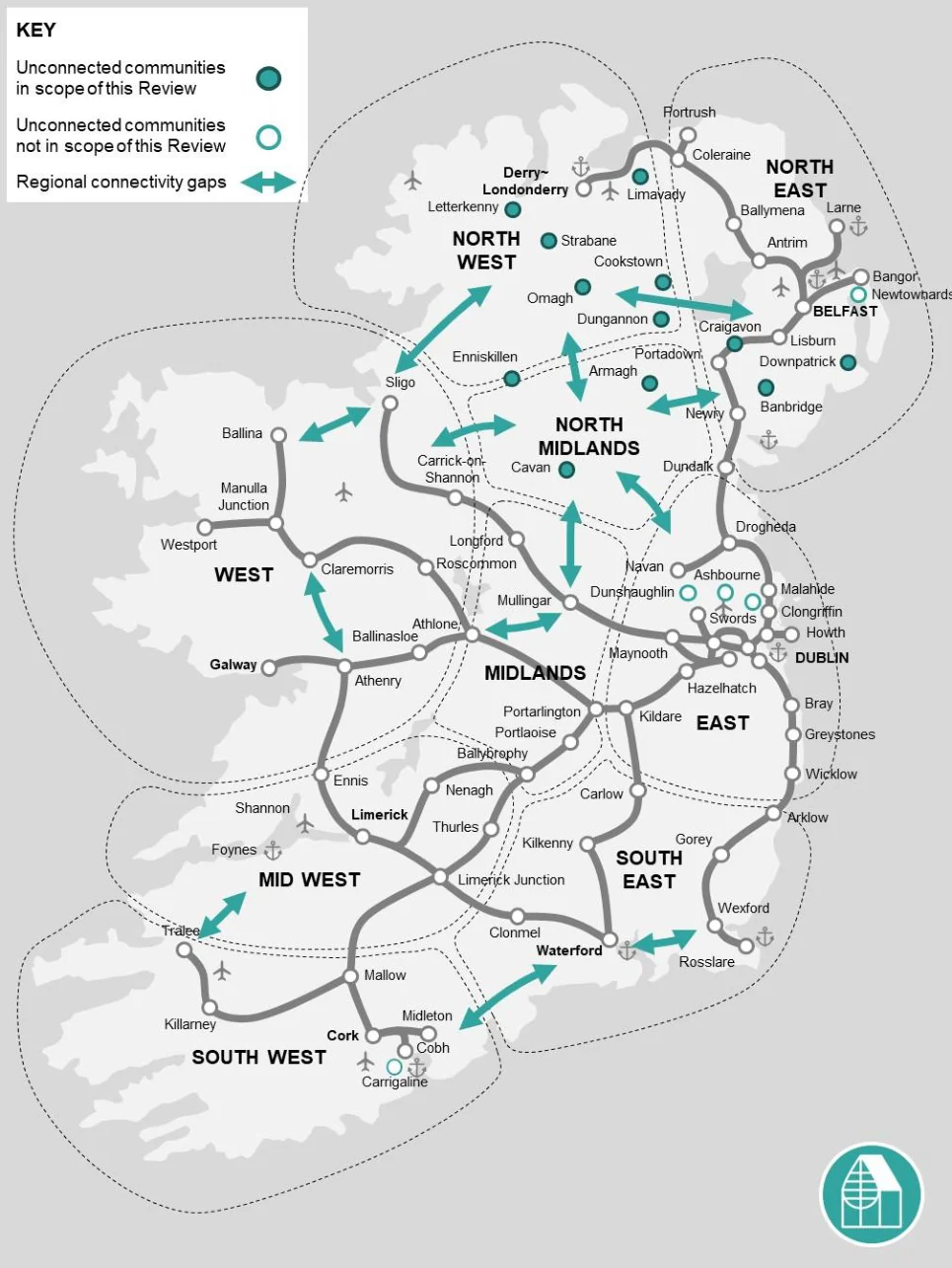
Figure 11
Figure 11 Regional and rural connectivity challenges
Northern Ireland
The railway network in Northern Ireland is centred on Belfast and is mostly confined to the area east of the River Bann. Service patterns are reasonably frequent in the core of the network, with half hourly services all day on lines connecting Belfast with Portadown, Bangor, and Whitehead and hourly services to Derry~Londonderry, Portrush, and Larne. Enterprise services between Belfast and Dublin run around once per two hours.
Given the large gaps in the existing network, and the number of large settlements currently unserved, there are many opportunities to enhance and grow the rail network in Northern Ireland. The Review has considered improved intercity connections for Belfast and Derry~Londonderry, both between the two cities themselves and onwards to Dublin and Galway. Many regional and rural lines have also been considered that reconnect larger settlements and restore regional links to the Midlands and the West of Ireland.
The existing network has several constraints, which reduce the quality of service. None of the network is electrified and large portions are single track, particularly the lines from Whiteabbey to DerryLondonderry and Downshire to Larne along with the Dargan Bridge in Belfast. Level crossings in places such as Lurgan and poor alignments such as the line between Portadown and Newry limit speeds and capacity. Online upgrades are very challenging on some existing alignments, such as the coastal route between DerryLondonderry and Coleraine. Congestion on routes into Belfast and Dublin also limits the speed and frequency of the Enterprise service between the island’s two largest cities.
Some of the options considered were found to have limited viability for rail services within the horizon of the review. Physical constraints ruled out some options, such as the Sperrin Mountains ruling out Cookstown as a stop on a service from Derry~Londonderry to either Belfast or Dublin. In other cases, remoteness from population centres was the major factor, particularly for routes serving Enniskillen where anticipated travel demand is unlikely to justify the cost of delivering rail services at this time.
Rail services to locations such as Newtownards would function as commuter links to Belfast and thus fell outside the scope of the Review. Future Local and Regional Transport Plans could consider how Belfast’s public transport network can better serve these places.
In addition to constraints on the existing network, its sparseness leaves many large settlements entirely unserved by rail. The west of Northern Ireland was one of the areas worst affected by rail closures in the mid-twentieth century, and large settlements such as Armagh, Cookstown, Dungannon, Enniskillen, Omagh, and Strabane have had no rail services for decades. There are also large towns further east with no rail access despite their proximity to Belfast, mostly in County Down including Banbridge, Downpatrick, and Newtownards.
The Review has identified several opportunities in Northern Ireland where rail is well-placed to improve connectivity.
West Coast
While many of the larger settlements along the west coast of Ireland are served by the railway network, these are along three distinct lines linking Galway, Westport/Ballina, and Sligo to Dublin without direct services between the main settlements in the region. Links to other regions are also limited, with the line linking Athenry to Limerick the only one that does not run to Dublin. Service frequencies are fairly low, with only between five and nine services per weekday in each direction. The region is the source of much of the island’s existing freight on the routes from Ballina and Westport to Waterford and Dublin.
These opportunities include:
•Restoring the rail line between Derry ~ Londonderry and Portadown. This would link the large towns of Strabane, Omagh, and Dungannon to the rail network and greatly improve intercity connectivity between Derry~Londonderry and both Dublin and Belfast.
Figure from page 63
•Reinstating the railway from Portadown to Armagh, Cavan, and Mullingar. This would reconnect many towns to the network and boost connectivity between Northern Ireland, the Midlands, and the West.
Further to the north there have been no rail services in County Donegal since the mid-twentieth century, although the county once had an extensive network – albeit narrow gauge rather than Irish gauge. The Western Rail Corridor connecting Limerick to Sligo, which was closed to scheduled passenger services in the 1960s and 1970s, had been expected to reopen as far north as Claremorris in the 2007-2013 National Development Plan. However, with the onset of the 2008 financial crisis, only the section between Ennis and Athenry was completed.
•Building a new direct linebetween Lisburn and Newry, together with a tunnel from Adelaide to the Lisburn area. This would improve journey times and deliver much needed capacity on the Belfast-Dublin route, while also providing rail services to Banbridge and Dromore.
•Electrifyingmuch of the network, which would contribute to decarbonisation and improve journey times on existing lines.
•Integrating bus and rail ticketing and timetabling. This would enable people in areas without direct rail services, such as Enniskillen, to seamlessly connect with the rail network for longer journeys.
The Review has considered several options to improve connectivity both within the region and to and from adjacent regions. These have included increasing frequencies to a minimum of once per two hours on all routes, and hourly or better on many lines. Targeted speed improvements and double tracking between Athenry and Galway have also been evaluated.
Many new lines have been assessed, including routes linking Derry~Londonderry to Sligo via Letterkenny, Sligo to Galway via Claremorris, and Sligo to Enniskillen and onwards to Portadown and Belfast via either Clones or Omagh.
These interventions include:
•Improving services between Galway and Dublin, Limerick, Cork and Waterford – together with double tracking between Athenry and Galway.
•Improving service frequencies between key Mayo towns and Athlone by building more passing loops on this corridor.
Given the relatively low population density and lack of larger towns across the region, the Review has found that expansion of rail is difficult to justify in much of the region within the horizon of the Review. Furthermore, there is challenging terrain in many parts of the region – for instance, a line between Sligo and Derry-Londonderry would require complex crossings of the River Garavogue and River Erne and then a route through the Barnesmore Gap. The relatively low level of anticipated demand suggests that rail is not the appropriate solution to improve connectivity along many of the routes assessed.
•Restoring the rail line between Athenry and Claremorris. This would be particularly beneficial for freight, allowing a direct route for freight from Ballina and Westport to ports on the South Coast that avoid the most congested part of the rail network around Dublin. This would also reconnect Tuam to the railway and enable direct services between Galway and Mayo.
•Developing a new rail link from Letterkenny to Derry~Londonderry. This would connect the major urban centres of the North West to each other and greatly improve access to Belfast and Dublin.
While many options for developing new railways in the region are unlikely to be viable within the horizon of this Review, the Review has identified several interventions that could have potential.
South Coast
There are several constraints that make it challenging to improve passenger and freight access to the South East. Much of the railway is single track, limiting opportunities to increase service frequencies. Rail alignments are poor, limiting opportunities to increase speeds.
While the South West of Ireland has relatively good connectivity to Dublin, the South East is more isolated, and connectivity between the South Coast cities of Cork and Waterford is poor.
The South East of Ireland is connected to the railway by a largely single-track railway that runs south of Dublin to Rosslare Europort via Wexford. The railway is intensely used by the DART service between Dublin and Greystones. Between Greystones and Rosslare Europort, however, the railway is lightly used by passenger services (around 4 – 5 trains per day each direction). The towns of Wicklow, Arklow, Gorey, Enniscorthy, and Wexford, as well as Rosslare Harbour, are therefore poorly served by rail. Journey times from Rosslare Europort to Dublin are currently around 3 hours.
There are also significant conflicts with DART services, particularly between Dublin and Greystones, and there are significant geographical constraints limiting potential diversions (e.g., Bray Head).
Despite these challenges, there are opportunities for growing the role of rail in this region. Over 300,000 people live in County Wexford and County Wicklow, and Rosslare Europort is growing following changes to trading arrangements between Ireland, the UK, and the European Union.
Rail connectivity in the South East has declined in recent years with the closure of the South Wexford Railway in 2010. Furthermore, the line from Waterford to Limerick Junction has only two services per day per direction and has many speed restrictions, hampering connections to Limerick and Cork.
The Review has considered interventions to enable faster and more frequent journeys between Rosslare Europort and Dublin, including adding passing loops, tunnelling through Bray Head, developing a new railway along the M11 corridor, and building a new line for DART services along the N11 corridor. A more direct route between Cork and Waterford was also considered but found to be impractical due to the geography of this corridor.
A map of these proposals is shown in Figure 12.
Many of these solutions would be very costly and are unlikely to be justifiable as most railways in this region would not be expected to support more than one or two trains per hour in each direction.
It appears that the best way forward for boosting connectivity in the South East of Ireland in the shorter term is to introduce an hourly shuttle service between Wexford and Greystones, with DART services to be extended to Wicklow.
Figure 12 South East Ireland
Connectivity could be further improved by reinstating the railway between Waterford and Rosslare (including a chord/curve to the south of Wexford) and extending some Dublin – Waterford intercity services to a new station to the south of Wexford O’Hanrahan once the line between Heuston and Waterford has been upgraded. With improvements to the intercity corridors described above, this would reduce journey times between Dublin and Wexford by around an hour. This intervention would also support further development of freight services to and from Rosslare Europort.
Improving the Waterford to Limerick Junction line would also improve connectivity between the South East and cities to the South and West. This railway could deliver significant benefits for freight services, which could access the North West without needing to pass through Dublin or turn back at Kildare.
Furthermore, installing a curve at Limerick Junction would enable trains to leave the Cork – Dublin line and join the Limerick – Waterford line, which would boost passenger rail connectivity between Cork and Waterford.
North Midlands
Given its central location, restored rail links through the region would also help integrate other regions across the island. The Review considered direct services from Belfast to Galway that would link the West and North East to each other in addition to connecting the communities along the way. Lines through the region would also deliver alternative freight paths to Northern Ireland that avoid the most congested parts of the network around Dublin, improving the reliability of both passenger and freight services across the network.
Bisected by the border, the North Midlands region is centred on parts of counties Armagh, Cavan, Fermanagh, and Monaghan. It saw large scale closures to its rail network in the midtwentieth century and today is entirely unserved by rail. This is despite the region containing several large towns that are relatively close to the two largest cities on the island – Dublin and Belfast.
The Review considered the potential of rail to serve several functions within the region. One of these would be to connect communities within the region to each other and to their nearest major cities of Belfast, Dublin, and Galway. Public transport and road connections within the region are often poor compared to other parts of the island which impacts on its economic competitiveness. Large settlements such as Armagh and Cavan are within the commuting catchment of Belfast and Dublin and restored rail links would have a beneficial impact on access to employment, third level education, healthcare, and international gateways.
The Review has found that while anticipated demand (within the Review’s horizon) fell below the threshold for rail on some routes, such as from Clones to Sligo via Enniskillen, there is potential for rail in certain parts of the region. While through services from Belfast to Galway were not found to generate high demand, demand towards Dublin and between Armagh and Belfast was sufficient to support rail services. Combined with the restoration of rail services on the line between Mullingar and Athlone this line would greatly increase inter-regional accessibility across the northern half of the island.
Recommendations
To deliver the regional and rural Goals and Objectives of this Review, both governments should develop plans to develop the interventions shown in Figure 13 and listed below:
•Extend the railway into Tyrone, DerryLondonderry, and Donegal. Reinstating the railway between Portadown, Dungannon, Omagh, Strabane, DerryLondonderry, and Letterkenny would connect the railway to many communities and support direct services between Dublin, Belfast, Derry~Londonderry, and Letterkenny.
13
•Provide more direct services between Ireland’s West and South Coasts – e.g., between Galway, Limerick, and Cork.
8
•Ensure regional and rural lines have at least one train per two hours (at regular times) – and hourly services between Galway, Limerick, Cork, and Waterford.
9
•Reinstate the South Wexford Railway to boost connectivity in the South East.
14
•Develop the railway to boost connectivity in the North Midlands. Reinstating the railway between Portadown, Cavan, Mullingar, and Athlone would address several regional connectivity gaps. Building a new link between Maynooth and Adamstown and dualling the railway to Mullingar would also add capacity to support services to this region.
•Increase line speeds to at least 120km/h (75mph) – this would deliver significant benefits for communities across the island.
15
10
•Upgrade Limerick Junction and the Limerick Junction – Waterford line. This will support freight services between the South Coast ports, Foynes, and the North West. With a chord at Limerick Junction, it will support direct Cork – Waterford services.
11
•Integrate bus service and rail service timetables to connect communities where direct rail access is unviable – bus services can help new railways boost public transport connectivity to places like Donegal, Enniskillen, Cookstown, and Downpatrick.
16
•Reinstate the Western Rail Corridor railway between Claremorris and Athenry. This will support freight and regional connectivity objectives in the West of Ireland.
12
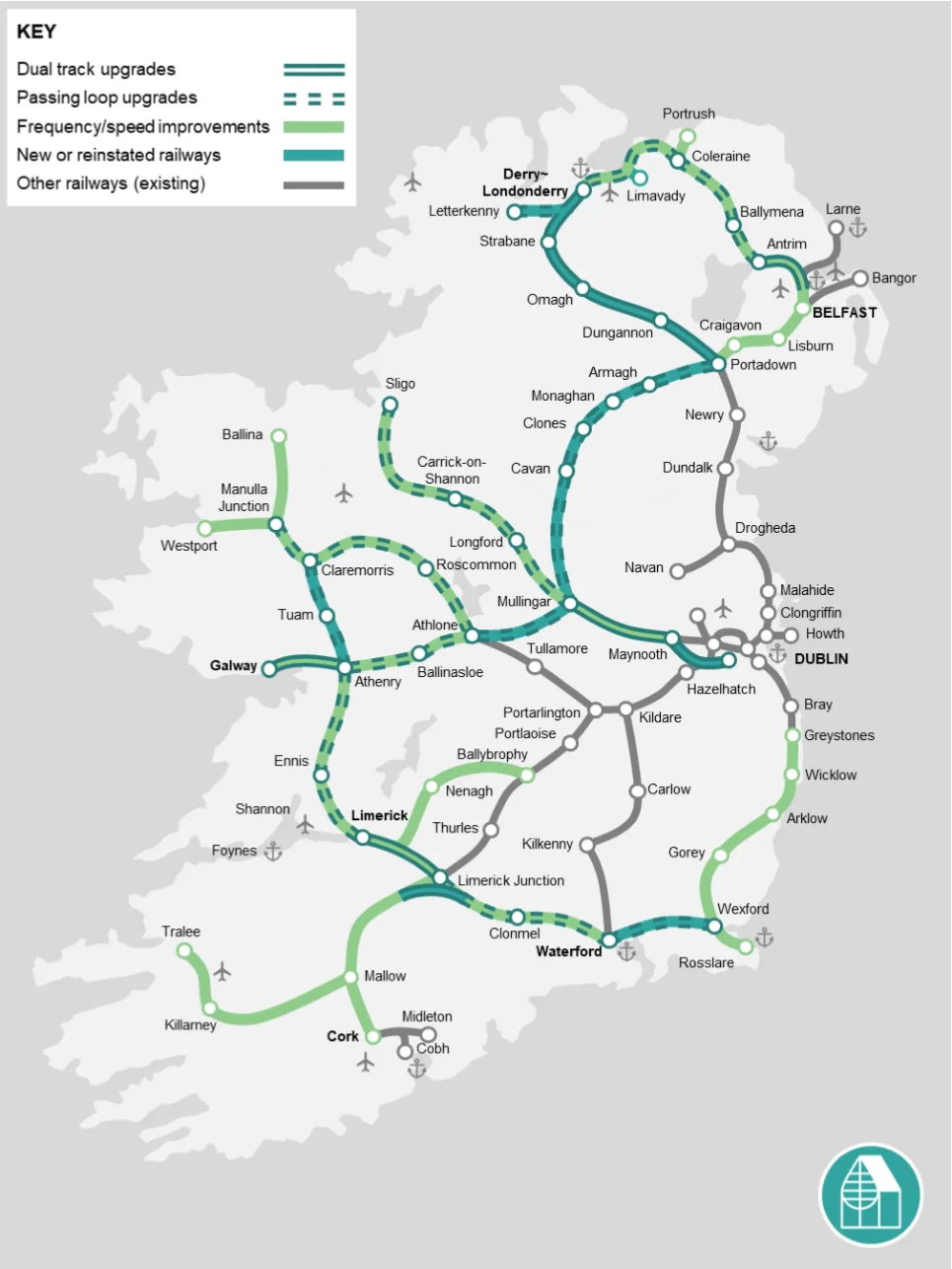
Figure 13
Figure 13 Regional and rural interventions
Case study | Scottish Borders Railway
The Borders Railway at Galashiels (Photo: Walter Baxter, Creative Commons)
The Borders Railway serves a northsouth corridor in the South East of Scotland connecting the city centre of Edinburgh with settlements to the South East of the city, Midlothian, and the Borders. The corridor runs c. 50km from Edinburgh City Centre to the village of Tweedbank in the Borders. This railway was closed in 1969 and partially reopened in September 2015.
This demand has exposed the ‘basic’ infrastructure and caused overcrowding which would not have been an issue had actual demand mirrored the forecasted demand. While high demand should be seen as a success, the failure to anticipate this demand has meant that the Borders Railway has effectively capped its capacity. Some of the constraints built into the infrastructure also presents longterm challenges in decarbonising the railway.
The Business Case for reinstating this railway was borderline (at best), and the Final Business Case reported a Benefit to Cost Ratio of 0.5 – 0.7 in 2012. The railway specification was limited to an unelectrified, single-track railway, reflecting relatively cautious demand forecasts.
The good news is that, despite some of the challenges presented by infrastructure capacity constraints, it has been possible to increase service frequencies to two trains per hour during peak hours. There are also long-standing plans to extend the railway across the border to Carlisle, which would enable the railway to take on a greater role as an inter-regional railway.
In reality, demand for the Borders Railway far exceeded expectations. It became so popular that the annual return journey demand in the first year alone was 75% greater than estimated in the Business Case, which assumed just under 650,000 passengers would use the railway in its first year of operation. This grew to 1.7 million journeys in 2018/19.
It is a difficult balance to strike between future proofing infrastructure and minimising exposure to perceived goldplating. In this sense, the borders railway offers a cautionary tale for pessimists.
Sustainable Cities
This section describes the key considerations and recommendations that have been developed to ensure this Review supports the ambitions of cities in both jurisdictions. In particular, it highlights how interventions developed in support of this Review’s wider all-island Goals and Objectives can help the island’s cities improve their urban and wider commuter rail networks.
Several cities across the island of Ireland are developing significant improvements to public transport services. These improvements cut across multiple modes of transport and are underpinned by city and regional strategies that take a holistic approach to journeys in their areas.
Figure from page 71
Additionally, this section considers opportunities to better connect the island’s railway to three of its busiest international airports (Dublin, Belfast International, and Shannon).
Plans for multi-billion Euro improvements to public transport services in the island’s largest cities are taken as committed and are fully supported by the Review. While the scope of the Review does not include detailed proposals for commuter and urban rail services on the island, the Review indicates how the all-island interventions recommended by this Review can support plans to improve these services.
Dublin
As noted in the introduction to this Chapter, the Greater Dublin Area (GDA) Transport Strategy sets out a statutory framework for the development of transport across the Dublin region up to 2042. The recommendations set out below represent potential additional complementary provision which could be considered for inclusion in future updates to the GDA Transport Strategy.
There is significant alignment between the Goals and Objectives of this Review and the ambitions of the island’s largest cities – as set out in the National Transport Authority’s Metropolitan Transport Strategies for the Greater Dublin Area, Cork, and Limerick-Shannon Area, as well as the Department for Infrastructure’s Eastern Area Transport Plan. For example, the DART+ Programme in Dublin and planned new stations in the Belfast area should help grow the attractiveness of rail, which, in turn, should boost demand for intercity services. That said, there may be competition for capacity between intercity, freight, urban, and commuter rail services. This Review has therefore considered where conflicts might arise between different services and proposes plausible solutions to address these potential conflicts.
In line with this Transport Strategy, the National Transport Authority and Iarnród Éireann are currently delivering an ambitious DART+ Programme, which will expand DART beyond its current coastal corridor to the North, West, and South West of the GDA. This will include increasing service frequencies on several lines, including Dublin Connolly – Maynooth, Connolly – Drogheda, and Heuston – Hazelhatch. To support the development of higher frequency DART services, there will likely be a need to segregate DART services from others – particularly intercity and freight. This is especially the case if the future heavy rail network of Ireland is driven by different OHLE traction than the 1.5kV DC DART system.
Belfast
The Greater Belfast Area has benefitted from significant investment in public transport in recent years. A new major transport hub is being delivered at Belfast Grand Central, and there are plans to expand the city’s successful Glider mass transit system.
In the relatively near future, Translink and the Department for Infrastructure are planning to deliver a new station to the west of Lisburn. Other potential interventions – some of which have been described above – that would boost the attractiveness of rail in Belfast include:
•Developing a new railway between Adelaide and the Lisburn area to deconflict intercity and local services.
•Reinstating the railway between Lisburn – Antrim with a station at Belfast International Airport.
The recommendations included in this Review that would support this objective include:
•Developing new stations at Templepatrick/ Ballymartin, Lisburn West, Craigavon, and potentially elsewhere on the network.
•Developing a long-term solution to the bottleneck between Connolly – Drogheda.
•Improving connectivity between Sydenham station and George Best Belfast City Airport.
•Providing a new link between Adamstown – Maynooth to enable Sligo services to be diverted away from the DART West route and to enable DART to eventually extend commuter services to Navan.
Derry~Londonderry
The development of a new railway between Portadown and Derry~Londonderry could free up additional capacity on the existing Coleraine route and enable separate suburban and inter-city services on these two corridors.
•Routing longer-distance services to the South East via an improved railway between Kildare and Waterford and a reinstated rail link between Waterford and Wexford.
Improvements to suburban services could include building a spur to and station at Limavady and building new stations at places such as Ballykelly.
•Delivering a transformational, eastwest, cross-Dublin rail link between Heuston and the Northern Line.
Cork
Airports
Cork is currently served by a commuter service that provides a two-train per hour service between Cork Kent, Midleton, and Cobh. There are proposals to electrify and expand the Cork suburban network to serve several new stations and improve frequencies on all branches. Phase 1 of Cork’s commuter rail programme, which is ongoing, will deliver capacity improvements in the area. The Cork Metropolitan Area Transport Strategy includes proposals for a tram route between Mahon and Ballincollig, which in the longer term could extend south to Cork Airport and Carrigaline.
Four of the five busiest airports on the island of Ireland (based on 2019, prepandemic patronage data) are not connected to the rail network. This includes the busiest airport in Ireland – Dublin – which is the busiest airport in Europe to lack a rail or metro/light rail connection. Several committed schemes and intervention options outlined in this Chapter identify opportunities to improve airport connectivity. Committed and proposed interventions include:
Figure from page 73
•Plans to connect Dublin Airport to Dublin via a new MetroLink line.
•As discussed above, proposals to connect Belfast International Airport through reinstating the Lisburn – Antrim railway.
Limerick
Currently, there are limited local rail services in the Limerick area. However, the configuration of the railway here, as well as committed plans to reinstate the railway to Foynes, could open-up opportunities to develop a suburban rail service to serve local journeys. Options for developing local rail services in this area are set out in the Limerick Shannon Metropolitan Area Transport Strategy and include developing stations between Foynes – Limerick – Sixmilebridge and extending the railway to Mungret and Shannon Airport.
Additionally, this Review has considered options to improve airport connectivity by:
•Directly connecting Dublin Airport to the inter-urban rail network. Several options have been considered for connecting the island’s busiest airport to the inter-urban railway, including building a direct link from the Northern Line.
A direct link could be combined with the proposed cross-Dublin tunnel to enable direct journeys between the Airport and places beyond Dublin, including Cork, Limerick, Galway (and potentially Northern Ireland with a change at Clongriffin). This aims to complement the MetroLink project, which will connect the Dublin Airport to Dublin City Centre.
Galway and Waterford
While Galway and Waterford do not have specific urban rail services, many of the recommendations in this Review will support sustainable mobility in these cities and enable them to deliver their respective Metropolitan Area Transport Strategies.
•Building a spur from Limerick to Shannon Airport.
•Improving connectivity between Sydenham and George Best Belfast City Airport.
Recommendations
−Building a spur from
In support of wider policies and strategies for urban railways in the island’s largest cities, both jurisdictions should develop plans shown in Figure 14 and described below to:
Sixmilebridge or Cratloe to Shannon Airport. This intervention could include developing new stations between the airport and Limerick to be served by a new urban rail service centred on Limerick.
•Connect Dublin, Belfast, and Shannon airports to the railway by.
−Building a spur from Clongriffin
•Extend double tracking in the Belfast area. The section of railway between Antrim and Monkstown would need to be dualled to enable more frequent local services to the North and East of Belfast.
18
to Dublin Airport. This intervention, which aims to complement the planned MetroLink project in Dublin, would enable intercity and other longer-distance services to directly access Ireland’s busiest airport. With the proposed cross-Dublin tunnel outlined in the intercity section above, this intervention could connect places like Cork and Galway to Dublin Airport.
•Segregate long-distance/fast services from stopping services. This can be achieved by delivering a four-track railway on the approaches to Dublin Heuston and Connolly, and potentially by diverting Sligo and Longford trains away from the Maynooth – Connolly corridor using a new link between Adamstown and Maynooth.
19
−Reinstating the railway between
Lisburn and Antrim. This would enable Belfast International Airport to be connected to the railway network.
•Explore the case for developing new stations in the Belfast, Cork, Derry~Londonderry (e.g., Limavady), and Limerick – Shannon city regions.
20
− Improving existing rail-airport
connections at George Best Belfast City Airport.
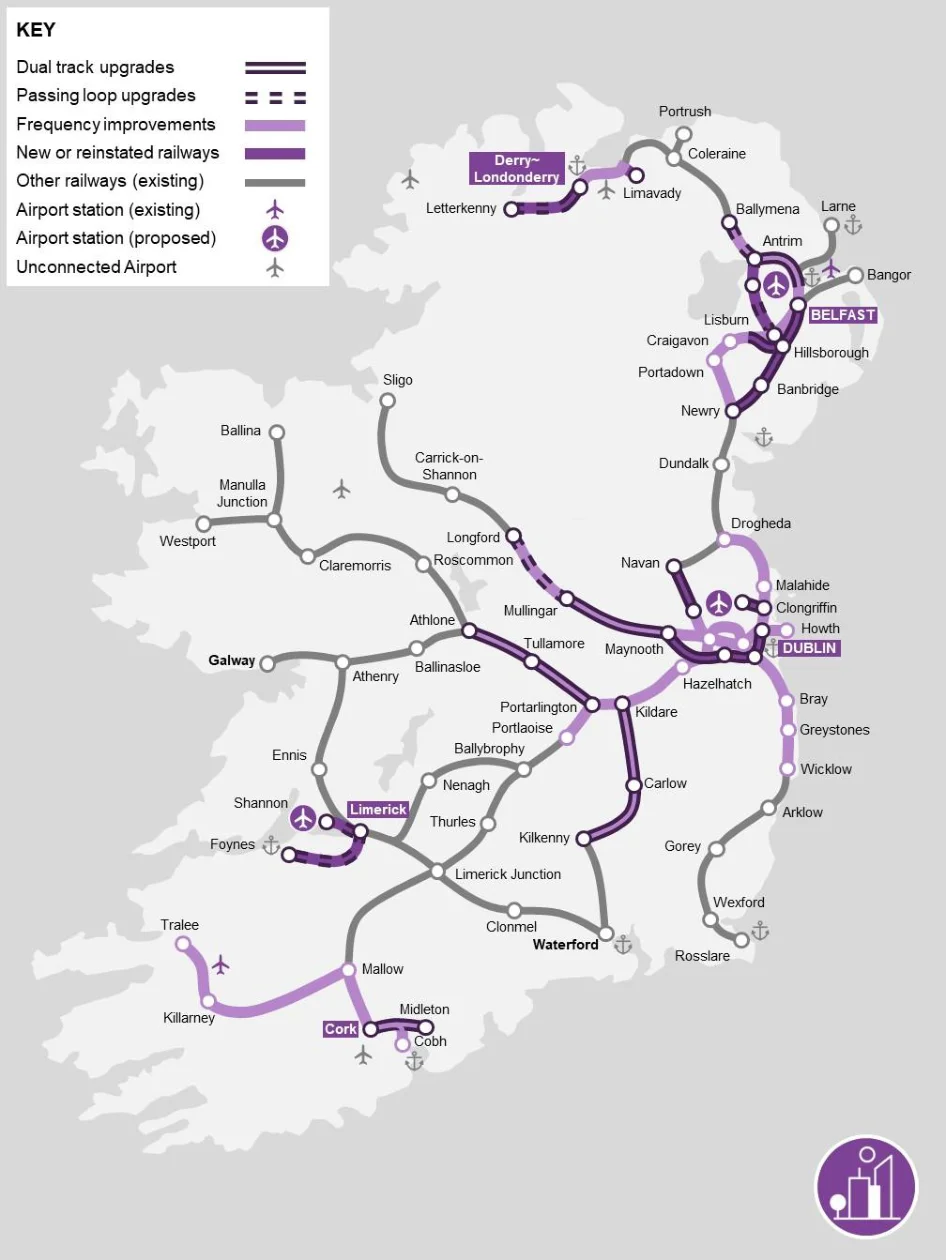
Figure 14
Figure 14 Sustainable cities heavy railway interventions
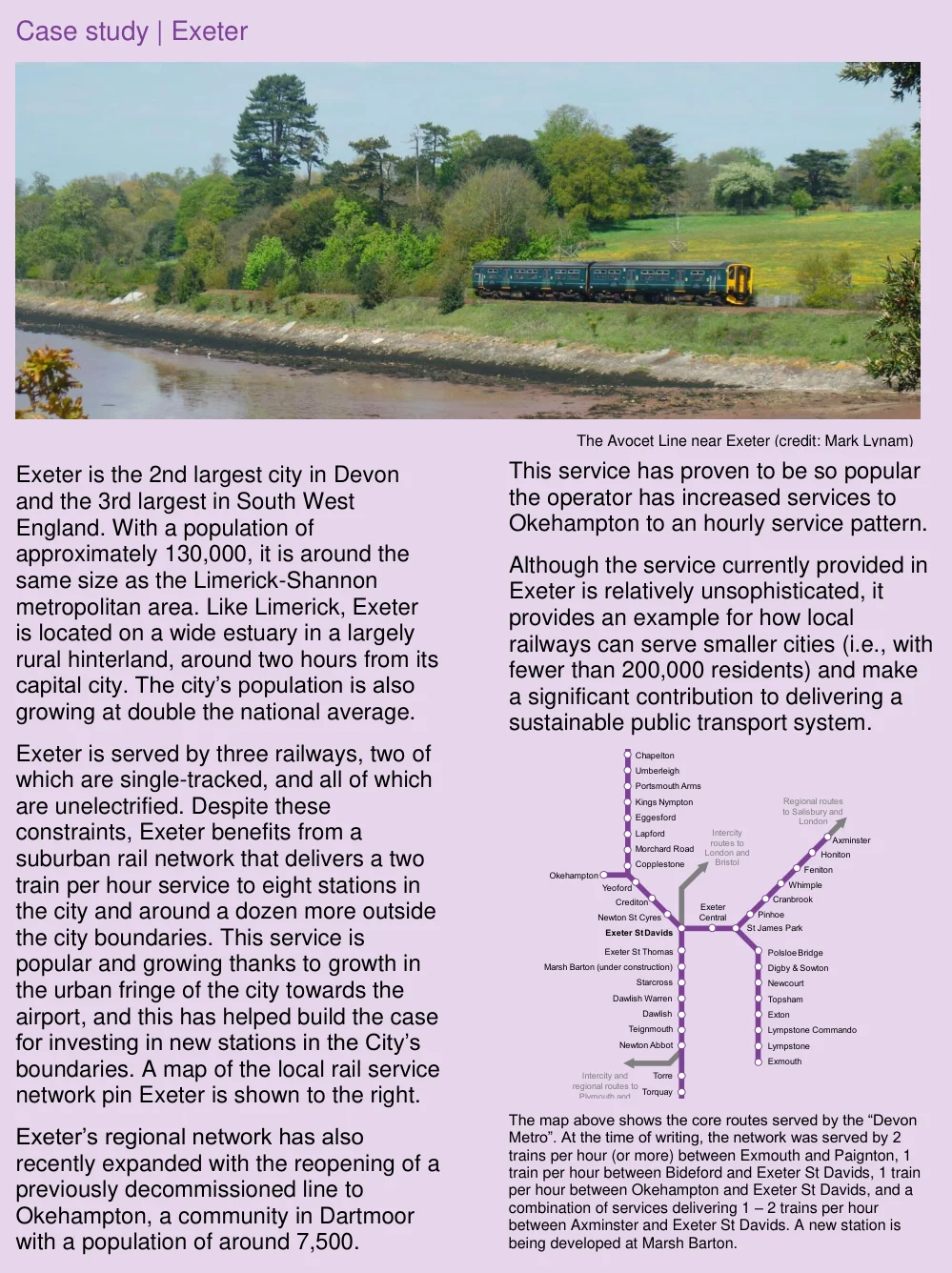
Figure from page 76
Case study | Exeter
The Avocet Line near Exeter (credit: Mark Lynam)
This service has proven to be so popular the operator has increased services to Okehampton to an hourly service pattern.
Exeter is the 2nd largest city in Devon and the 3rd largest in South West England. With a population of approximately 130,000, it is around the same size as the Limerick-Shannon metropolitan area. Like Limerick, Exeter is located on a wide estuary in a largely rural hinterland, around two hours from its capital city. The city’s population is also growing at double the national average.
Although the service currently provided in Exeter is relatively unsophisticated, it provides an example for how local railways can serve smaller cities (i.e., with fewer than 200,000 residents) and make a significant contribution to delivering a sustainable public transport system.
Exeter is served by three railways, two of which are single-tracked, and all of which are unelectrified. Despite these constraints, Exeter benefits from a suburban rail network that delivers a two train per hour service to eight stations in the city and around a dozen more outside the city boundaries. This service is popular and growing thanks to growth in the urban fringe of the city towards the airport, and this has helped build the case for investing in new stations in the City’s boundaries. A map of the local rail service network pin Exeter is shown to the right.
Chapelton
mberleigh
Portsmouth Arms
Regional routes to Salisbury and
Kings Nympton
Eggesford
London
Intercity routes to London and
Lapford
Axminster
Morchard Road
Honiton
Bristol
Copplestone
Feniton
Okehampton
Whimple
eoford
Cranbrook
Crediton
Exeter Central
Pinhoe
Newton St Cyres
St ames Park
xeter St avids
Exeter St Thomas
Polsloe Bridge
Marsh Barton (under construction)
Digby Sowton
Starcross
Newcourt
Dawlish Warren
Topsham
Dawlish
Exton
Teignmouth
Lympstone Commando
Newton Abbot
Lympstone
Exmouth
Intercity and regional routes to
Torre
Tor uay
Plymouth and
The map above shows the core routes served by the “Devon Metro”. At the time of writing, the network was served by 2 trains per hour (or more) between Exmouth and Paignton, 1 train per hour between Bideford and Exeter St Davids, 1 train per hour between Okehampton and Exeter St Davids, and a combination of services delivering 1 – 2 trains per hour between Axminster and Exeter St Davids. A new station is being developed at Marsh Barton.
Exeter’s regional network has also recently expanded with the reopening of a previously decommissioned line to Okehampton, a community in Dartmoor with a population of around 7,500.
Freight
Despite recent challenges, the Iarnród Éireann Rail Freight 2040 Strategy aims to grow rail freight towards levels seen in Europe and provides a framework to achieve this goal.
Rail freight is something of a “niche” activity on Ireland’s railways today. The railway supports some outbound freight flows from Mayo to Waterford and mining products from Tara Mines to Dublin, as well as inbound intermodal freight from Dublin and Waterford to the North West. However, the competitiveness of rail freight has been significantly eroded in recent decades and volumes have fallen from c.4 million tonnes in 1981 to c.0.3 million today (which is less than 1% of modal share).
This Review has explored opportunities for increasing rail freight’s market share so that it is broadly comparable to similar countries and recognises that future rail freight growth will come from modal shift (rather than organic growth). This will help reduce carbon emissions, improve air quality, reduce road noise and congestion, and support regional economic development.
There are also opportunities to develop inland rail freight terminals to serve the largest urban and industrial areas across the island – including areas in Northern Ireland. These large multi-purpose rail freight interchange and distribution centres would be ideally linked to both the rail and strategic road networks. They could play a role in helping reverse rail freight’s recent decline on the island.
As Figure 15 below shows, in 2019 Ireland recorded the lowest level of rail freight mode share in the European Union (excluding Member States that have no railways). Northern Ireland (which is in the UK figure below) currently has no regular rail freight operations. There are several factors driving this trend, including changes in freight and logistics patterns, the development of Ireland’s motorway network, and many of the railway’s infrastructure constraints outlined in Chapters 2 and 3. The cost of rail freight versus road freight, including relatively high track access charges levied on operators, is also an issue.
There are also opportunities to improve the efficiency of transferring freight between rail and sea transport. Currently, the rail network can only accommodate Load-on/Load-off (“LoLo”) cargo movements, but some European railways can also accommodate Roll- On/Roll-Off (“RoRo”).
80
Rail freight mode share (%, 2019)
70
60
50
40
30
20
10
0
Figure 15
European countries’ rail freight mode share (source: Eurostat, 2019)
Approach
Dublin Port will play a key role in helping grow rail freight in Ireland. The 2040 Dublin Port Masterplan plans for growth through consolidating the existing estate and expanding on the Poolbeg peninsula. Rail connectivity to the current port area is poor – part of the railway runs on and across busy roads, creating significant conflicts with road traffic – and there is currently no rail connectivity to Poolbeg. These challenges will need to be addressed to realise the objective of growing rail freight in Ireland to reduce road congestion and decarbonise the transport system.
The Iarnród Éireann 2040 rail freight strategy proposes to increase Ireland’s rail freight’s mode share “in line with other European countries”. Given Ireland’s geographical context as an island situated some distance from the core rail freight corridors of Europe, it seems reasonable to target the level of mode share that is currently achieved by other island and/or peninsula railways in Europe. This ranges from 3% in Greece to 30% in Sweden, but most countries in this category appear to lie in the 5 – 10% range. This Review has therefore considered how the railway could support a level ofrail freight mode comparable to western European countries – around 10%, which reflects an ambition to use rail freight to decarbonise the island’s transport system. This will likely require interventions to support higher outbound flows, which tend to focus on the South Coast ports, and higher inbound intermodal flows, which are likely to target the island’s largest cities. There are also opportunities to leverage recent adjustments to trade patterns between Ireland, the UK mainland, and Europe to support rail freight flows between the island’s South Coast ports and the European mainland.
Strategic options
To grow rail freight in the island of Ireland, the Review has considered the following:
•Rail freight needs be price competitive with road freight, and it needs to connect major freight producers and customers together in a reasonable time. This means the railway needs to connect seamlessly to Ireland’s busiest ports and connect with inland rail freight terminals that serve the island’s largest population and industrial areas. This also means ports connected with the railway should enable the LoLo cargo movements, although it is noted that in some European countries increased levels of RoRo cargo movements are being handled via rail also, which warrants consideration in Ireland.
Future rail freight services within the island of Ireland are likely to be most viable where there is a sufficient critical mass of cargo movements (in terms of tonnes-lifted). In general, this means rail freight is likely to be competitive on corridors that support at least one million tonnes per annum of road freight covering distances above 100km. This suggests the greatest potential for intermodal rail freight will focus on routes between Dublin and the largest cities on the island of Ireland, while the greatest potential for outbound flows is from the North West to the South Coast ports.
•Rail freight must enable seamless movements between ports and inland terminals. This means key freight corridors must have the capacity to accommodate freight services and minimise conflicts with other rail users.
•Rail freight should be provided with access to decarbonised forms of railway traction.
Many of the interventions outlined earlier in this Chapter will support rail freight. These include:
Additionally, there will need to be enhancements to current ports and inland terminals, and the development of new inland terminals to serve the island’s largest industrial areas. While it is not the role of this Review to recommend specific locations for these terminals, it is considered that at least one terminal should be developed for the largest cities on the island of Ireland – ideally at locations with good road access, and where the railway is well suited to accommodating freight traffic. Further assessment will be needed to establish ideal locations for these terminals. To serve these terminals, there would need to be an increase in freight rolling stock capacity (both locomotives and wagons).
•Developing a new railway to link between Limerick – Foynes.
•Reinstating the railway between Claremorris – Athenry to enable rail freight from the North West to access the South and Mid West while avoiding the busy Dublin – Cork line (and the need to reverse at Kildare).
•Reinstating the railway between Rosslare – Waterford. While there is currently no rail freight traffic from Rosslare Europort, in the longer term this port could be developed to accommodate LoLo movements.
The Review has considered options for improving connections to the Port of Belfast and Ringaskiddy. In these cases, it was found that developing new rail links would be very costly and disruptive and would encourage freight traffic to use parts of the railway that are already quite congested. Alternative options for Belfast include developing an inland terminal to the South West of the city and alternative options for Ringaskiddy include connecting to Marino Point near Cobh.
•Reinstating the railways between Athlone – Mullingar – Portadown and adding capacity between Dublin – Mullingar. This will provide alternative routes between Dublin and the North and West (avoiding intercity routes).
•Adding capacity on corridors used by rail freight today, and that could be used in the future, including Dublin – Athlone, Dublin – Drogheda, and Limerick – Waterford.
•Considering opportunities to better connect other ports to the railway where it runs close to ports such as Marino Point near Cobh.
The Review has also analysed the economics of rail freight in Ireland and established that track access charges – which are reportedly among the highest in Europe – present a major barrier to growth. Analysis undertaken for this Review suggests bringing these charges closer to the levels that are typically levied in the EU should help stimulate growth in rail freight in the short term.
Recommendations
Strengthen rail connectivity to the island’s busiest ports where links are feasible and improve access to ports that currently are underserved by rail freight, including Foynes for Limerick, Waterford, Marino Point for Cork, and Rosslare Europort (in the longer term, when LoLo operations are feasible here, or, in the shorter term following analysis of the feasibility of RoRo rail freight).
To grow the island’s rail freight industry and support the freight Objectives of this Review, both jurisdictions should develop plans to:
•Develop a sustainable solution for first-mile-last-mile rail freight access for Dublin Port. Without this connection, there are limited options for growing rail freight.
21
•Develop a network of inland terminals close to major cities on the rail network, especially where there is good access to major roads/motorways, limited impact on communities and passenger traffic, and good access to industrial clusters. Potential locations for new terminals include the Upper Bann area for Northern Ireland, Limerick Junction, a location north of Cork, Athenry for Galway, Sligo, and west of Dublin.
24
•Reduce Track Access Charges for freight services. These charges are high compared to other European railways but could be reduced through support/government subsidy to stimulate demand for rail freight.
22
These interventions will enable freight services to operate on routes that avoid many busy intercity routes, as shown in light blue in Figure 16.
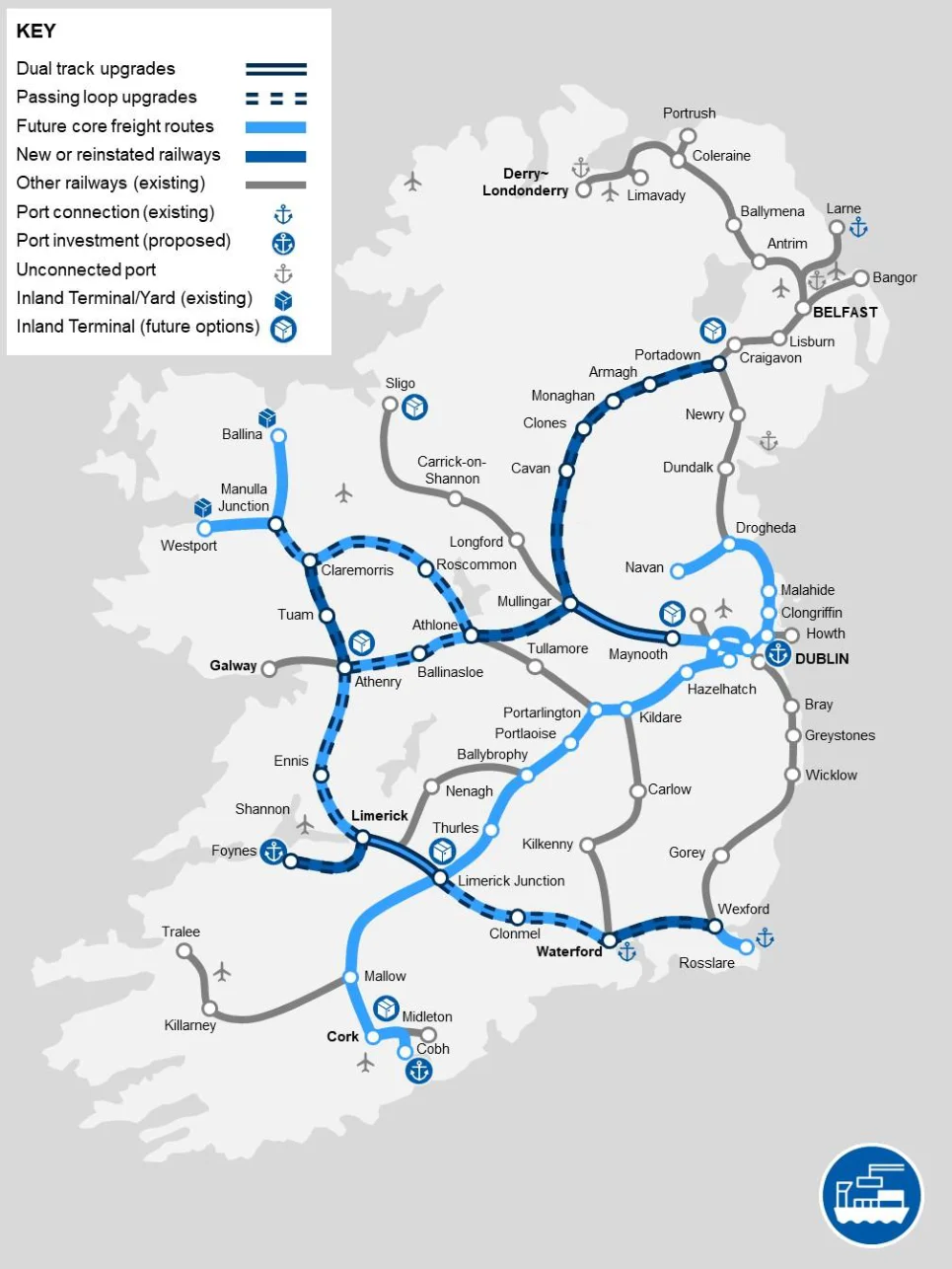
Figure 16
Figure 16 Rail freight interventions
Case Study | New Zealand
The New Zealand Rail Plan identifies several challenges that could hold back growth of rail freight. While some of these are external to the industry (e.g., COVID- 19), there are many operational restrictions and gaps in electrification across the network. To address these challenges plan, the government has committed to invest in:
•A longer-term sustainable programme of maintenance and renewals; and
New Zealand is an island nation with a similar population to Ireland but is more isolated from its nearest neighbours. As in Ireland, rail freight in New Zealand is used for moving imports and exports to and from major ports as well as carrying bulk commodities such as logging.
•A programme of intergenerational replacement of locomotives, Interislander ferries, wagons and shunts, and modernisation of facilities reaching end of life.
KiwiRail (a state owned enterprise) manages the 4,000km rail network and operates both freight and passenger services. The network is split into two parts, one on the North Island and the other on the South Island. Both islands are connected by the Interislander ferry service, which can carry rail vehicles. The rail network outside of cities is largely dedicated to freight (see map to the right).
Funding for these investments will come through the National Land Transport Programme under the new planning and funding framework, with support from the Crown and track users. The first tranches of funding have already been committed to a range of projects, including core asset maintenance, intergenerational asset replacement of rolling stock and Interislander ferries.
Rail freight’s mode share in New Zealand is much higher than in Ireland. In 2017/18, rail freight’s mode share was 11.5% for all goods and much higher in coal, paper, dairy, and meat products. KiwiRail operates more than 900 freight trains per week, or around 130 a day. While rail’s freight share has remained steady in recent years, there are concerns the industry will stagnate without intervention.
Thanks to recent investment, some ports have experienced significant growth in rail freight demand. For example, the Lyttelton Port Company saw significant growth in demand and subsequent rail freight services, with weekly services increasing from 2-3 per week in 2016 to 16 per week by 2020. The port estimates that this takes 120 heavy vehicles off the road each day. The port also notes that customers see rail freight as a key component of reducing the carbon emissions associated with their products. A new weekday rail service between Auckland and Christchurch is also being launched to help New Zealand businesses recover from the pandemic.
The Government considers rail an essential part of the freight industry, providing resilience through offering an alternative transport option for importers and exporters. Investing in restoring the rail freight network is one of two strategic investment priorities in the recently published 2021 Rail New Zealand Plan, which sets a framework for delivering a resilient and reliable rail network.
New Zealand shows it is possible for rail freight to compete and succeed on an island network.
Customer
Many of the interventions outlined in this section will be seen as ‘Business as Usual’ as the railway continuously improves its customer offer. One example of this is the railway’s continuous programme to improve accessibility by investing in stations and rolling stock that provide a seamless experience for all passengers – regardless of their needs.
Experience
Customer experience cuts across all aspects of the railways across the island. Customer satisfaction is driven by a wide range of factors that can affect all stages of a typical journey. This journey includes multiple stages, which are: journey planning; ticket purchase (and affordability); the journey to the station; experience at the station; experience on the train; interchange and egress; the journey to destination; and post journey customer care (lost property, compensation, etc.). To deliver a good customer experience it is therefore important to consider each part of a customer’s journey and work to ensure this journey is as seamless as possible.
As fully integrated, vertically aligned operators, Iarnród Éireann and Translink are well placed to deliver a seamless customer experience. Many of the factors that drive customer satisfaction are monitored by Public Service Contracts in both jurisdictions. The contract in place in Ireland imposes penalties on Iarnród Éireann if they consistently fail to deliver good customer service.
Strategic options
Many of the infrastructure-led interventions described earlier in this chapter will help improve several key elements of service quality: including the speed, frequency, and reliability of services.
While customer satisfaction with passenger rail services is generally high in both jurisdictions, international benchmarking suggests the current customer offer is behind comparative European operators. At the time of writing, for example, on-board catering is quite limited, and many stations lack adequate amenities for the size of the communities they serve (e.g., Lurgan).
In addition, there are opportunities to improve the passenger experience by:
•Improving the availability of information in advance, during, and after each journey – especially during periods of planned and unplanned disruption, particularly for those with disabilities which make it harder to access information and services.
Many topics considered in this section were highlighted in hundreds of responses to the first public consultation that supported this Review. In particular, respondents highlighted concerns about accessibility, integration, affordability, cleanliness and anti-social behaviour. Some of the concerns highlighted in the public consultation could and should be addressed in the short term. Indeed, there are already many initiatives underway in both jurisdictions to improve customer experience, such as investments in integrated ticketing systems, step-free access, and new rolling stock.
•Targeting investments that add capacity to reduce overcrowding, such as longer trains and more frequent passenger services.
•Using cascaded rolling stock to deliver more frequent, ‘clock-face’ timetable services.
•Maintaining a consistently high-quality cleaning and maintenance regime across the whole railway estate.
Both jurisdictions should continue to invest in online, in-station, and on-board information systems and leverage opportunities presented by the latest technology. For example, many on-board customer information systems also provide information about crowding in different carriages, toilet occupancy, the status of connecting services, and notices about events. Additionally, both jurisdictions should work with operators to enable them to provide real-time timetables and performance data through Advanced Programming Interfaces (APIs). This will enable developers to build applications that provide customers with better information to enable them to plan their end-to-end journeys.
•Ensuring stations and rolling stock are attractive, clean, accessible, warm, well lit, and equipped to enable customers, regardless of their mobility needs, to undertake their journeys.
•Providing a wider range of hot and cold catering at larger stations and on longer distance services.
•Providing, maintaining, and cleaning high-quality facilities (e.g., washrooms) at stations and on longer distance services.
•Providing wi-fi and charging facilities at stations and onboard trains to enable passengers to work and enjoy online activities on board services.
Stations
While many stations on the island of Ireland provide a welcoming environment for customers, the station experience varies significantly across the island. Not all stations provide the ticketing, waiting, alighting, and interchanging services that most customers have come to expect from modern public transport. Research shows that the station experience is a particularly important driver for longer distance passengers who tend to spend more time at stations. The accessibility of stations is also critically important to passengers with mobility needs, and wayfinding is important for passengers unfamiliar with the railway.
•Providing car parking, secure bike storage (at stations and on trains), and high-quality interchanges with public transport and walking and cycling networks at stations.
•Ensuring the railway estate is accessible for passengers with mobility needs.
Many of the interventions listed above are being pursued by multiple agencies in the rail and wider transport industry, and there have been significant improvements delivered in recent years (notably contactless and integrated payment systems).
Each jurisdiction has a rolling programme of station enhancements and renewals. It is common for enhancements (and new stations) to be tied to local investment in growth and development, which can help raise the quality of the built environment to the benefit of all parties. Stations also offer opportunities to generate revenue from customers by providing retail and hospitality services – these services not only increase customer choice but also help build the case for further investment.
Planning and information
The quality, timeliness, and accuracy of information provided to customers (and potential customers) is a key driver of customer satisfaction. This issue is especially important during periods of disruption, when customer anxiety is often at its highest and when information is often at its scarcest.
Rolling stock
Fares and ticketing
One of the most significant drivers of customer satisfaction is the quality, accessibility, maintenance, and cleanliness of rolling stock. In addition to the quality of the on-board experience that is provided by rolling stock, the size of the fleet often drives the regularity and frequency of timetables, which is another key driver of customer satisfaction.
One of the most popular topics of political discourse about the railways – and public transport in general – is the affordability and simplicity of fares. There will always be a challenge in balancing the needs of passengers (and the benefits to society arising from their decision to travel by rail and not by car) with the needs of taxpayers, who ultimately fund the gap between the cost of running the railway and the revenues generated from operations. At the time of writing, each EU Member State that has a railway (as well as the UK) provides some form of subsidy to passenger rail services. In some cases, governments are covering more than half the total cost of operating passenger rail services in their jurisdictions. Some subsidy is therefore likely to be needed for years to come.
Figure from page 85
Many of the infrastructure-led interventions described earlier in this chapter will only deliver their full benefits if they are supported by high-quality, lowcarbon, high-performance, accessible rolling stock. This presents some challenges in timing the delivery of interventions. For example, much of the Iarnród Éireann intercity fleet (which is entirely driven by diesel traction) is relatively new and will not need to be replaced for at least a decade. This suggests the near-term focus of electrification should be on DART and Enterprise services, as rolling stock for these services is due for renewal earlier.
The Irish government has recently reduced fares for some journeys and aspires to generally improve the affordability of public transport. There may be opportunities to further reduce fares where capacity is in high supply, for example in counter peak directions travelling out of Dublin in the morning. Varying fares on longer distance services could help match demand to supply for services that offer reservations systems.
In the longer term, both jurisdictions should ensure their future rolling stock fleets are:
•As standardised and consistent as possible (as they generally are today).
There are opportunities to further improve ticketing systems. Digital ticketing and contactless payment systems should continue to roll out across the whole island, and these should integrate well with other payment systems.
•Capable of electric and non-electric (but otherwise decarbonised) traction.
•Capable of reaching up to 160km/h on regional and rural routes and up to 200km/h on intercity routes – if the infrastructure-led interventions described above are delivered.
•Configured to provide high levels of comfort, accessibility and highquality amenities (e.g., information, wi-fi, charging points, good quality catering, washrooms, etc.).
•Aligning service calling patterns to enable seamless transfer to other rail and other public transport services.
Accessibility and integration
The Review recognises that inaccessibility in transport means more than just not being able to gain access to physical infrastructure. It presents a real obstacle for autonomy, personal development and participation in a wide range of activities in the community. Many of the interventions outlined in this Review – including proposed expansion of the rail network and increases in service frequency – provide a way of addressing wider challenges and opportunities for the island of Ireland, including in terms of supporting an aging population and supporting more equitable outcomes for all. The Review also recognises the commitment of both jurisdictions to invest in rolling programmes to improve accessibility across the public transport network.
There are examples of the initiatives listed above being delivered in both jurisdictions. For example, Translink provides free bus services between some stations and their respective city centres (e.g., Newry), and Dublin’s terminus stations have good connectivity to other public transport services (e.g., Luas and bus). An integrated Next Generation Ticketing plan is being developed by the National Transport Authority in Ireland. Delivering further improvements will rely on the co-operation of parties outside the rail industry. There may be a role for government to enable these parties to work seamlessly together.
Figure from page 86
Cross-border partnership working
As the railway grows and develops potentially more cross-border opportunities, there could be a case for strengthening cross-border working in the planning of cross-border infrastructure and rail services. This is likely to be needed if the number of cross-border passenger rail services grows from a few dozen today to potentially over a hundred in the future.
That said, there are opportunities to further improve the accessibility and integration by:
•Improving the physical integration of rail stations with other public transport and active travel options.
•Improving the accessibility of the railway, particularly for those with mobility needs. This should include step-free access to and within stations and, where future interventions allow, step-free rolling stock.
Finally, the Department of Transport and Department for Infrastructure, along with other key stakeholders who have been engaged in this Review, wish to highlight the benefits of undertaking this exercise across both jurisdictions, and express the hope that such an exercise can be repeated. The final recommendation of this Review is, therefore, to encourage political leaders to commit to a reevaluation of this Review over its timeframe to reflect on progress to date, refresh objectives, and – where appropriate – amend recommendations to deliver the railway the island of Ireland needs to thrive as a prosperous, sustainable community in the long-term.
•Providing better information about accessibility on on-line platforms and using audio-visual announcements on trains and at stations.
•Aligning fare structures and concessions, between both rail operators and/or with other public transport providers.
•Integrating modern customer information and payment systems.
•Invest in improving integration within rail and between rail and other transport options – and put in place appropriate forums to coordinate work across institutions.
Recommendations
Both jurisdictions are recommended to:
•Continue to invest in initiatives that deliver a seamless customer journey such as improving information provision and catering.
25
•Deliver clock-face timetablecalling patterns that integrate with other services.
29
•Continue to benchmark and monitor service quality and deliver continuous improvement. The Public Service Contracts provide a framework for holding operators to account for delivering high levels of service.
26
•Develop cross-border structures to improve the effectiveness of crossborder infrastructure and rail service planning.
30
•Continue to invest in a rolling programme of accessibility improvements, including step-free access, to ensure that all people have equal access to the railways.
31
•Ensure future rolling stock specifications are aligned to the infrastructure-led interventions outlined in this Review. This includes increasing the size and/or speed of the rolling stock fleet to deliver higher frequency service patterns and new services.
27
Update the All-Island Strategic Rail Review once a decade, taking account of latest policies and developments.
32
The costs of these interventions are not included in the capital costs presented in Chapter 5 but would be expected to be included in “business as usual” costs.
| Case Study | Leap Card | ||||
|---|---|---|---|---|
| In 2011, the Railway Procurement Agency (now part of Transport Infrastructure Ireland) developed a contactless smart card for automated fare collection for the Greater Dublin Area. This enabled users to pay for Luas, DART, Iarnród Éireann and Dublin Bus services with a single card. This card was branded the “Leap Card” and has since been rolled out across many urban areas in Ireland. Today, Leap Cards are widely accepted in the Greater Dublin Area, the Cork Metropolitan Area, the Limerick and Shannon Metropolitan Area, Galway, Waterford, Westmeath, Drogheda, Sligo, and Kilkenny. There are plans to expand further to other towns and communities in Ireland. Initially, Leap Cards offered only a pre- paid electronic wallet system for single-trip fares, but it has since developed to enable weekly, monthly, and annual subscriptions. It also enables concessions (such as student discounts) and can be purchased tax-free through employers. Tickets purchased using the Leap Card are generally discounted compared to cash prices, and integrated ticketing is offered in the Dublin area via a flat fare system across all modes of transport. Leap Cards can be purchased at convenience stores offering Payzone services and topped up at any Luas or Irish Rail ticketing machines, using iPhone/ Android Apps, and in convenience stores. The minimum top-up for the card is currently €5.00/£4.20. Users who opt to register their card can also view their purchase history on line. | In 2011, the Railway Procurement Agency | |||
| (now part of Transport Infrastructure | ||||
| Ireland) developed a contactless smart | ||||
| card for automated fare collection for the | ||||
| Greater Dublin Area. This enabled users | ||||
| to pay for Luas, DART, Iarnród Éireann | ||||
| and Dublin Bus services with a single | ||||
| card. This card was branded the “Leap | ||||
| Card” and has since been rolled out | ||||
| across many urban areas in Ireland. | ||||
| Today, Leap Cards are widely accepted in | ||||
| Today, the Leap Card is accepted | ||||
| the Greater Dublin Area, the Cork | ||||
| Metropolitan Area, the Limerick and | nationwide on numerous private bus | |||
| Shannon Metropolitan Area, Galway, | operators’ services all over the country as | |||
| Waterford, Westmeath, Drogheda, Sligo, | well as on many services managed by the | |||
| and Kilkenny. There are plans to expand | National Transport Authority. Leap Cards | |||
| further to other towns and communities in | are accepted across more than 13,000 | |||
| Ireland. | devices from more than 13 different | |||
| Initially, Leap Cards offered only a pre- | equipment suppliers. | |||
| To date over 6.3 million Leap Cards have | ||||
| paid electronic wallet system for single-trip | ||||
| fares, but it has since developed to enable | been issued of all types. The card has | |||
| weekly, monthly, and annual | been used for more than 1.2 billion | |||
| subscriptions. It also enables concessions | journeys, and the payment system | |||
| (such as student discounts) and can be | underpinning the card has handled over | |||
| purchased tax-free through employers. | €1.6bn/£1.3bn in top-ups. 2022 was the | |||
| Tickets purchased using the Leap Card | busiest year ever for sales of Leap Cards, | |||
| with over 950,000 cards issued across | ||||
| are generally discounted compared to | ||||
| Ireland. | ||||
| cash prices, and integrated ticketing is | ||||
| Looking ahead, there are opportunities to | ||||
| offered in the Dublin area via a flat fare | ||||
| system across all modes of transport. | expand contactless and integrated | |||
| Leap Cards can be purchased at | ticketing beyond current metropolitan | |||
| areas to spread the benefits of integration | ||||
| convenience stores offering Payzone | ||||
| to the rest of the island of Ireland. | ||||
| services and topped up at any Luas or | ||||
| This case study shows the benefits of | ||||
| Irish Rail ticketing machines, using | ||||
| iPhone/ Android Apps, and in convenience | delivering integrated public transport | |||
| stores. The minimum top-up for the card is | services across the island of Ireland and | |||
| currently €5.00/£4.20. Users who opt to | showcases the improvements that are | |||
| register their card can also view their | being delivered today, thanks to cross- | |||
| purchase history on line. | agency working and partnerships. | |||
Pages 43–88 · View in original PDF