Chapter 3 | The Case for Change

Figure from page 33
Figure from page 34
Introduction
•Station access is inconsistent and, in some places, poor. Many stations are not fully accessible to users with mobility needs, and many stations are located some distance from the communities they serve.
This Chapter describes the key challenges and constraints the current railway on the island of Ireland is facing and the undesirable outcomes the current railway is generating. It summarises the findings of the public consultations that were held to inform this Review, which demonstrated the significant public interest in improving rail services across the island. This is followed by a discussion of the policy response to current arrangements, and a summary of this Review’s Vision, Goals, and Objectives.
•No major airport on the island is currently served by passenger rail services. Only Kerry and George Best Belfast City Airports are currently served by the rail network, and these do not have direct connections to terminal buildings. Dublin Airport is the busiest airport in Europe without a railway or metro station.
Figure from page 35
Challenges and constraints
•Integration across cities (notably Dublin), modes, and jurisdictions is inconsistent. Allowing for interchange times with Luas it takes around 40 minutes to cross Dublin from Heuston to Connolly, which can make journeys from Belfast to towns and cities beyond Dublin very long.
The key challenges and constraints identified by the Review (shown in Figure 6) are:
•There are significant gaps in the rail network’s coverage. There is significant interest in this study from stakeholders in poorly served areas who wish to see their communities back on the rail map.
•Current infrastructure limits opportunities to deliver affordable, transformational improvements. A map showing the key infrastructure constraints of the current rail network is provided in Figure 6.
•Service frequencies and speeds are relatively low compared to similar railways (such as in Scotland and Denmark – see Chapter 4). The train is often slower than the car and bus between key cities.
•Demographics on the island are not conducive to supporting high density, high frequency railway networks in many places. There are some corridors and communities whose public transport needs are probably better served by bus.
•Ireland has the lowest level of electrified railway in the European Union and Northern Ireland has no electric railways. Electrification is a key enabler for achieving a net-zero carbon transport system.
•The island’s natural assets present some constraints to future rail development on some corridors. Many of the island’s coastal transport corridors pass through highly scenic (and designated/protected) areas.
•The quality of service offered does not consistently meet customer expectations. Many respondents to the initial public consultation highlighted concerns about service quality (e.g. lack of catering on services).
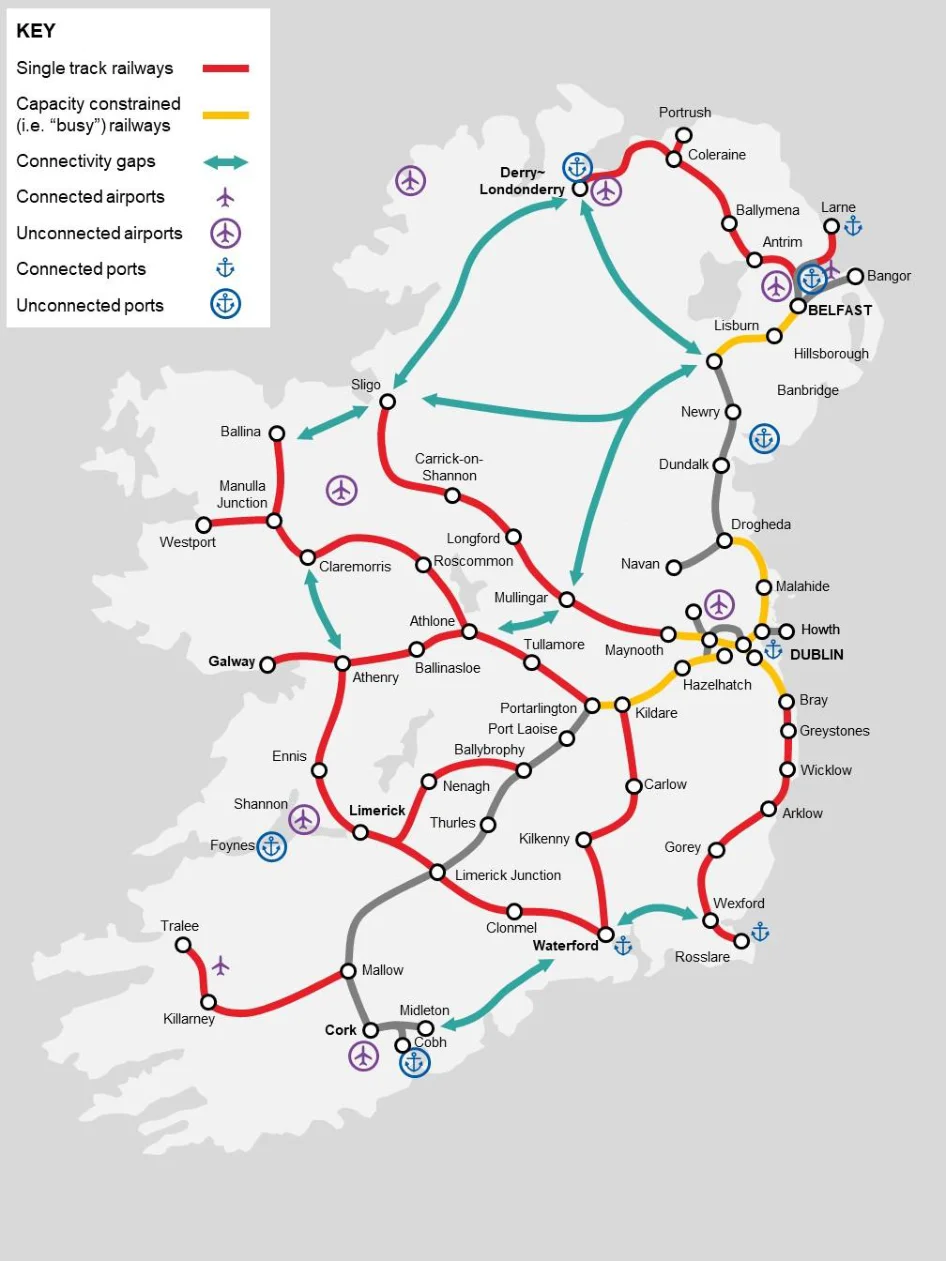
Figure 6
Figure 6 Key constraints and connectivity gaps
•Environmental impacts: Rail can play a significant role in the fight against climate change. The carbon footprint of rail is significantly lower than cars and HGVs and can be lower still if the rail network decarbonises. Rail is also space efficient, which means it can deliver high-capacity, transport corridors that require less land, and generate less noise/air pollution than roads.
Undesired outcomes
The challenges and constraints described above are driving the following undesirable outcomes:
•Low passenger rail mode share and high private car mode share.
•Low rail freight mode share and high road freight mode share.
•Relatively high carbon emissions from the rail and the wider transport system.
•Challenging rail industry finances: Low passenger and freight use risks fuelling a vicious cycle. In the past, low demand has harmed the case for investment. Boosting demand would help put the rail industry’s finances on a more sustainable footing.
These drive the following undesirable wider socioeconomic and environmental impacts:
•Economic impacts: High private car and road freight mode share means more congested roads, reduced productivity, and in some circumstances, missed opportunities for investment. Indirectly, high reliance on cars can promote low density development and inefficient land use. Improving rail services can enable businesses to access larger customer and labour markets and unlock agglomeration benefits (from pooling of resources/labour markets) across regions.
Stakeholder aspirations
The Review held a firstpublic consultation from November 2021 to January 2022 and asked the public and wider stakeholders in both jurisdictions about their aspirations for the railway. The “Work Package 1: Context and Policy” Report, which is published alongside this Report, provides details about the results of this consultation.
This exercise showed there is significant interest from stakeholders in both jurisdictions in improving rail services across the whole island. In total, 7,120 responses were received via the consultation website and email. Input was also sought from public bodies at all levels of government as well as voluntary and specialist interest groups.
•Social impacts: Overreliance on cars and Heavy Good Vehicles (HGVs) risks isolating vulnerable communities and limiting equitable access to jobs and services. Heavy traffic is associated with poor air quality and reduced safety, which undermines health and wellbeing. Some policy responses to congestion, such as road expansion, can be costly and may only work in the short term (road building often induces more demand).
There was a particularly strong response rate from the North West of the island where many respondents expressed interest in seeing the reinstatement and improvement of passenger railway services in these areas. There were slightly more responses from Northern Ireland (54%) as compared to the rest of the island (42% – other responses did not
•Many public respondents said they felt the quality of infrastructure was behind comparable European countries, and that they wanted to feel pride in their infrastructure. This included several references to airport and port connectivity, which are seen to be better in comparable European counties.
declare a specific location), which reflected strong interest in this study in the North West. A map showing the distribution of responses to the initial public consultation alongside the current coverage of the rail network is provided in Figure 7. The key themes that emerged from the initial consultation were:
•There is significant interest in improving intercity connectivity (particularly from urban dwellers) and enhancing regional and rural connectivity.
•Respondents also cited anti-social behaviour as a concern, which reflects recent data showing a marked increase in policing interventions between 2019 and 2020 (which may reflect concern about COVID-19 pandemic offences).
•There is significant interest in reinstating or building new railways. 85% of public responses cited this aspiration (97% of responses in the North West of the island).
The responses from this consultation have been used to develop and refine the Goals and Objectives of this study, which are set out later in this Chapter.
•Public responses also highlighted strong interest in shortening journey times, increasing service frequencies, and decarbonising the wider transport system.
•Responses from public stakeholders (e.g., local councils) placed significant emphasis on decarbonisation and climate change. These stakeholders also highlighted the role rail could play in supporting local economic development, enabling modal shift from road to rail freight, boosting connectivity to global gateways, and supporting tourism.
•Several respondents wished to see better integration between cycling and rail and with Park and Ride interchanges. More broadly, accessibility was raised as a concern from several respondents.
Figure 7 Consultation responses by area
SEA Public consultation
The following amendments have been included in this final Report to take account of feedback from the public consultation exercise.
The Review held a second public consultation from July to September 2023. The technical remit of this consultation was to formally consult on a Draft Strategic Environmental Assessment (SEA), which was published alongside the Draft Final Report for the Review. However, a large majority of responses focused on non-SEA topics.
•A specific new recommendation to continue to invest in improving accessibility on the rail network, including rolling out step-free access more widely. The Review also commits to undertake Equality Impact Assessments when schemes are taken forward for future development.
In total, 454 unique responses were received: 131 from stakeholders, including airports and ports, business groups, campaign groups, councils, elected officials, government, and other institutions; and 323 from the public. Of the responses that expressed a clear opinion of the Review and its recommendations, approximately 64% were favourable; 29% were unfavourable; and 7% expressed mixed sentiments. The most cited issue in the consultation, featuring in 32% of responses, was the absence of proposals to extend rail services to Enniskillen in Co. Fermanagh. Excluding responses relating to Fermanagh, approximately 74% of the remaining responses were favourable; 17% were unfavourable; and 9% were mixed. Only 2% of respondents were unsupportive of not investing more in rail. Additional feedback included requests for the Review to go further by proposing to reopen more railways and include more new stations in the recommendations. There were also requests to examine the role of tourism in boosting demand, and to make firmer commitments to delivering a more accessible railway.
•A new recommendation for both jurisdictions to undertake a refresh of this Review once a decade.
•The Report has been amended to clarify that the proposed new railway between Derry~Londonderry and Portadown should be designed to accommodate line speeds up to 200km/h, as was the intention in the Draft Final Report.
•The Report has been amended to reflect plans to improve connectivity to the South- East – as outlined in the latest Greater Dublin Area Transport Strategy – to include the extension of the DART network to Wicklow.
•The timeline for delivery has been adjusted to bring forward the reinstatement of the North Midlands railway between Portadown and Armagh from a long-term to a medium-term horizon.,
•Maps have been amended to include a proposed new station at Craigavon.
•Some technical wording has been adjusted to reflect the high-level nature of the Review (e.g. removing references to in-cab signalling).
The feedback from this consultation was carefully analysed and motivated the project team to commission further research – including into the potential role of tourism demand in strengthening the case for investment, as well as sensitivity tests relating to rail to Enniskillen.
•A reference has been added to the Executive Summary on safeguarding alignments identified for future railways and stations. Further details about this public consultation are provided in Appendix A.
Policy context
Vision, Goals, and Objectives
There are strong commitments to reducing the carbon emissions associated with transport. Policies and plans at every level of government in both jurisdictions have clear aims to increase the share of passenger travel by sustainable modes: public transport, walking and cycling.
This Review aims to present a coherent strategic vision for delivering a railway that meets the aspirations of the people it serves and supports the development of a prosperous, equitable, and sustainable future. The Vision Statement underpinning the Goals and Objectives of this Review is to deliver:
Public policy recognises that rail is well placed to address wider challenges and opportunities for the island of Ireland. As the stronger backbone of a sustainable transport system, rail can support a growing and aging population, enable housing growth and other transport orientated development, mitigate congestion in cities, and deliver more equitable outcomes for all regions and cities of the island.
“An accessible, efficient, safe and sustainable transport system that supports communities, households and businesses.”
To deliver this ambition, the Review developed six overarching Goals and 13 Objectives. These are set out in Table 1. The Goals and Objectives were published in November 2021 as part of the initial public consultation and were positively received by many respondents to this consultation. The Goals and Objectives have been endorsed by Steering Group members from both jurisdictions. In the following Chapter, this Report presents a set of recommendations that have been developed by the Review that, collectively, deliver the Vision, Goals, and Objectives of this Review.
Both jurisdictions are committed to investing in public transport to address the challenges the island faces. However, to unlock this investment, there needs to be a clearer route for delivery. The aim of the Review, therefore, is to provide a strategic vision for a clear route forward to policymakers in both jurisdictions.
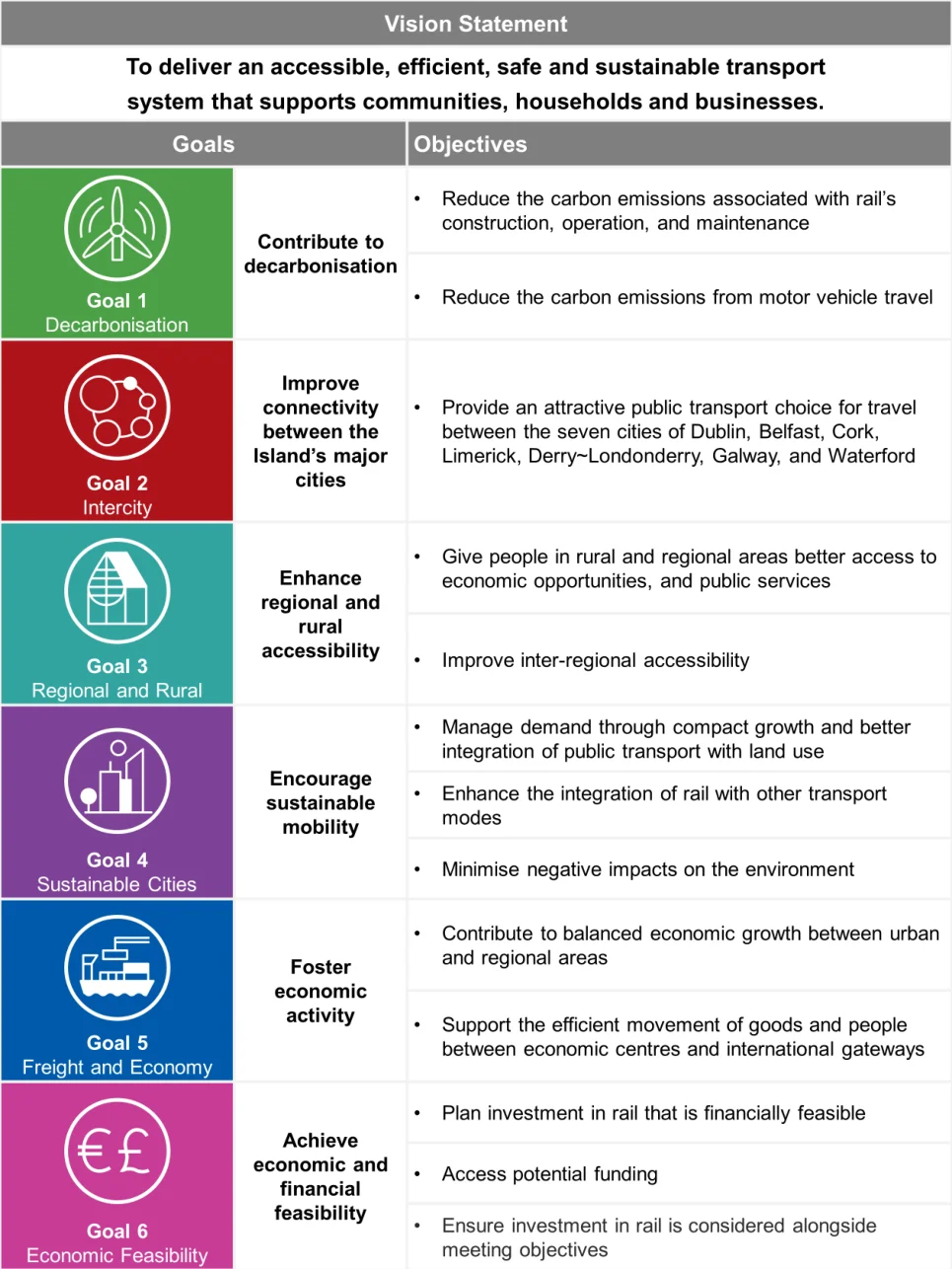
Table 1
Table 1 Review Goals and Objectives
Figure from page 42
Pages 33–42 · View in original PDF