Chapter 2 | The Railway Today

Figure from page 21
Figure from page 22
Introduction
The only electrified sections of the railway are those used by the Dublin Area Rapid Transit service (DART) – a suburban service operating along the coast of the Dublin area from Greystones to Malahide and Howth. All other services are powered by diesel traction.
This Chapter describes the island’s rail network as it is configured today, outlines how the network has developed in recent decades, and summarises the current socioeconomic and environmental context on the island. The Chapter shows how rail can help support wider policy goals to improve connectivity, enhance accessibility, boost economic growth, enable regional development, and deliver each jurisdiction’s climate change goals across the whole island – both for passengers and freight.
The Irish Gauge of 1,600mm (5’3”) is used across the island, which is slightly wider than the gauges used in Great Britain and most of Europe.
Figure from page 23
The maximum speed permitted on the rail network is 160km/h (100mph) along the lines from Dublin to Cork, Kilkenny, and Athlone. The maximum speed on Northern Ireland’s network is 145km/h (90mph) between Belfast and Dublin and on parts of the Belfast to Derry~Londonderry route. Numerous speeds restrictions apply on these routes and across the wider network.
Today’s railway
A map of the public railways in operation on the island today is provided in Figure 1. This map highlights currently electrified sections of the network, as well as areas where infrastructure investment is planned in the short term (e.g., Dublin’s DART+ programme, the Foynes freight line, and line speed improvements planned for the Derry~Londonderry – Belfast railway).
At the time of writing there were 199 passenger rail stations on the island of Ireland. Each of the seven major cities serves as a terminus for rail services. Dublin, Belfast, and Cork each have a suburban rail network, although some only serves a limited number of areas within these cities, while the other cities (Limerick, Derry~Londonderry, Galway, and Waterford) have one station each.
The island of Ireland currently has around 2,300km (1,438 miles) of public rail lines. Iarnród Éireann (Irish Rail), the state-owned railway company in Ireland, operates 1,944km (1,215 miles) of the rail network, and Translink (Northern Ireland Railways), the state-owned transport company in Northern Ireland, operates another 357km (223 miles) in Northern Ireland. Most rail corridors radiate from Dublin and Belfast, with several branches off the main routes to these cities. The route from Waterford to Athenry/Galway via Limerick is the only significant crosscountry link that does not radiate from Dublin or Belfast. Apart from the mainlines from Dublin to Cork and Belfast and some short stretches of suburban lines around these cities, most of the rail network is a single-track railway, which severely limits service frequencies.
Dublin has multiple terminus stations, the busiest of which are Connolly, Heuston, and Pearse. While it is possible to travel between Connolly and Pearse by rail, Heuston and Connolly are not currently connected by passenger rail services. For the latter, connections via the Luas tram are possible, and future DART services through the Phoenix Park Tunnel are planned. This presents wider challenges for the rail network as it makes it difficult to operate direct passenger services between towns and cities in northern and eastern parts of the island and those to the west of Dublin.
Service frequencies are currently relatively low, especially in regional and rural areas, where many routes are served by one train per two hours, and some only have two services per day. Service frequencies are significantly higher on the DART (e.g., Malahide – Greystones) and Dublin commuter network and on suburban services in the Belfast area.
The earliest rail closures were mainly on the most rural lines that struggled for viability as road transport improved, but from the 1950s onwards more substantial closures occurred. In Northern Ireland, the government developed extensive motorway building plans and planned to close many railways. While the motorway network plans were ultimately scaled back, the rail network within Northern Ireland shrunk considerably, leaving most areas west of the River Bann without a service. Closures across the rest of the island’s network were more gradual but ended up removing almost all branch lines and cross-country routes not serving Dublin directly.
Figure from page 24
Some rail lines in Ireland are also used for freight. These connect Ballina, Westport, and Navan to the ports of Waterford and Dublin. The freight lines from Mayo share track with passenger services between Mayo and Dublin, along with the corridor from Kildare to Waterford. Freight services to Navan share track with passenger services between Dublin and Drogheda before continuing to Navan on a freight only line. There are currently no rail freight operations in Northern Ireland.
The emergence of the two separate jurisdictions in the 1920s also had a significant impact on the island’s rail network. The introduction of customs controls on the new border disrupted rail services and impacted traditional patterns of trade and commerce. At that time, there was much less cooperation between the two new administrations than there is today. As such, almost all cross-border routes were closed in the 1950s and 1960s, initially on the Northern Ireland side. This left Cavan, Donegal, Fermanagh, Monaghan, and Tyrone without any rail services and just one cross-border line between Dublin and Belfast.
Historic development
The island’s rail network reached its peak around 1920, with approximately 5,540km (3,442 miles) of network. At that time, Ireland had one of the densest railway networks in the world. The railway network therefore once served almost every population centre across the island.
However, between the 1930s and the 1970s the network shrank substantially. These closures occurred for two main reasons. One was the perception, common at the time in many parts of the western world, that rail was a technology that would be surpassed by the perceived convenience of personal road-based transport, and this view was supported by evidence of declining demand for passenger rail. The other was the prevailing economic circumstances arising from the partition of Ireland.
The railway network stabilised from the 1980s onwards, and, since the 1990s, there has been something of a renaissance in rail. In common with many other western countries, the growth and regeneration of cities, along with increasing congestion on roads, has stimulated significant growth in demand for rail services.
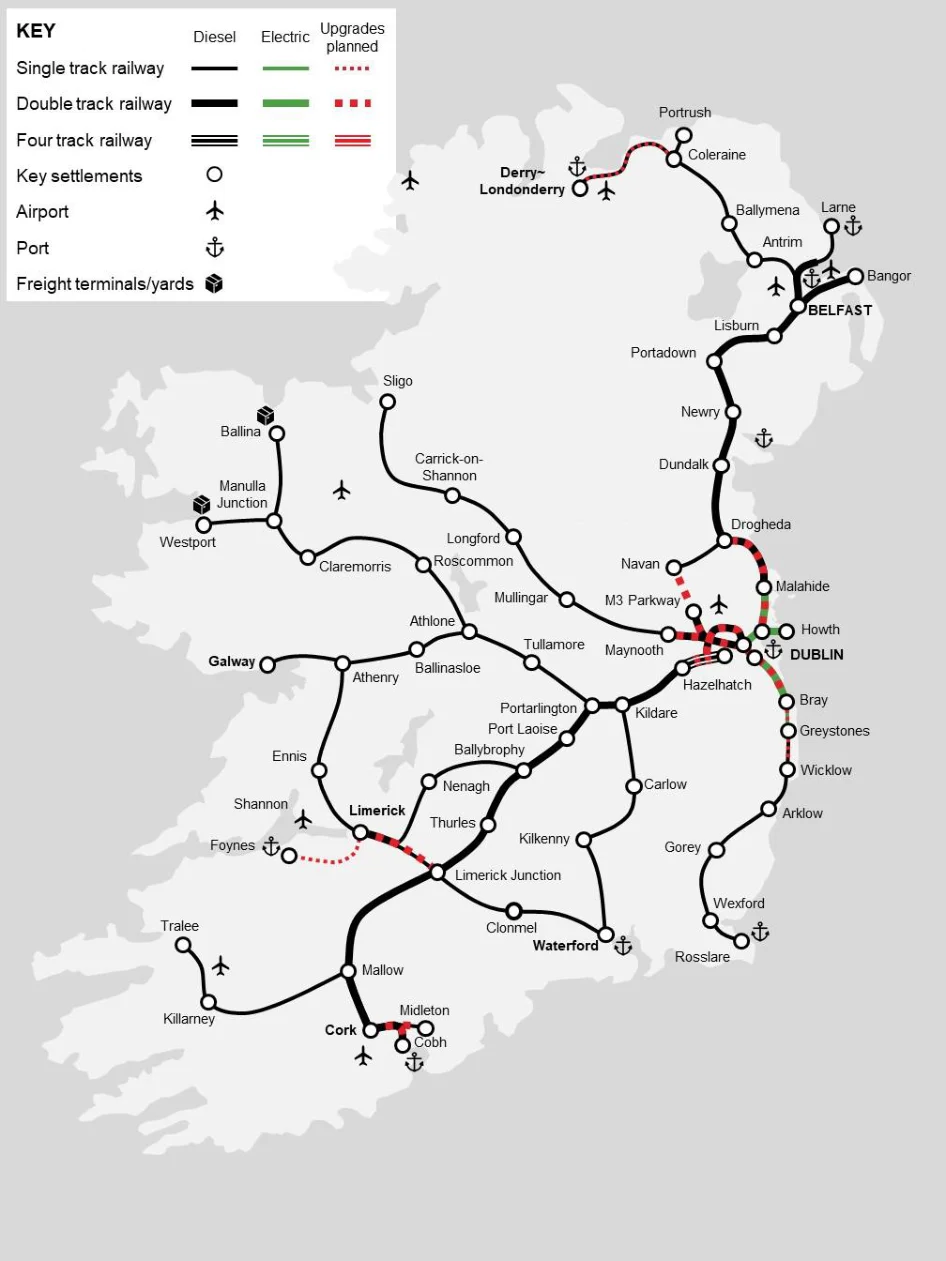
Figure 1
Figure 1 Baseline rail network
Upgrades marked in red in this map are planned short-term interventions that were agreed prior to the finalisation of the All-Island Strategic Rail Review such as Dublin’s DART+ programme, the Foynes freight line, and line speed improvements planned for the existing Derry~Londonderry – Belfast railway.
The launch of the DART network in 1984, along with investment in the cross-border Enterprise service in the 1990s, highlighted the potential role the railways could play in supporting the island’s economic growth. This gave both jurisdictions confidence to invest in enhancing and expanding rail services. In the 1990s passenger services were reinstated between Limerick and Ennis, and these were extended to Athenry in 2010. Since the turn of the millennium there have been additional reopening of railways between Whiteabbey and Antrim, between Clonsilla and M3 Parkway near Dublin, and between Glounthaune and Midleton.
This recent investment has contributed to a 37% growth in passengers across the whole island between 2011 and 2019 (Figure 2) – with the railway reaching a record of serving more than 65 million passengers in 2019. While demand fell significantly during the COVID-19 pandemic, there are encouraging signs that demand is recovering fast. In 2022, both Iarnród Éireann and Translink recorded 70% of pre-pandemic demand. Despite this recent growth, however, passenger rail market (or mode) share remains low at around 1% of all trips or around 3% of passenger kilometres, which is lower than most European countries (the EU average for the latter figure is around 8%). Rail freight mode share is also at a historical low of less than 1% of total tonne kms.
Both jurisdictions have also invested in improving service frequencies on key intercity and commuter routes (e.g., Dublin – Cork), adding track capacity (notably to the west of Dublin), and investing in modern rolling stock (e.g., Ireland’s intercity fleet and Northern Ireland’s New Trains programme).
Looking ahead, there are grounds to be optimistic. There are clear commitments to expand Dublin’s DART network (DART+ programme), invest in the Belfast – Dublin enterprise service, expand and renew rolling stock, double-track short sections of the railway, and invest in a multi-billion Euro MetroLink line in Dublin.
70
Passenger journeys (millions)
60
50
40
30
20
10
0
200820092010201120122013201420152016201720182019202020212022
Rail Passengers (Ireland) Rail Passengers (Northern Ireland)
Figure 2 Annual passenger rail journeys (millions) Sources: Iarnród Éireann, Translink
However, many regions of the island, including Derry~Londonderry and Waterford, have not benefitted from the same growth as the largest cities and have less access to key services and international gateways. Improved rail connections to the strongest performing urban areas, together with better regional connections and regeneration based around railway hubs, would improve access to economic opportunities in these places.
Socioeconomic context
The island’spopulation steadily declined in the aftermath of the Great Famine from a peak of approximately 8.5 million in the 1840s to just 4.2 million in the 1960s. This decline coincided with the period from the beginnings of the Irish railways to the last of the substantial closures in the mid-twentieth century. However, since the 1960s, this trend in population has reversed and in the last half century the island’s population has grown to over 7 million at present.
Figure from page 27
There are known challenges regarding the affordability of housing in Ireland with the highest rent increases recorded in Dublin, Cork, and Galway. A lack of affordable housing in the major cities means there is a potential threat to social cohesion and economic growth. With a lack of affordable housing in major cities, there is potential to enhance rail links to serve more affordable areas within the island’s largest cities. Developing housing in compact, transport-oriented developments around stations can help promote sustainable travel outcomes.
The island’s population is expected to grow significantly in the future. Ireland’s National Planning Framework estimates the population will grow by a million people by 2040. It will also become more urbanised, as most of this growth is concentrated in the island’s largest cities (Figure 3).
Increased urban populations make car ownership both less attractive and less necessary, making the role of rail for longer distance travel more important. As such, rail is in a strong position to serve the island’s growing population. This will likely increase over the horizon of this Review, especially as planning policies are increasingly promoting demand management and transport orientated growth around rail stations.
In both jurisdictions legislation has been passed that commits to achieving netzero carbon emissions by 2050. The Government of Ireland has also recently published a Climate Action Plan, which includes measures to reduce the number of car journeys taken, reduce on-street parking, and prioritise active travel and the use of public transport. This plan includes a key goal to increase the public transport mode share by 130% by 2030. Many regional and local authorities in both jurisdictions have made similar commitments and are pursuing similar plans. As one of the least carbon intensive forms of passenger transport, rail could help achieve this objective.
The island has experienced significant economic growth in the last two decades, although the island’s economy was severely affected by the 2008 Global Financial Crisis and COVID-19 pandemic. In recent years the island’s economy has benefitted from significant Foreign Direct Investment, notably in Dublin, Cork, Limerick, Galway, and Belfast.
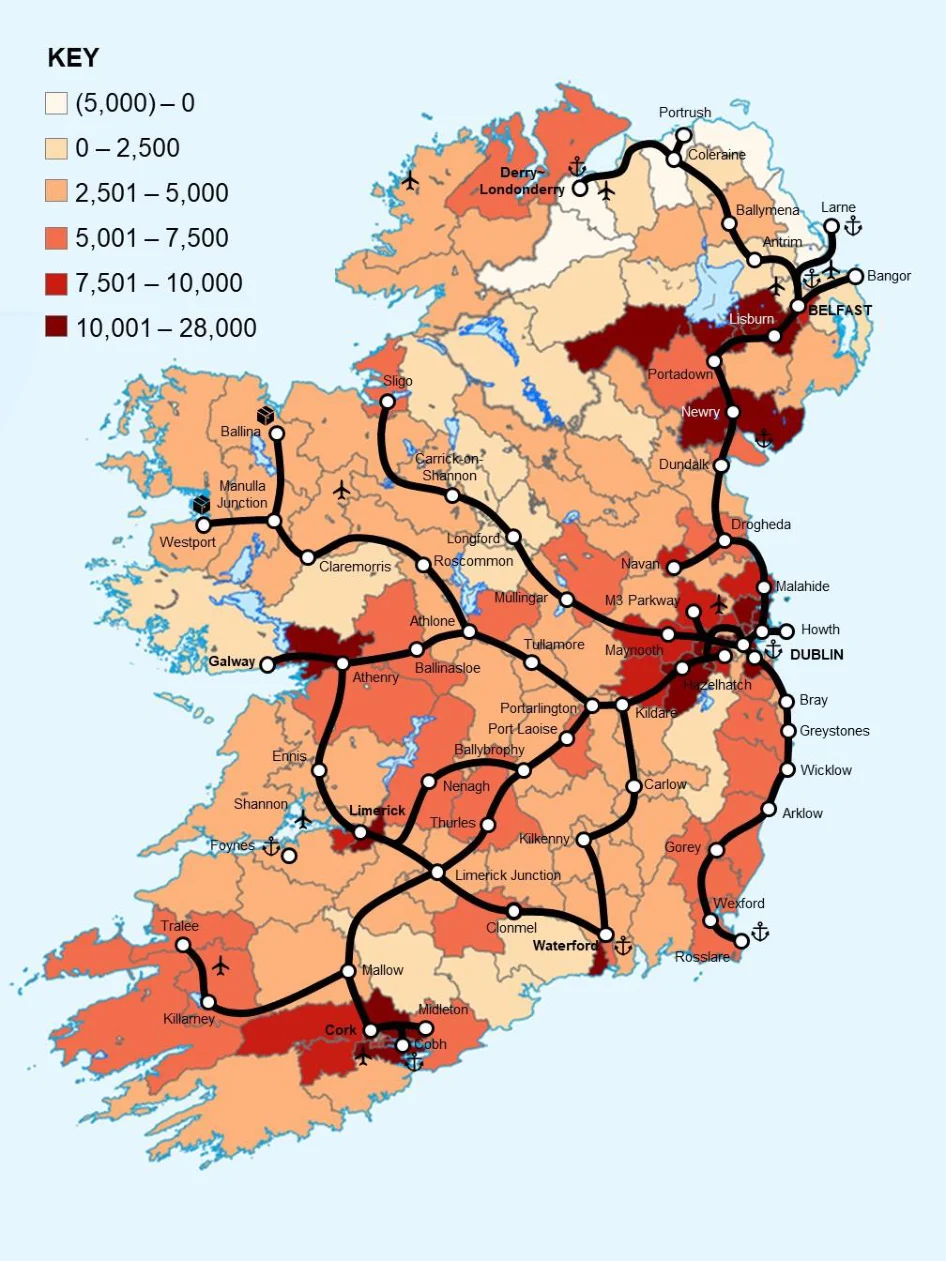
Figure 3
Figure 3 Forecast population growth (2019-40)
Sources: National Development Plan (Ireland), NISRA (Northern Ireland)
The role of rail
To realise this role, rail will need to grow its market (or mode) share of travel. Research, such as the CSO National Travel Survey, shows there are several features of a passenger rail service that can be improved to boost ridership. These features are:
Rail has the potential to deliver on accessibility, climate, connectivity, economic growth, environmental and regional development goals across the whole island – both for passenger and freight flows. It can change the economic landscape of the island by unlocking regeneration and growth opportunities, attracting investment, and supporting sustainable development.
•Well-connected (i.e., enables passengers to complete most of their journey directly);
•Accessible and easy to use;
As part of an integrated transport solution, the rail system could evolve to be a stronger ‘backbone’of the public transport system, providing a core network of connectivity between urban areas and regions that is an attractive travel option to a range of customers and businesses.
•Affordable;
•Frequent;
•Reliable;
•Fast; and
•Pleasant and comfortable to use.
A backbone is an integral but interdependent component to any system, which delivers value through integration with the other components. In a public transport system, this means enhanced regional connectivity into the main railway nodes, facilitating last mile connections, providing intermodal terminals for freight, and integrated ticketing and trip planning for a seamless public transport travel experience. Rail should not compete with other complementary elements of the system, but instead provide a vital pillar upon which the other elements can function.
While there are some examples on the island where the railway is competitive against other modes, in many cases it falls short. The Review has identified many opportunities for rail to significantly improve its competitiveness and grow its market share. Some opportunities can be delivered quickly while others will require longer-term intervention.
In general, rail is best suited to the corridors with highest demand between major cities and the largest towns. One of rail’s key strengths is its spatial efficiency. As Figure 4 shows, rail can carry very high volumes of passengers for a relatively small footprint – more efficient than any other form of land transport.
90,000
80,000
70,000
60,000
50,000
40,000
30,000
20,000
10,000
0
Mixed Traffic Regular Bus Cyclists Pedestrians Bus Rapid
Light Rail
Heavy Rail
Mass Rapid
Mass Rapid
Transit
Transit
(London)
Transit (London)
Transit (Hong Kong)
Figure 4 Capacity of transport modes (passengers per 3.5m lane/track) – rail is highlighted in purple
Sources: H. Botma and H. Papendrecht 1991. Traffic Operation and Bicycle Traffic. In Transportation Research Record 1320. TRB Washington DC: National Research Council and based on GTZ calculations 2009.
Tied to this efficiency, rail is one of the lowest emitters of carbon on a passenger km basis. As shown in Figure 5, the carbon footprint of electric railways – even those that operate at very high speed – is significantly lower than other land modes except active travel. Climate policies have been introduced in both Ireland and the UK that legally require large reductions in greenhouse gas emissions over the coming decades. The enhancement and expansion of rail services is a key component in meeting decarbonisation targets, particularly if combined with rail network electrification.
Rail is also ideally suited to forming the core of compact transport-oriented development. These communities have higher densities than the car-centric urban sprawl that has proliferated across the island in the last half century and have many social, economic, and environmental benefits. Higher densities support a larger number of services within walking distance, reducing the need for short distance car trips while rail provides for longer distance journeys. These types of development contribute to a more equitable society by reducing barriers to travel for non-drivers.
Petrol car
Diesel car
Short-haul flight
Taxi
Ferry (car passenger)
Hybrid car
Bus
Motorcycle
Electric Vehicle (Great Britain)
Rail (Great Britain)
Tram
Subway (London)
Coach
Ferry (foot passenger)
Rail (Eurostar)
0 20 40 60 80 100 120 140 160 180 200
Greenhouse Gas Emissions (grams per passenger kilometre)
Figure 5 Greenhouse gas emissions by transport mode – rail in purple
Source: UK GHG conversion factors for company reporting
Heavy rail is less suited to supporting lower demand corridors and more isolated communities, but it can complement a regional bus service that could connect these communities to the wider public transport system. Rail can provide access to journeys for those with no access to car and can attract demand from more carbon intensive modes.
Heavy rail can also play a role in supporting a sustainable freight logistics and transport system. It is particularly suited to the traditional bulk freight market (which are generally nontime critical flows), as well as the growing market in intermodal goods and parcel services (which are more time critical).
As this Report will describe in Chapter 4, rail freight is generally considered to be most competitive over relatively long distances. In the island of Ireland, this means the potential role of rail freight will be focused on serving inter-regional journeys between the island’s largest cities and busiest ports.
It is notable that areas of the island that are not served by the railway also have relatively high levels of deprivation. This underlines the potential wider role rail could play in supporting regional economic development and rebalancing the economy across the island of Ireland.

Figure from page 32
Pages 21–32 · View in original PDF