Appendix B | Review Methodology

Figure from page 117
Figure from page 118
Approach and methodology
The outputs of this work are published alongside this Final Report as the following documents:
The technical work underpinning the All- Island Strategic Rail Review was delivered through eight stages. A diagram illustrating the stages is provided in Figure B.1. The key activities undertaken at each stage of the study were:
- Work Package 1: Context and Policy
- covering Stages A, B, and C.
•Work Package 2: Package Development and Sifting – covering Stages D, E and F.
•Stage A: Understand the context of the Review and identify connectivity opportunities.
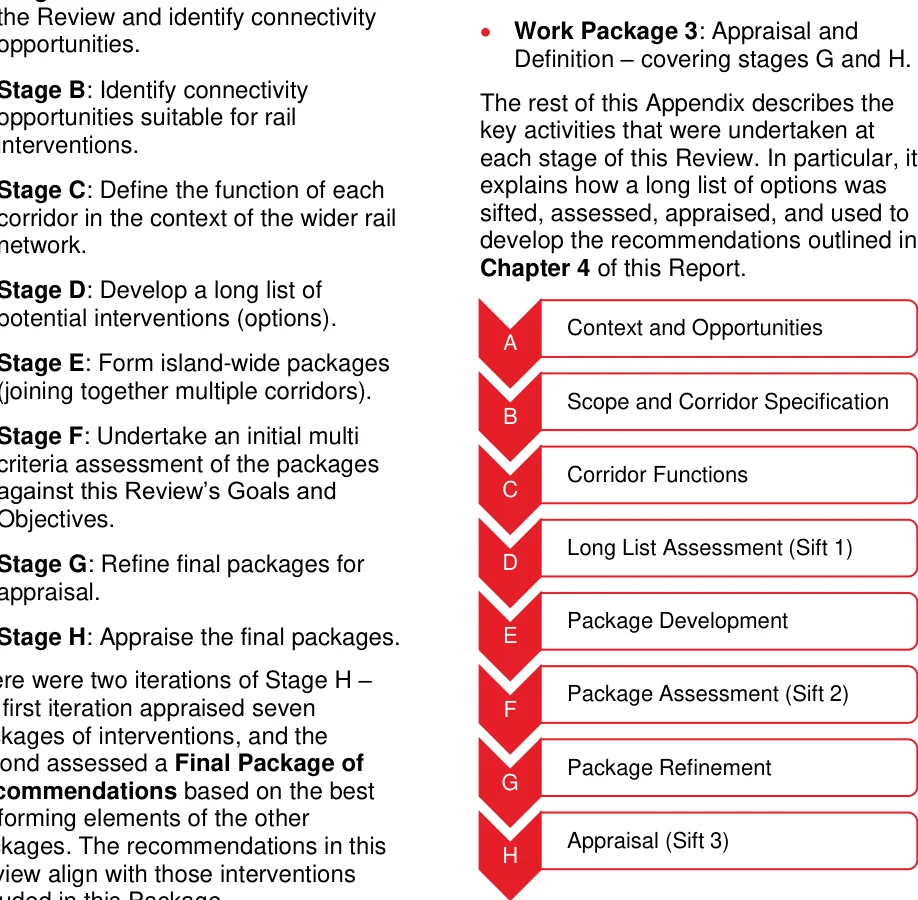
Figure from page 119
•Work Package 3: Appraisal and Definition – covering stages G and H.
•Stage B: Identify connectivity opportunities suitable for rail interventions.
The rest of this Appendix describes the key activities that were undertaken at each stage of this Review. In particular, it explains how a long list of options was sifted, assessed, appraised, and used to develop the recommendations outlined in Chapter 4 of this Report.
•Stage C: Define the function of each corridor in the context of the wider rail network.
•Stage D: Develop a long list of potential interventions (options).
Context and Opportunities A
•Stage E: Form island-wide packages (joining together multiple corridors).
Scope and Corridor Specification B
•Stage F: Undertake an initial multi criteria assessment of the packages against this Review’s Goals and Objectives.
Corridor Functions C
Long List Assessment (Sift 1) D
•Stage G: Refine final packages for appraisal.
Package Development E
•Stage H: Appraise the final packages.
There were two iterations of Stage H – the first iteration appraised seven packages of interventions, and the second assessed a Final Package of Recommendations based on the best performing elements of the other packages. The recommendations in this Review align with those interventions included in this Package.
Package Assessment (Sift 2) F
Package Refinement G
Appraisal (Sift 3) H
Figure B.1 Stages in the Review
Stage A | Context
enhancements to existing railways and the development of new (or reinstatement of former) rail corridors. They were generally restricted to infrastructure interventions – complementary measures were considered at a broader, qualitative level. The long list of options was then passed through the first of three sifts. This sift focused on ruling out options due to unambiguous, strategic constraints, including those that were:
In Stage A the project team undertook an extensive review of the policy, socioeconomic, and environmental context of the island of Ireland and its railways. The evidence collated by this review enabled the team to identify the key strategic corridors and connectivity opportunities to be included in the scope of the Review. A public consultation was also held at this Stage, and the insights from this consultation informed all subsequent stages of the Review. One of the key outputs from Stage A was the development of Goals and Objectives for this Review.
•Not aligned with policy. This ruled out options that were not aligned to strategies such as the Greater Dublin Area Transport Strategy and Cork Metropolitan Area Transport Strategy, as identified in Stage A.
Stages B&C | Corridor definition
•Out of the scope of the study. This ruled out options that did not serve the strategic movement corridors and connectivity opportunities identified in Stages B and C.
In Stage B the evidence collated in Stage A was used to identify where rail could play a role in supporting passenger and freight connectivity on the island of Ireland. In Stage C, concepts (or typologies) were developed for strategic movement corridors to highlight the type of movements rail could support across the island of Ireland. This further enabled the team to tighten the scope of the Review. The key corridors (and their roles) identified and analysed in these stages are presented in Figure A.2.
•Targeting corridors or towns with very low demand potential. Interventions that aimed to connect towns with populations of 10,000 or more that passed through sparsely populated areas (e.g., Letterkenny – Sligo) were considered, whereas interventions that did not extend to towns of a similar population and only served sparsely populated areas (e.g., West Cork) were deemed to be unviable for rail.
Stage D | Sift 1
In Stage D the project team collated a long list of options for interventions on the strategic movement corridors identified in Stages B and C and undertook an initial sift of these options. Options for interventions were sourced from the project team, client team, High Level Steering Group members, and feedback gathered from the public consultation exercise. The options were carefully tabulated in a central database and updated throughout the sifting process. They included proposals for
•Likely to generate an adverse impact on protected areas where better alternative corridors exist. For example, the Review considered multiple options for a new railway between Portadown and Derry~Londonderry but ruled out options that ran through the Sperrins Area of Outstanding Natural Beauty.
The results of Sift 1 (Stage D) are presented in Table B.1.
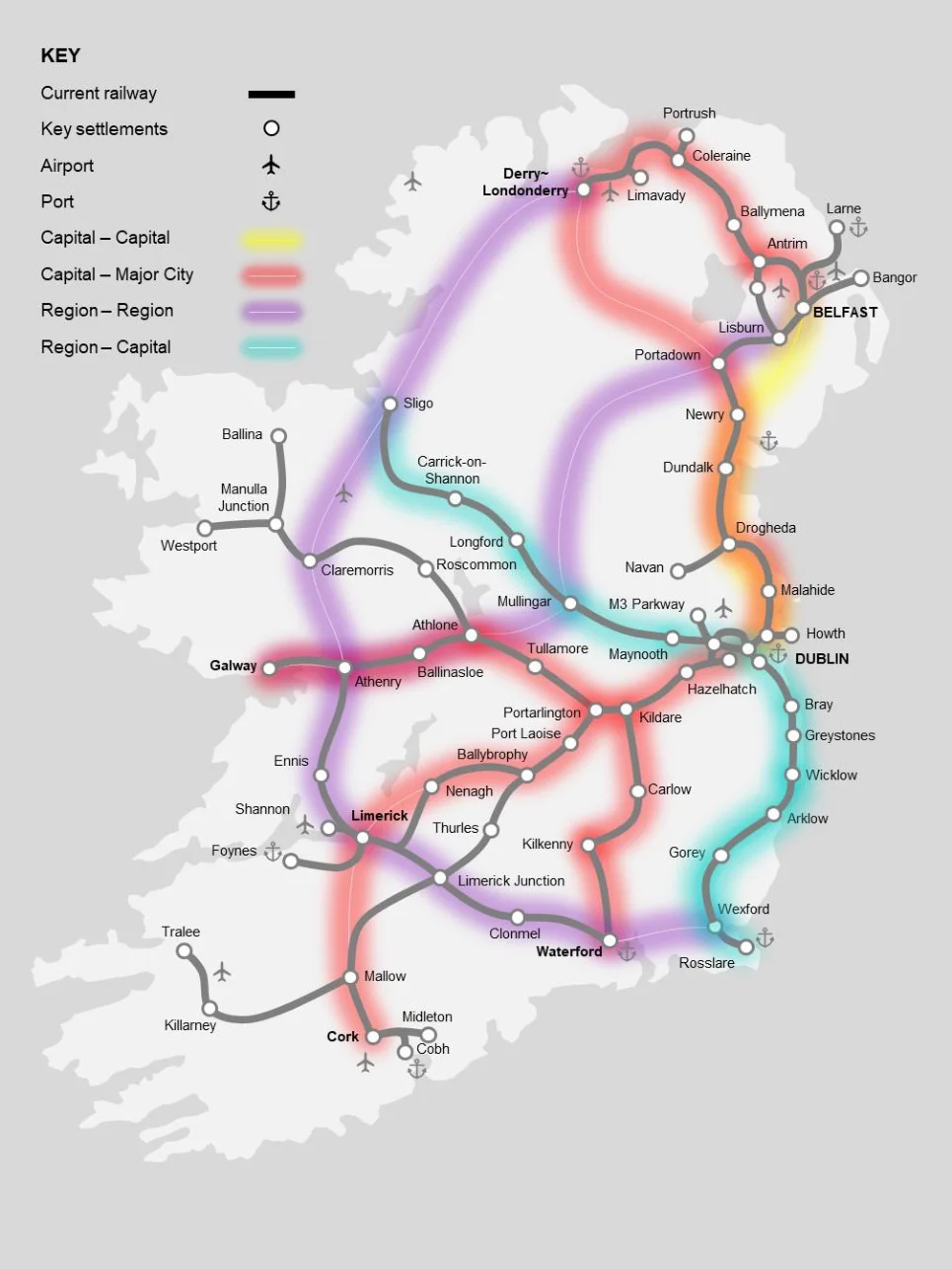
Figure from page 121
Figure A.2 Strategic movement corridors on the island of Ireland
Stage E | Package development
Stage F | Sift 2
In Stage E the project team combined options into groups of interventions called packages. These packages were developed to enable functionally similar interventions to be qualitatively assessed against the Review’s Goals and Objectives in Stage F. The packages were defined as follows:
In Stage F the project team undertook a qualitative assessment of the packages developed in Stage E. Almost all the options that passed Sift 1 were found to support many of the Review’s key Goals and Objectives. However, it was recognised at this stage that some of the regional and rural packages may need to be disaggregated as they progressed to the next stage.
•Package 1 – Do Minimum: This package focused on committed interventions and options that required minimal investment in new infrastructure (e.g., some regional service frequency enhancements).
Sift 2 established that a “spider” high speed rail network (based on multiple lines radiating from Dublin) would be much more costly to deliver than a “linear” high speed network (based on a single line from Cork to Belfast via Dublin), while both options would largely meet the same Goals and Objectives. The latter option was therefore taken forward to the next Stage, while alternative high speed rail options were “parked”.
•Package 2 – Transformational Intercity Connectivity: This package included variants of possible future segregated high-speed railways that would deliver top speeds of 300km/h / 186mph between major cities.
•Package 3 – Enhanced Regional Connectivity: This package included upgrades to the existing rail network to improve journey times and service frequencies on longer distance routes.
The results of Sift 1 (Stage D) and Sift 2 (Stage F) are presented in Table B.1.
•Package 4 – Enhanced Rural Connectivity: This package included the reinstatement of old and creation of new railways to fill strategic gaps and expand rail access to rural areas.
| Sift 1 | |||||||
|---|---|---|---|---|---|---|---|
| Ref | Intervention / Option | Sift 2 | Result | ||||
| Policy | Scope | Demand | Impact | ||||
| 1.01a | Belfast – Antrim – Derry~LD (online improvements) | Proceed | |||||
| 1.01b | Limavady (new spur) | Proceed | |||||
| 1.01c | Belfast – Derry~Londonderry (new High Speed Line) | X | Park | ||||
| 1.02a | Drogheda – Newry (online improvements) | Proceed | |||||
| 1.02b | Belfast – Newry (new line) | Proceed | |||||
| 1.02c | Belfast – Newry (four-tracking) | Proceed | |||||
| 1.02d | Clongriffin – Drogheda (four-tracking) | Proceed | |||||
| 1.02e | Clongriffin – Drogheda (new line) | Proceed | |||||
| 1.02f | Clongriffin – Connolly (four-tracking) | Proceed | |||||
| 1.03a | Dublin – Portarlington (online improvements) | Proceed | |||||
| 1.03b | Hazelhatch - Portarlington (full 4-tracking) | Proceed | |||||
| 1.03c | Hazelhatch - Portarlington (part 4-tracking) | Proceed | |||||
| 1.03d | Hazelhatch - Portarlington (new line) | Proceed | |||||
| 1.03e | Dublin – Cork (new direct High Speed Line) | X | Park | ||||
| 1.03f | Dublin – Cork (new High Speed Line via Waterford) | X | Park | ||||
| 1.03g | Dublin – Cork (new High Speed Line via Limerick) | Proceed | |||||
| 1.03h | Portarlington – Cork (online improvements) | Proceed | |||||
| 1.03i | Dublin – Limerick (new High Speed Line) | X | Park | ||||
| 1.03j | Dublin – Galway (new High Speed Line) | X | Park | ||||
| 1.04 | Dublin – Sligo (online improvements) | Proceed | |||||
| 1.05 | Galway – Portarlington (online improvements) | Proceed | |||||
| 1.06 | Limerick – Athenry (online improvements) | Proceed | |||||
| 1.07 | Limerick – Limerick Junction (online improvements) | Proceed | |||||
| 1.08 | Waterford – Limerick Junction (online improvements) | Proceed | |||||
| 1.09 | Waterford – Kildare (online improvements) | Proceed | |||||
| 1.10a | DART Coastal Loops | X | X | Park | |||
| 1.10b | Bray Head | X | Park | ||||
| 1.10c | Wicklow - Arklow | X | Park | ||||
| 1.10d | Wexford Waterfront | Proceed | |||||
| 2.01a | Heuston – Dublin Airport – Drogheda (new line) | Proceed | |||||
| 2.01b | Heuston – Tara St – Northern Line (new line) | Proceed | |||||
| 2.02 | Lisburn – Belfast Int’l – Antrim (reinstated/new line) | Proceed | |||||
| 2.03a | Derry~Londonderry – Omagh – Portadown (new) | Proceed | |||||
| 2.03b | Derry~Londonderry – Cookstown – Portadown (new) | X | Park | ||||
| 2.03c | Derry~Londonderry – Magherafelt – Antrim (new) | X | Park | ||||
| 2.03d | Derry~Londonderry – Navan (new line) | X | Park | ||||
| 2.04a | Waterford – New Ross – Wexford (new line) | Proceed |
| Sift 1 | |||||||
|---|---|---|---|---|---|---|---|
| Ref | Intervention / Option | Sift 2 | Result | ||||
| Policy | Scope | Demand | Impact | ||||
| Waterford – Wellingtonbridge – Wexford (reinstated | Proceed | ||||||
| 2.04b | |||||||
| line) | |||||||
| 3.02a | Letterkenny – Sligo (new line) | Proceed | |||||
| 3.02b | Derry~Londonderry – Letterkenny (new line) | Proceed | |||||
| 3.02c | Enniskillen – Omagh (new line) | Proceed | |||||
| 3.03a | Claremorris – Athenry (reinstated line) | Proceed | |||||
| 3.03b | Claremorris – Collooney (new line) | Proceed | |||||
| 3.03c | Sligo – Ballina – Westport – Galway (new line) | X | X | Park | |||
| 3.04a | Portadown – Clones (new line) | Proceed | |||||
| 3.04b | Clones – Sligo (new line) | Proceed | |||||
| 3.04c | Clones – Mullingar (new line) | Proceed | |||||
| 3.05 | Midleton – Waterford (new line) | Proceed | |||||
| 3.06 | Athlone – Ballina/Westport (online improvements) | Proceed | |||||
| 3.07 | Tralee – Mallow (online improvements) | Proceed | |||||
| 3.08 | Athlone – Mullingar (reinstated line) | Proceed | |||||
| 3.09 | Limerick – Ballybrophy (online improvements) | Proceed | |||||
| 4.01a | Belfast – Portadown (online improvements) | Proceed | |||||
| 4.01b | Belfast Suburban (online improvements) | Proceed | |||||
| 4.02a | Cork Suburban (online improvements) | Proceed | |||||
| 4.02b | Cork Suburban (port access) | Proceed | |||||
| 4.02c | Cork – City Centre – Airport – West Cork (new line) | X | X | Park | |||
| 4.03 | Derry~Londonderry Suburban (online improvements) | Proceed | |||||
| 4.04 | Dublin Suburban (DART programme) | X | Park | ||||
| 4.05a | Sixmilebridge/Cratloe – Shannon Airport (new spur) | Proceed | |||||
| 4.05b | Limerick Commuter service (using Foynes link) | Proceed | |||||
| 4.06 | Galway Suburban (online improvements) | X | Park | ||||
| 4.07 | South Dublin relief line (new line) | X | X | Park | |||
| 4.08 | Ballycastle Branch (new line) | X | X | Park | |||
| 4.09 | West Donegal Branches (new line) | X | X | Park | |||
| 4.11 | Foynes – Tralee (new line) | X | Park | ||||
| 4.12 | Kilkenny – Portlaoise (new line) | X | Park | ||||
| 4.13 | Donegal – Enniskillen (new line) | X | Park | ||||
| 4.14 | Mullingar – Navan (new line) | X | Park | ||||
| 4.15 | Adamstown – Maynooth (new line) | Proceed | |||||
| 4.16 | Enfield – Edenderry | X | X | Park |
Table B.1 Sift 1 and 2 Results (Stages D and F)
•Through services between Cork and Galway via Limerick with modifications to track and platforms at Limerick Junction to allow more through movements Cork-Limerick and Limerick-Waterford.
Stage G | Package refinement
In Stage G the packages that performed well in Sift 2 were revised and re-defined. This reflected the outcomes of Sift 2, which showed only one (segregated) high speed rail option needed to be taken forward for future assessment, while a greater number of disaggregated regional and rural packages were needed to enable the project team to better understand their regional impacts.
•Direct services between Belfast and Portrush.
•New passenger services on the Limerick-Foynes line together with a new line to Shannon Airport.
The packages defined in Stage E were therefore refined to create the following seven packages:
•Restored passenger services on the Lisburn-Antrim line and a new station at Belfast International Airport.
Package 1 | Short term and decarbonisation
Package 2 | Intercity
Package 2 focused on improving connections between the seven major cities. There are two packages within this, with the first of these (Package 2a) centred on a higher-speed network with maximum speeds of 200km/h / 125mph, and the second (Package 2b) centred on a high speed network with maximum speeds of 300km/h / 186mph. These packages include the interventions in Package 1. The features of each package are described below.
Package 1 focused on service improvements along existing rail lines to improve frequencies, enhance interchange, directly connect more destinations, increase electrification, and provide some new services on relatively short sections of disused or new rail routes. The main features of this package are:
•Electrification of intercity and commuter services between Belfast- Bangor, Belfast-Drogheda, Dublin- Cork, Portarlington-Galway, Limerick Junction-Limerick, and Kildare- Waterford.
Package 2a | Higher Speed
•Upgraded track, including realignments, to deliver up to 200km/h / 125mph line speed on intercity routes between Dublin and Belfast, Galway, Limerick, Cork, and Waterford.
•Speed upgrades to maximum of 160km/h on core and some regional intercity lines, improving journey times across the island.
•A new rail route between Drogheda and Inchicore, partially in tunnels, to allow for direct trains between Belfast and the major cities in the South and West via Dublin. This includes new stations at Drogheda East, Dublin Airport, and Glasnevin to connect with MetroLink, DART, and the airport.
•One train per hour on intercity routes between Dublin and Belfast, Cork, Limerick, Galway, and Waterford.
•One train per two hours on regional routes including Galway-Limerick, Limerick-Cork, Limerick-Ballybrophy, Dublin-Sligo, Dublin-Westport/Ballina, and Greystones-Rosslare Europort.
•New stations on lines to/from Dublin.
•Dual tracking between Galway and Athenry.
Package 3a | Northern Ireland
•A new 200km/h / 125mph electrified double-tracked line between Portadown and DerryLondonderry via Omagh, providing direct connections between DerryLondonderry and both Belfast and Dublin on an hourly basis.
Package 2b | High Speed
•A new 300km/h / 186mph electrified rail alignment between Belfast and Cork via Dublin and Limerick, acting as a spine for the island’s rail network.
•A new 120km/h / 75mph single-track unelectrified line between Omagh and Enniskillen with an hourly service.
•Upgrades to the Portarlington-Galway and Kildare-Waterford lines to 200km/h / 125mph, with both lines having through connections to the Belfast-Dublin-Cork spine.
•Enhanced suburban rail around Derry~Londonderry, with extra track capacity, new stations on the line to Coleraine, and a new spur to Limavady.
•Electrification of the Maynooth- Longford line including a realignment bypassing Enfield for express services.
•Additional stations and capacity enhancements (e.g., passing loops) on the existing Derry~Londonderry- Belfast line including new stations on this corridor, all with at least hourly service.
•A new link between Hazelhatch and Kilcock, allowing trains from Sligo to travel directly to Heuston. This both separates longer distance trains from the DART network and enables trains from Sligo to travel directly to Dublin Airport and onwards towards Belfast.
Package 3b | West Coast
•A new 120km/h / 75mph electrified line between DerryLondonderry and Sligo, double-tracked between DerryLondonderry and Letterkenny and single-track between Letterkenny and Sligo. Hourly services along the whole line and two trains per hour between Letterkenny and Derry~Londonderry.
•A restored Mullingar-Athlone link, allowing services between Dublin and Galway and Mayo to alternate between routing via Portarlington and via Mullingar.
Package 3 | Regional and rural
Package 3 focused on improving the connections of different regions both to each other and to the major cities and international gateways. It addresses gaps in the existing railway network, particularly in the North West but also in the West and the South East. There are four packages within this, each focused on a particular geographic region of the island. These packages also incorporate the interventions in Package 1 and Package 2a. The main features of each package are described below.
•A new 120km/h / 75mph electrified single-track line between and Sligo and Athenry, with hourly Sligo- Galway services.
•Electrification and speed upgrades, including limited realignment, between Athenry and Sixmilebridge to enable hourly services between Limerick and Galway.
Package 3c | South Coast
Package 3d | North Midlands
•Electrification and speed and capacity enhancements along the Limerick Junction-Waterford line to enable 120km/h / 75mph running.
•A new 120km/h / 75mph electrified double-tracked line between Portadown and Clones via Armagh and Monaghan.
•A new 120km/h electrified doubletracked line between Waterford and Wexford via New Ross, with interventions to deconflict rail movements in Wexford Town.
•A new 120km/h / 75mph electrified single-track line between Clones, Enniskillen, and Collooney.
•A new 120km/h / 75mph electrified single-track line between Clones and Mullingar via Cavan, Ballyjamesduff, and Oldcastle (later amended to follow the alignment for the former railway, which avoids these towns).
•A new 120km/h / 75mph electrified single-track line between Midleton and Waterford along the South Coast with an hourly service.
•Direct services between Rosslare Europort and both Limerick and Cork. Intercity trains to/from Waterford (with origin/destination in Belfast/Derry~Londonderry via Dublin) which continue to Rosslare Europort.
•Restoring the Mullingar-Athlone link, allowing direct services between Belfast and Galway via Cavan.
•Hourly services between Belfast and Sligo via Enniskillen, one train per two hours between Belfast and Dublin via Cavan, and one train per two hours between Belfast and Galway via Cavan.
•Existing Dublin-Rosslare Europort service is replaced with hourly Greystones-Wexford service, connecting with the DART at Greystones and Wicklow.
•One train per two hours between Dublin and Galway via Mullingar and Athlone.
Stage H | Appraisal and Sift 3
Further information about the assessment and appraisal undertaken for this Review is provided in the Work Package 3: Appraisal and Definition Report that is published alongside this Report. A breakdown of benefits and costs in present values (discounted and presented in 2010/11 prices), are presented in Table B.3 (for CAF) and Table B.4 (for TAG).
In Stage H the project team undertook a qualitative assessment and economic appraisal of the packages that were developed in Stage G. The core economic appraisal undertaken at this stage was based on the following guidance sources:
• K Department for Transport’s Transport Analysis Guidance (TAG);
Benefits
•Irish Department of Transport’s Common Appraisal Framework (CAF);
As part of the economic appraisal of the packages, the following benefits were considered and, where possible, monetised for each package:
•Better Business Cases Northern Ireland Supplementary Guidance;
•Journey time benefits for business, commuter, and leisure travellers;
•Ireland Public Spending Code;
•UK Treasury Green Book; and
•Highway/road decongestion;
•National Transport Authority and Transport Infrastructure Ireland Guidance.
•Accidents;
•Local air quality;
•Noise;
Some interventions (largely freight and customer service interventions) were not quantitively assessed but were qualitatively assessed.
•Greenhouse gases;
•Other external effects (CAF only), which includes impacts on nature, landscapes, and the urban environment; and
Initially, the project team assessed each of the seven packages developed in Stage G. This showed that while some packages performed well, others had shortcomings. The project team then combined the best performing elements of each package into an eighth package and appraised this using the same approach.
•Marginal External Costs (TAG only), which accounts for indirect taxation.
Benefits were calculated using journey times from a modelling suite that applied assumptions on alignments, calling patterns, and line speeds.
The economic appraisal was based on demand estimates that were delivered using an elasticity-based model (for routes on the existing network) and a gravity-based trip-end model (for new stations and routes). This high-level, indicative approach gives broad indications of the potential scale of demand, at an appropriate level of detail for this Review.
Costs
appraisal results, along with a breakdown of benefits and costs in present values (discounted and presented in 2010/11 prices), are presented in Table B.3 (for CAF) and Table B.4 (for TAG).
The following costs were considered and, where possible, monetised.
•Capital costs;
•Rolling stock costs; and
It should be noted that the packages were assessed as combinations and not in isolation. This reflects the Review’s assumption that the additional regional and rural interventions included in packages 3a, 3b, 3c and 3d would not be delivered in isolation but would likely be delivered alongside interventions included in Package 1, Package 2a, and Package 2b. Table B.2 shows which interventions were included in each package for qualitative assessment and appraisal.
•Additional operating and maintenance costs.
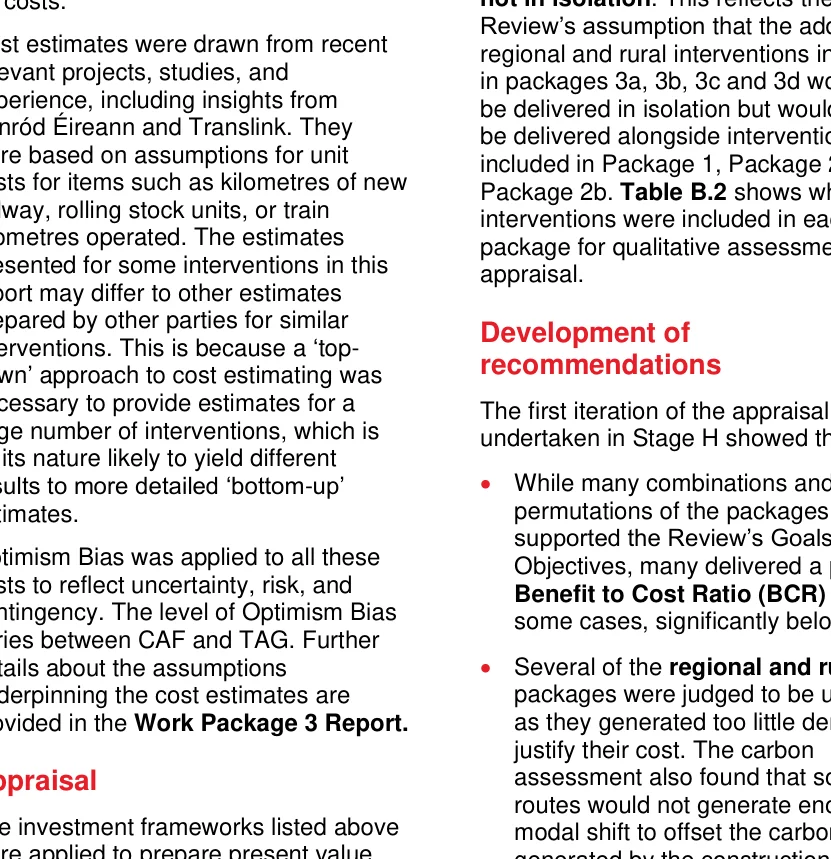
Figure from page 129
Cost estimates were drawn from recent relevant projects, studies, and experience, including insights from Iarnród Éireann and Translink. They were based on assumptions for unit costs for items such as kilometres of new railway, rolling stock units, or train kilometres operated. The estimates presented for some interventions in this report may differ to other estimates prepared by other parties for similar interventions. This is because a ‘topdown’ approach to cost estimating was necessary to provide estimates for a large number of interventions, which is by its nature likely to yield different results to more detailed ‘bottom-up’ estimates.
Development of recommendations
The first iteration of the appraisal undertaken in Stage H showed that:
•While many combinations and permutations of the packages supported the Review’s Goals and Objectives, many delivered a poor Benefit to Cost Ratio (BCR) – in some cases, significantly below one.
Optimism Bias was applied to all these costs to reflect uncertainty, risk, and contingency. The level of Optimism Bias varies between CAF and TAG. Further details about the assumptions underpinning the cost estimates are provided in the Work Package 3 Report.
•Several of the regional and rural packages were judged to be unviable as they generated too little demand to justify their cost. The carbon assessment also found that some routes would not generate enough modal shift to offset the carbon generated by the construction of the new railways.
Appraisal
The investment frameworks listed above were applied to prepare present value estimates for the benefits, costs, net present value, and benefit to cost ratios of each package. Results based on the TAG framework are presented in 2010 values, and results based on CAF guidance are presented in 2011 values. Both frameworks applied a 60-year appraisal period for the packages. The
•A new segregated high-speed railway from Cork to Belfast via Dublin would represent very poor value for money – but some sections of the route that was appraised appeared to stimulate high demand.
Tables B.3 and B.4 show the economic appraisal of the recommendations delivered a BCR above one under the Common Appraisal Framework approach (increasing to 1.1 with wider impacts) and Table B.5 shows the Final Scenario strongly supports the Review’s Goals and Objectives. Indeed, the final package of recommendations performs as well as or better than the other packages against all but three of the criteria used to assess their performance.
The results from this appraisal were used to develop a final package of recommendations, (Package 3e), which combined the best performing elements of the other seven packages.
Table B.2 presents interventions that were included in the final package of recommendations and explains why some options were not taken forward.
Recommendations appraisal
This does not mean that each recommendation is guaranteed to produce a BCR above one when assessed individually in future appraisals, but the evidence suggests that when taken together, the benefits of delivering the recommendations in this Review – including nonmonetised benefits – more than outweigh their costs.
An appraisal of the recommendations was then undertaken, and the results of this appraisal are presented alongside the results of the other packages in Table B.3 (€) and Table B.4 (£). The assessment results for all eight packages are presented in a Multi Criteria Assessment Framework in Table B.5.The project team also estimated the scale of wider impacts, whichaccount for agglomeration and imperfect competition, that Scenario 3e could deliver.
| Package | Comment | ||||||||||
|---|---|---|---|---|---|---|---|---|---|---|---|
| Ref | Intervention / Option | Result | |||||||||
| 1 | 2a | 2b | 3a | 3b | 3c | 3d | 3e | ||||
| 1.01a | Belfast – Antrim – Derry~LD (online improvements) | ✓ | ✓ | ✓ | ✓ | ✓ | ✓ | ✓ | ✓ | Included | |
| 1.01b | Limavady (new spur) | ✓ | ✓ | Included | |||||||
| 1.02a | Drogheda – Newry (online improvements) | ✓ | ✓ | ✓ | ✓ | ✓ | ✓ | Included | See note 1 | ||
| 1.02b | Belfast – Newry (new line) | ✓ | ✓ | Included | |||||||
| 1.02c | Belfast – Newry (four-tracking) | ✓ | ✓ | ✓ | ✓ | ✓ | Parked | ||||
| 1.02d | Clongriffin – Drogheda (four-tracking) | Parked | |||||||||
| 1.02e | Clongriffin – Drogheda (new line) | ✓ | Included | ||||||||
| 1.02f | Clongriffin – Connolly (four-tracking) | ✓ | Included | ||||||||
| 1.03a | Dublin – Portarlington (online improvements) | ✓ | ✓ | ✓ | ✓ | ✓ | ✓ | Included | See note 2 | ||
| 1.03b | Hazelhatch - Portarlington (4-tracking) | ✓ | ✓ | ✓ | ✓ | ✓ | Parked | ||||
| 1.03d | Hazelhatch - Portarlington (new line) | ✓ | ✓ | Included | |||||||
| 1.03g | Dublin – Cork (new high speed line via Limerick) | ✓ | Parked | ||||||||
| 1.03h | Portarlington – Cork (online improvements) | ✓ | ✓ | ✓ | ✓ | ✓ | ✓ | Included |
| Package | |||||||||||
|---|---|---|---|---|---|---|---|---|---|---|---|
| Ref | Intervention / Option | Result | Comment | ||||||||
| 1 | 2a | 2b | 3a | 3b | 3c | 3d | 3e | ||||
| 1.04 | Dublin – Sligo (online improvements) | ✓ | ✓ | ✓ | ✓ | ✓ | ✓ | ✓ | ✓ | Included | |
| 1.05 | Galway – Portarlington (online improvements) | ✓ | ✓ | ✓ | ✓ | ✓ | ✓ | ✓ | Included | ||
| 1.06 | Limerick – Athenry (online improvements) | ✓ | ✓ | Included | |||||||
| 1.07 | Limerick – Limerick Junction (online improvements) | ✓ | ✓ | ✓ | ✓ | ✓ | ✓ | ✓ | ✓ | Included | |
| 1.08 | Waterford – Limerick J. (online improvements) | ✓ | ✓ | Included | |||||||
| 1.09 | Waterford – Kildare (online improvements) | ✓ | ✓ | ✓ | ✓ | ✓ | ✓ | ✓ | Included | ||
| 2.01a | Heuston – Dublin Airport – Drogheda (new line) | ✓ | ✓ | ✓ | ✓ | ✓ | ✓ | Parked | |||
| See note 3 | |||||||||||
| 2.01b | Heuston – Tara St – Northern Line (new line) | ✓ | Included | ||||||||
| 2.02 | Lisburn – Belfast Int’l – Antrim (reinstated/new line) | ✓ | ✓ | ✓ | ✓ | ✓ | ✓ | ✓ | ✓ | Included | |
| 2.03a | Derry~Londonderry – Omagh – Portadown (new) | ✓ | ✓ | Included | |||||||
| 2.04b | Waterford – Wellingtonbridge – Wexford (reinstated) | ✓ | ✓ | Included | See note 4 | ||||||
| 3.02a | Letterkenny – Sligo (new line) | ✓ | Parked | ||||||||
| See note 5 | |||||||||||
| 3.02b | Derry~Londonderry – Letterkenny (new line) | ✓ | ✓ | Included | |||||||
| 3.02c | Enniskillen – Omagh (new line) | ✓ | Parked | See note 6 | |||||||
| 3.03a | Claremorris – Athenry (reinstated line) | ✓ | ✓ | Included | See note 5 | ||||||
| 3.03b | Claremorris – Collooney (new line) | ✓ | Parked | See note 5 | |||||||
| 3.04a | Portadown – Clones (new line) | ✓ | ✓ | Included | |||||||
| 3.04b | Clones – Sligo (new line) | ✓ | Parked | See note 6 | |||||||
| 3.04c | Clones – Mullingar (new line) | ✓ | ✓ | Included | |||||||
| 3.05 | Midleton – Waterford (new line) | ✓ | Parked | See note 4 | |||||||
| 3.06 | Athlone – Ballina/Westport (online improvements) | ✓ | ✓ | ✓ | ✓ | ✓ | ✓ | ✓ | ✓ | Included | |
| 3.07 | Tralee – Mallow (online improvements) | ✓ | ✓ | ✓ | ✓ | ✓ | ✓ | ✓ | ✓ | Included | |
| 3.08 | Athlone – Mullingar (reinstated line) | ✓ | ✓ | ✓ | Included | ||||||
| 3.09 | Limerick – Ballybrophy (online improvements) | ✓ | ✓ | ✓ | ✓ | ✓ | ✓ | ✓ | ✓ | Included | |
| 4.01a | Belfast – Portadown (online improvements) | ✓ | ✓ | ✓ | ✓ | ✓ | ✓ | ✓ | Included | ||
| 4.01b | Belfast Suburban (online improvements) | ✓ | ✓ | Included | |||||||
| 4.02a | Cork Suburban (online improvements) | ✓ | ✓ | ✓ | ✓ | ✓ | ✓ | ✓ | ✓ | Included | |
| 4.02b | Cork Suburban (port access) | ✓ | ✓ | ✓ | ✓ | ✓ | ✓ | ✓ | ✓ | Included | |
| 4.03 | Derry~Londonderry Suburban (online improvements) | ✓ | ✓ | Included | |||||||
| 4.05a | Sixmilebridge/Cratloe – Shannon Airport (new spur) | ✓ | ✓ | ✓ | ✓ | ✓ | ✓ | ✓ | ✓ | Included | |
| 4.05b | Limerick Commuter service (using Foynes link) | ✓ | ✓ | ✓ | ✓ | ✓ | ✓ | ✓ | ✓ | Included | |
| 4.15 | Adamstown – Maynooth (new line) | ✓ | ✓ | Included | See note 7 |
Table B.2 Composition of packages and development of Final Scenario (Package 3e)
north of Clongriffin, it will be necessary to add capacity on this corridor.
Notes on the Final Scenario
-
Dublin – Belfast corridor: Several options were considered for delivering faster and more frequent intercity services on this corridor. Detailed consultation with Iarnród Éireann and Translink helped establish the following:
-
Hazelhatch – Portarlington: The Review has examined several options for adding capacity on this corridor, which is needed if the objectives of a higher frequency intercity service (and more frequent and regular commuter service) are to be realised. The options considered include four tracking part or all this section and/or building a new line to the north of the existing alignment. Qualitatively, the latter option appears to have a lower impact on the environment as the current alignment runs through built up areas and the Curragh. As with the interventions discussed above, the business case process should consider all three options.
•Belfast – Newry: It would be very expensive to four-track the railway on this part of the corridor due to built-up areas, the constrained configuration of Portadown station, challenging alignments, and a significant number of level crossings. A shorter, direct line is likely to be a more viable solution for at this part of this corridor, but both options should be considered in developing this intervention.
•Drogheda – Clongriffin: This corridor is likely to become constrained when the DART is extended north. The Review examined options to provide additional loops, fully four-track the line, and develop a new (shorter and faster) line in parallel. From a qualitative standpoint, the new line appears to offer more advantages than disadvantages, but all options would need to be considered for this corridor.
- Cross-Dublin Link: The Review has considered two broad approaches for linking the North East of the rail network to the South West, enabling transformational improvements in cross-island and cross-Dublin connectivity. This is seen as a critically important intervention to deliver the Review’s Goals and Objectives for the intercity network. Two options have been considered: one that links Heuston to Drogheda via Dublin Airport (north-south), and one that broadly follows the DART+ Tunnel / Interconnector scheme (east-west). Following consultation with senior stakeholders in industry and government, it has been concluded that the east-west option aligns better with wider aspirations for the Greater Dublin Area. This option also has the benefit of being carefully studied in the recent past, which has enabled
•Clongriffin – Connolly: Several studies in the past have concluded that it would be technically viable to deliver a four-tracked solution on this corridor. This Review has considered developing a tunnel from Clongriffin to Connolly (or Spencer Dock if it were part of a cross-Dublin Tunnel scheme) and concluded this would be extremely costly to deliver. However, to realise the benefits of interventions
planners to identify a technically feasible and deliverable route.
passenger service. This link was also retained, but all other proposed links in Package 3b were dropped form the Final Scenario.
-
South Coast: Modelling undertaken for interventions in this corridor generally showed they would attract a reasonable level of patronage. They would also support rail freight between the South Coast Ports and the rest of the island. However, it would likely be more cost effective to route longer distance services between Cork and Waterford via improved railways between both cities and Limerick Junction rather than on a new line, so a new railway between Cork and Waterford was not included in the Final Scenario (package 3e).
-
North Midlands: Modelling undertaken for interventions in this Package showed demand would be skewed to the corridor between Portadown, Armagh, Clones, Cavan, and Mullingar. The same modelling showed that demand between Clones, Enniskillen and Sligo would be much lower – and therefore would be unlikely to represent good value for money. Similarly, the modelling showed that providing a railway for this corridor via Enniskillen and Omagh would probably not stimulate enough demand to justify developing a new railway on this corridor. In response to the public consultation held July – September 2023, the economic feasibility of a link to Enniskillen was further tested and confirmed the initial assessment. This suggests a higher frequency, integrated bus link between Enniskillen and rail stations such as Omagh, Dungannon, and Cavan would offer a better public transport offer at this time.
-
West Coast: Modelling undertaken for interventions on this corridor showed there would be very low demand for passenger rail services on this route and that building a railway on this corridor would have a significant adverse impact on the environment. There are also no obvious opportunities for developing significant rail freight demand between Claremorris and Derry
Londonderry. That said, the modelling showed there would some demand between Letterkenny and DerryLondonderry. It was also assessed that a connection to Letterkenny was essential for achieving the Review’s goals of reaching as many large (population >10,000) towns as possible within reasonable economic constraints. This link was therefore retained in the Final Scenario. It was also noted that the link between Claremorris and Athenry provided an important link for the Island’s rail freight network, and that the town of Tuam would probably generate demand for a -
Sligo – Dublin: The Final Scenario includes a link between Adamstown and Maynooth/Kilcock to enable Sligo trains to access Heuston (and potentially a new cross-Dublin tunnel) as an alternative to Connolly. This may be needed if (as is planned) the frequency of DART services increases on the route between Maynooth and Connolly, which would likely limit the speed of longer distance services as well as limit opportunities to increase the frequencies of these services.
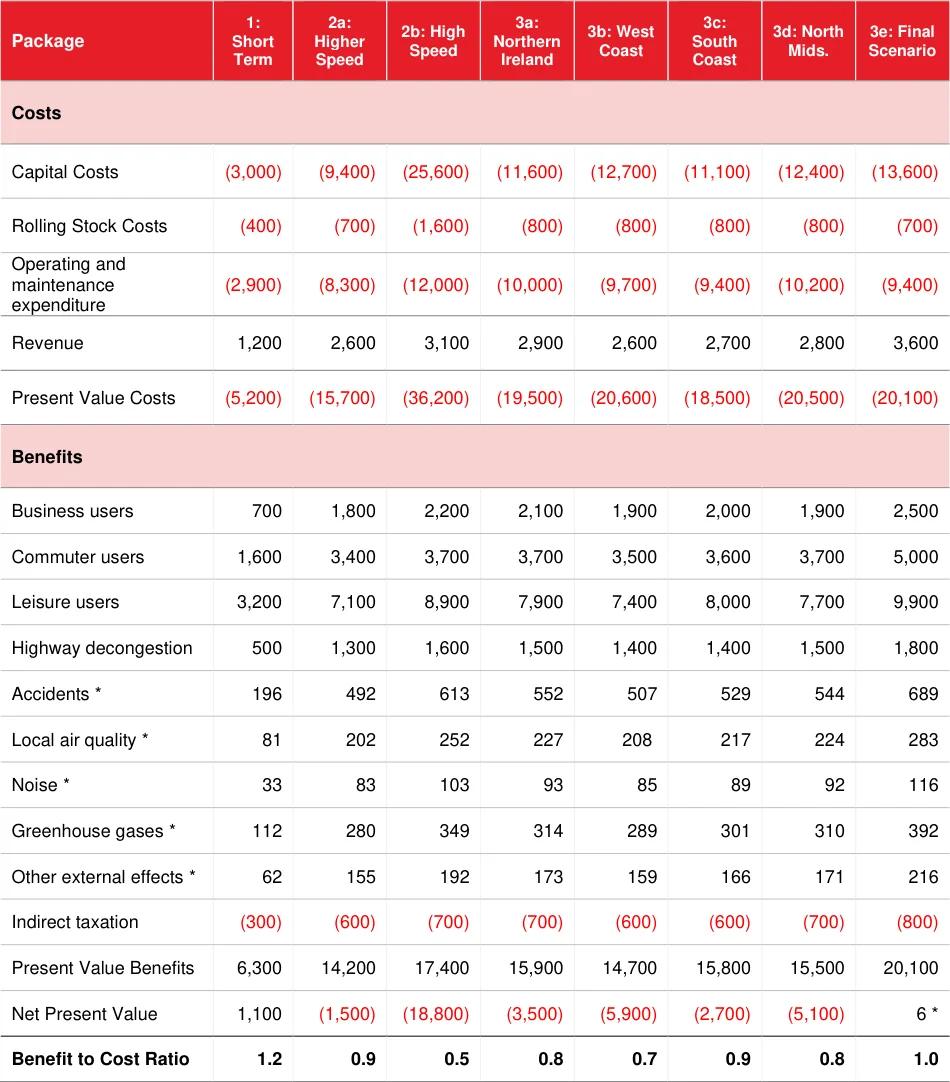
Figure from page 134
Table B.3 Economic appraisal results, Common Appraisal Framework approach
2011 Prices, €m, discounted, rounded to nearest €100m (except where a figure has an asterisk *)
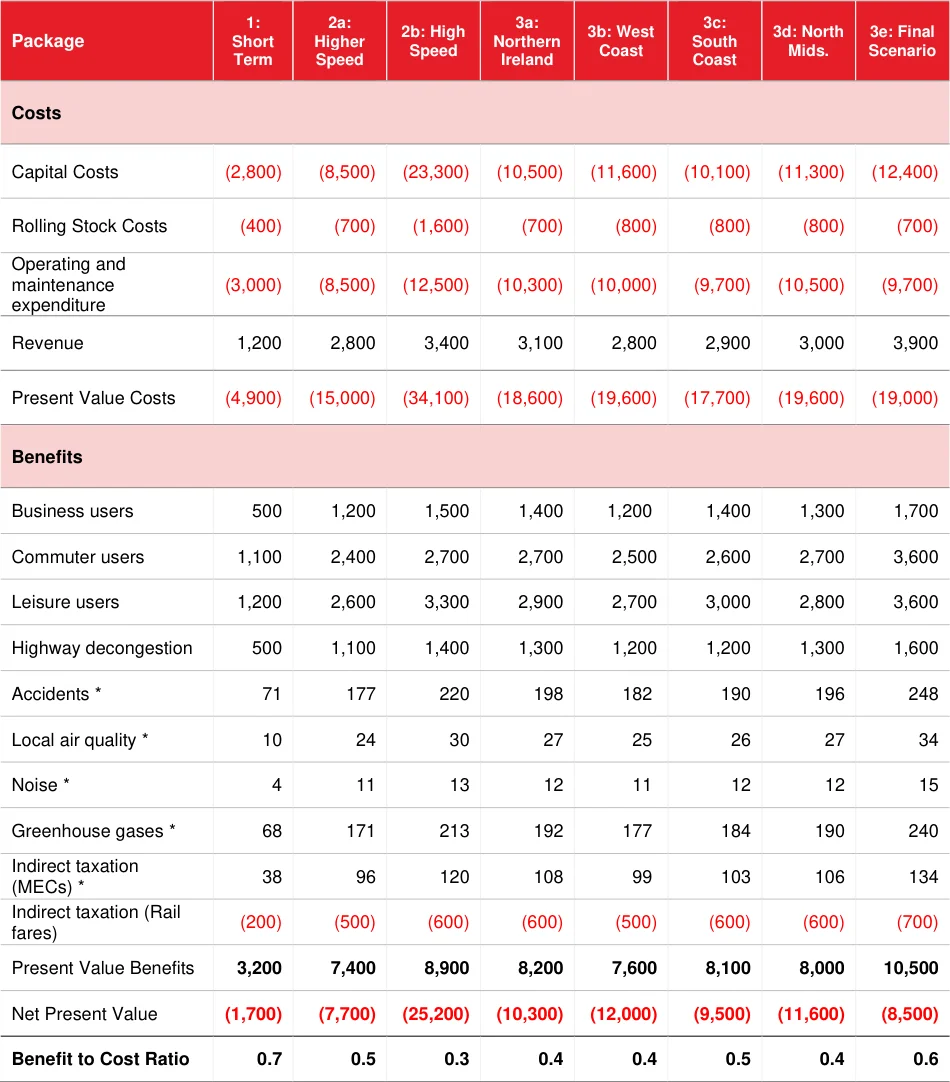
Figure from page 135
Table B.4 Economic appraisal results, Transport Analysis Guidance approach
2010 Prices, £100m, discounted, rounded to nearest £m (except where a figure has an asterisk *)
The Final Package of Recommendations
In summary, the interventions identified as recommendations for this Review are:
Short term and decarbonisation:
•Electrification of intercity and commuter services between Belfast- Bangor, Belfast-Drogheda, Dublin- Cork, Portarlington-Galway, Limerick Junction-Limerick, and Kildare- Waterford.
•Through services between Cork and Galway via Limerick with modifications to track and platforms at Limerick Junction to allow more through movements Cork-Limerick.
•Direct services between Belfast and Portrush.
•Speed upgrades to 160km/h / 100mph on core and some regional intercity lines.
•New passenger services to the Limerick-Foynes line and a spur to Shannon Airport.
•One train per hour on intercity routes between Dublin and Belfast, Cork, Limerick, Galway, and Waterford.
•Reinstatement of the Lisburn-Antrim line with a station at Belfast International Airport.
•One train per two hours on regional routes including Galway-Limerick, Limerick-Cork, Limerick-Ballybrophy, Dublin-Sligo, Dublin-Westport/Ballina, and Greystones-Rosslare Europort.
Intercity
•A new 200km/h / 125mph line from Belfast to Newry via Hillsborough, Dromore, and Banbridge, with connections to the Lisburn-Antrim line and towards Portadown.
•A new 200km/h / 125mph doubletracked electrified alignment between Hazelhatch and Portarlington and a link to the Kildare-Waterford line.
•A short link between Maynooth and Adamstown to separate longerdistance trains from the DART services.
•A new 200km/h / 125mph line linking Drogheda to Clongriffin with fourtracking from Clongriffin to Connolly/Spencer Dock.
•Double tracking from Dublin as far as Mullingar, Athlone, and Kilkenny, as well as between Galway and Athenry.
•A spur to Dublin Airport from Clongriffin.
•A cross-Dublin tunnel from the north of Spencer Dock to Heuston, with connections for DART and MetroLink at several stations in Dublin City Centre.
Regional and rural
•A new 200km/h / 125mph dualtracked electrified line between Portadown and Derry~Londonderry.
•A reinstated single-track line between Mullingar and Athlone.
•A reinstated single-track line between Claremorris and Athenry via Tuam.
•A new single-track line between Derry~Londonderry and Letterkenny.
•A reinstated single-track line between Waterford and south of Wexford.
•New stations between Derry~Londonderry and Coleraine, including a spur to Limavady.
•A curve at Limerick Junction to facilitate through services between Cork-Waterford.
•Dual-tracking and new stations between Belfast and Antrim (on the Belfast – Derry~Londonderry line).
•Enhancements to capacity and alignment along the Limerick Junction-Waterford line.
•A new single-track line between Portadown and Mullingar via Armagh, Monaghan, Clones, and Cavan.
Other interventions including enhanced port connectivity, inland freight terminals, reduced freight access charges, and customer experience initiatives were not quantitively assessed but have been qualitatively assessed and are included in the Review’s recommendations.
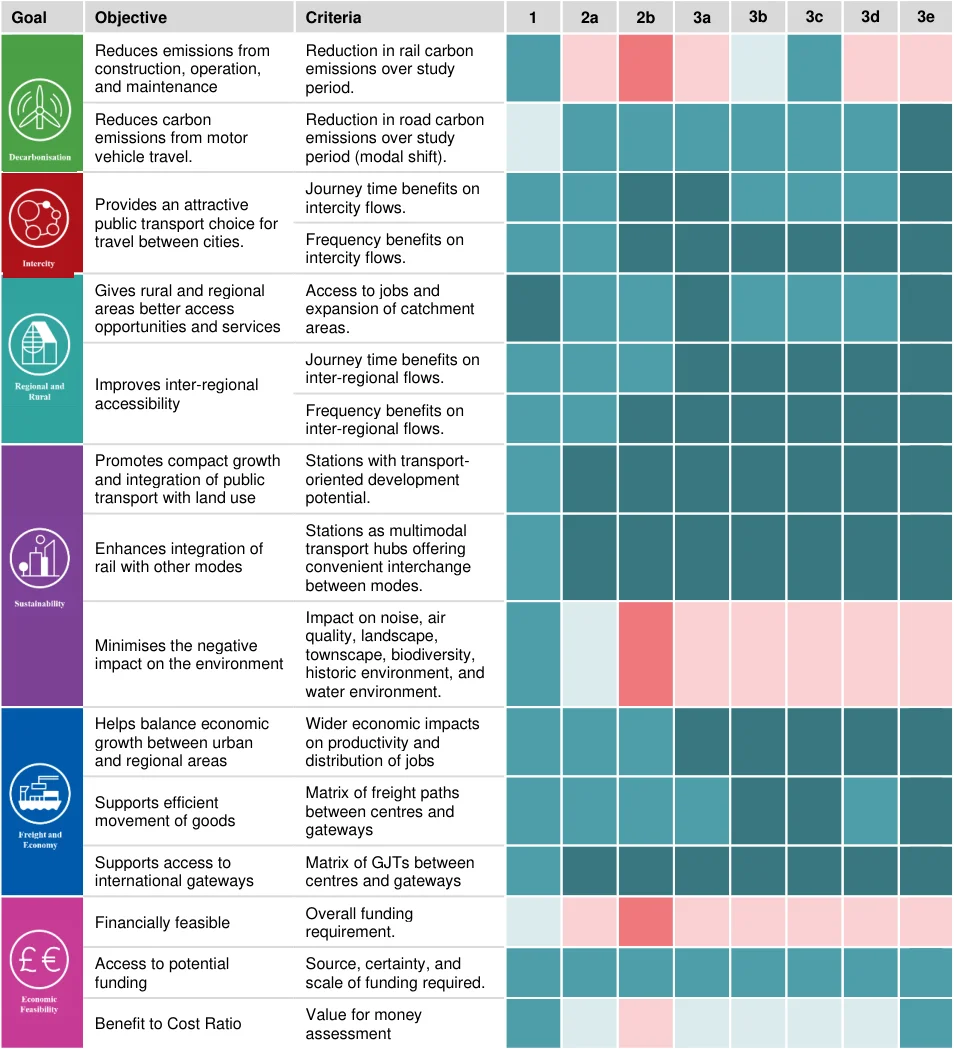
Figure from page 138
Table B.5

Figure from page 138
Results of a qualitative multi-criteria assessment of the performance of the eight packages against the Review’s Goals and Objectives. Key to shading is provided to the right.
Pages 117–138 · View in original PDF